
3M Aqua-Pure AP717 Inline Water Filter System Review: Is It Worth It?
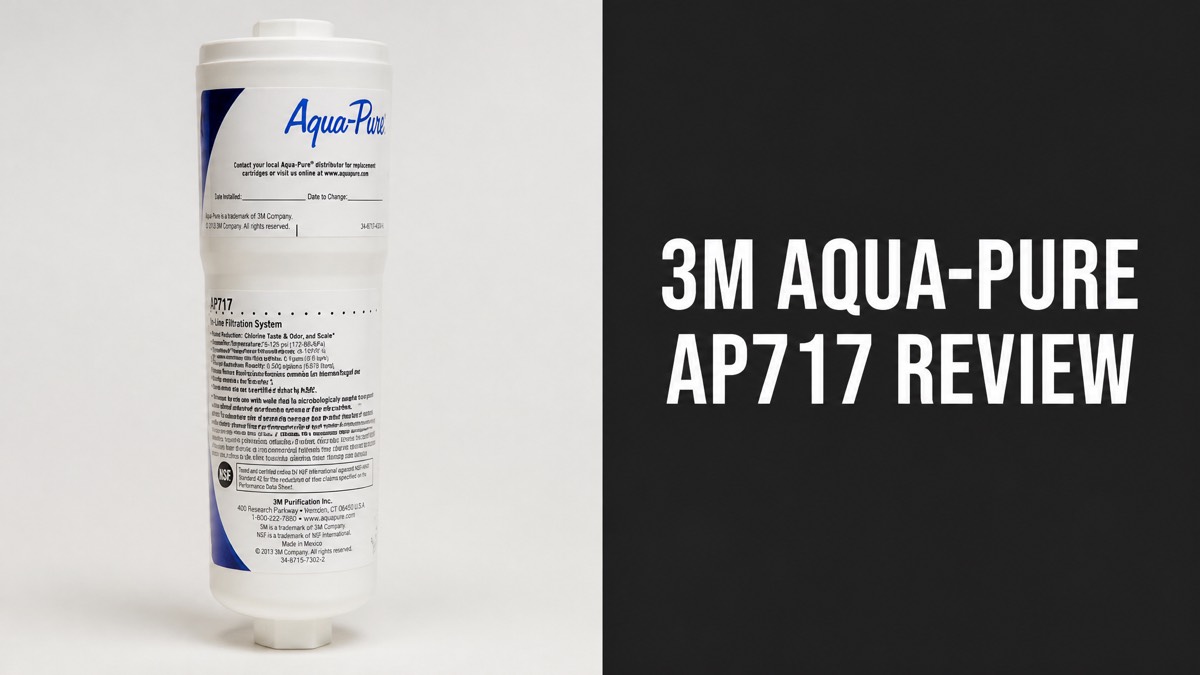
The 3M Aqua-Pure AP717 is a single-cartridge inline water filter for the cold feed line to a refrigerator or ice maker. Activated carbon cuts sediment, chlorine taste and odor, and scale in the water. Homes without a built-in fridge filter get better water and ice from one add-on unit.
The AP717 carries NSF/ANSI Standard 42 certification and a 1,500 gallon (5,678 liter) rating. Owners praise the clean taste, the easy installation, and the clearer ice. The common complaints involve leaks at hand-tightened fittings and carbon fines from a new cartridge. Cartridges cost $55 to $65 and need a swap every six months. That cost adds up to $110 to $122 a year.
The AP717 doesn't remove lead, PFAS, or bacteria, so the claims stay narrow, and cheaper inline filters compete on price. This review covers the specs, real-world results, install steps, running costs, alternatives, and who should skip it, so you can decide with confidence before you buy.
What Is the 3M Aqua-Pure AP717?
The 3M Aqua-Pure AP717 is a single-cartridge inline water filter that installs on the cold feed line to a refrigerator or ice maker. The Aqua-Pure series carries the 3M name, and the filter sits outside the appliance on a 1/4 inch water line.
To be clear, the model also appears under 3M number 5560222 and manufacturer part AP717. The body is white polypropylene, and the unit is made in the United States. Sellers use all three identifiers for the same filter.
One cartridge handles three jobs. What are they? Sediment reduction, chlorine taste and odor reduction, and scale inhibition. The rated capacity is 1,500 gallons (5,678 liters) at a flow rate of 0.5 gpm (1.89 lpm).
Who Is the AP717 For?
The AP717 targets refrigerators, ice makers, and drinking fountains that lack a built-in filter. A fridge with no internal cartridge gains filtered water and ice from one add-on unit under the sink or behind the cabinet.
And it isn't limited to fridges. Coffee machines and drink dispensers sit on the list of approved applications. Any cold, 1/4 inch drinking-water line near 100°F (37.8°C) or cooler fits the design.
The bad news? Fridges with a built-in filter gain little from a second cartridge. Whole-house needs also fall outside the design. The AP717 filters a single 1/4 inch line, so every other tap in the home stays unfiltered. In plain English: it's a point-of-use filter.
How Does the AP717 Work?
The AP717 filters water through specially formulated activated carbon and progressive porosity media. The carbon adsorbs chlorine and the compounds behind its taste and odor. The media stages catch particles down to 5 microns nominal.
The cartridge uses a sanitary design. Why does that matter? Standard 1/4 inch NPT connections sit on both ends, so a change-out never touches the filter media. Hands stay on the fittings, not on the carbon.
Here's why flow matters: water passes through at up to 0.5 gpm (1.89 lpm). That rate covers an ice maker fill or a glass at the fridge dispenser.
What Are the AP717 Specs?
The AP717 stands 8 3/8 inches (21.3 cm) tall with a 2 1/4 inch (5.7 cm) diameter and weighs 0.75 pounds (0.34 kg). The compact body fits behind a fridge or inside a sink cabinet.
By the numbers, performance ratings include 5 micron filtration, 0.5 gpm flow, and a 1,500 gallon (5,678 liter) capacity. The maximum water temperature is 100°F (37.8°C), and the operating pressure range runs from 25 to 125 psi (1.7 to 8.6 bar).
AP717 Quick Specs:
| Spec | Value |
|---|---|
| Height | 8 3/8 in (21.3 cm) |
| Diameter | 2 1/4 in (5.7 cm) |
| Weight | 0.75 lb (0.34 kg) |
| Filtration | 5 micron nominal |
| Flow rate | 0.5 gpm (1.89 lpm) |
| Capacity | 1,500 gal (5,678 L) |
| Max temperature | 100°F (37.8°C) |
| Connections | 1/4 in NPT |
The connections are 1/4 inch NPT. The box includes 1/4 inch push-in fittings, and buyers describe tubing that snaps into the fitting. The filter media is carbon inside a polypropylene shell.
Is the AP717 NSF Certified?
Yes. The AP717 carries NSF/ANSI Standard 42 certification. Independent testing confirms the chlorine taste and odor reduction claim, which is the core job of this filter.
Standard 42 covers aesthetic effects such as taste and odor. So what about health contaminants? The claims on the product don't include lead, PFAS, or other health contaminants. Buyers who need those reductions need a different filter.
The scale claim has a different backing. Who ran the test? The manufacturer's own laboratory tested and verified scale reduction. That test isn't independent, so treat the scale benefit as a maker claim.
What Are the Benefits of the AP717?
The AP717 delivers better tasting water and ice from a single add-on cartridge. The chlorine taste and odor drop, and the sediment and scale load on the fridge line drops with them.
Here's the part most people miss: sediment and scale reduction protects the ice maker. Scale builds up inside valves and trays over time. Less scale in the supply water means fewer white deposits on cubes.
Main Benefits:
- Better tasting water and ice
- Lower sediment and scale load on the fridge line
- Tool-light cartridge change-out
- One model for fridges, ice makers, fountains, and coffee machines
And it gets better: the cartridge swaps without tools beyond a wrench or pliers and some plumber's tape. A single model also serves fridges, ice makers, fountains, and coffee machines.
Does the AP717 Improve Taste and Odor?
Yes. The AP717 reduces chlorine taste and odor, which gives better tasting water and ice. Carbon media targets chlorine directly.
For example, one owner drinks straight from the faucet after installing the filter, and the water no longer smells of chlorine. That owner adds a sediment filter ahead of the AP717 to protect the cartridge.
Taste also tracks the replacement schedule. What happens when a swap runs late? An owner who waited too long noticed the difference in the water right away. A fresh cartridge restored the clean taste.
Does the AP717 Reduce Scale and Sediment?
Yes. The AP717 filters sediment down to 5 microns nominal and inhibits scale build-up. Sediment and rust stop at the media instead of reaching the ice maker valve.
The scale effect shows up in ice. One owner installed the filter to remove white specks from ice cubes. What happened? About 95 percent of the specks disappeared, and the owner reordered a spare cartridge.
But very dirty supply water changes the picture. An owner with heavy sediment adds a pre-sediment filter before the AP717. The pre-filter takes the bulk of the particles, and the AP717 handles taste and scale.
What Do AP717 Reviews Say?
The AP717 earns a 4.6 out of 5 average from 736 ratings. That volume makes the score a reliable signal for a small point-of-use filter.
A smaller sample shows a perfect 5 out of 5 from 7 ratings and 5 written reviews. Several of those reviews were incentivized or collected through a promotion. Weight the larger sample more heavily.
Here's the pattern: praise and complaints repeat across listings. Owners like the taste, the ice, and the simple install. Complaints center on leaks at the fittings and on carbon fines from a new cartridge.
What Do Owners Like?
Owners praise the clean taste, the easy installation, and the clearer ice. The taste comment comes up most. One owner drinks the water right from the tap after installing the filter.
Installation earns steady credit, too. The tubing pushes into the fitting, and a pair of kitchen scissors handles the cut. The whole install is a short DIY job.
Ice quality improves for owners who struggled with white specks. Long-term use is common too. Several buyers have used the AP717 for years and reorder it on schedule.
What Are the Common Complaints?
The top complaint is a leak at the fittings after hand-tightening. The fittings arrive pre-wound with barely any plumber's tape, so hand-tight alone doesn't seal the connection.
And the included zip tie is too short for some setups. Owners flag it as a small annoyance in an otherwise easy install.
Common Issues:
- Leaks at hand-tightened fittings
- Barely any plumber's tape pre-wound on the fittings
- A zip tie that is too short
- Carbon fines from a new cartridge
- Dirty supply water that needs a pre-sediment filter
Carbon fines are the second issue. What's the fix? Flush the cartridge before connecting the outlet line to the fridge, so loose carbon doesn't reach the ice maker. Dirty supply water also calls for a pre-sediment filter.
Is the AP717 Easy to Install and Replace?
Yes. The AP717 installs in about the time it takes to cut a line and tighten two fittings. Cut the plastic tubing square, push it into the fitting, wrap the male ends with plumber's tape, and tighten until no drips appear.
Let me break that down: replacement follows a short sequence. Turn off the water to the filter, unscrew the nut on both fittings, and pull the tubing out. Screw the fittings into the new cartridge with plumber's tape. Reconnect both sides and turn the water on.
Replacement Steps:
- Turn off the water to the filter.
- Unscrew the nut on both fittings.
- Pull the tubing out and discard the old cartridge.
- Screw the fittings into the new cartridge with plumber's tape.
- Reconnect the tubing on both sides.
- Turn the water on and flush the new cartridge.
Pay attention to this: a startup flush matters. Draw about two quarts (1.9 liters) through the new cartridge before drinking, and discard the first few trays of ice. The flush clears loose carbon from the media.
Always shut the supply valve before a swap. One owner warns that skipping this step floods the area. The job takes minutes, and a towel under the filter catches any residual water.
How Often Should You Replace the AP717?
Replace the AP717 every six months or after 1,500 gallons (5,678 liters), whichever comes first. A drop in flow rate or a change in taste or odor signals an earlier swap.
Owner schedules vary, though. One buyer swaps every four to five months and likes the taste at that interval. Another replaces the cartridge every 12 to 18 months. A third range runs three to six months.
The capacity math explains the six-month interval. How much water is that? At 1,500 gallons over six months, a household uses about 8 gallons (30 liters) a day through the filter. Heavier use shortens the life.
How Much Does the AP717 Cost?
The AP717 costs between $55.00 and $64.99 from most Walmart sellers in the United States. A plumbing supplier lists it at $60.97, a discount from the $68.68 list price.
By comparison, prices in other markets run higher. Amazon Canada lists the filter at CAD 58.00, and Amazon in the United Arab Emirates asks AED 236.28. Shipping is free at several sellers.
The running cost follows the replacement schedule. What does that add up to? Two cartridges a year at $55 to $61 each come to $110 to $122 a year. The yearly total is the real price of owning the AP717.
Does Buying Multipacks Save Money?
Yes. Multipacks cut the per-cartridge price from about $55 to as low as $40.22. A 2-pack costs $46.00 per filter, a 3-pack $42.29, a 4-pack $41.43, and a 6-pack $40.22.
Price Per Filter by Pack Size:
| Pack | Price Each |
|---|---|
| 2-pack | $46.00 |
| 3-pack | $42.29 |
| 4-pack | $41.43 |
| 6-pack | $40.22 |
The reason is simple: the six-pack saves about $15 per cartridge against a single unit. Two swaps a year at $40.22 cost about $80, which is $30 to $40 less per year than singles.
A six-pack covers three years of swaps. Is that too much to buy at once? A bulk buy ties up cash and storage space. A 2-pack or 3-pack captures most of the savings with a smaller up-front cost.
Where Can You Buy the AP717?
The AP717 sells at Amazon, Walmart, SIM Supply, R.S. Hughes, Fine Filters, waterfilters.net, and Drinking Well. Plumbing and water-filter specialists stock it alongside the big marketplaces.
What's more, eBay carries single cartridges as well as 2-packs, 3-packs, and an 8-pack. Many of those listings use the phrase genuine 3M in the title. Check the seller rating before buying from an auction listing.
Now here's the thing: compatible-brand cartridges also sell as direct fits for the AP717. Read the product title closely. A cartridge marked as an AP717 replacement isn't made by 3M.
How Does the AP717 Compare to Alternatives?
The AP717 costs more than several competing inline filters that target the same refrigerator line. The Waterdrop INL is the closest popular rival, with a 4.6 out of 5 average from 1,929 ratings.
The Waterdrop INL lists a one-year life and sells for AED 125.35 on the same marketplace page where the AP717 costs AED 236.28. The INL costs about half as much and lasts twice as long between swaps.
AP717 vs Common Alternatives:
| Filter | Price | Key Point |
|---|---|---|
| 3M Aqua-Pure AP717 | AED 236.28 | 6-month life, 736 ratings |
| Waterdrop INL | AED 125.35 | 1-year life, 1,929 ratings |
| Omnipure K2586-BB | From $16.24 | Budget carbon filter |
| Neo-Pure inline carbon | $10.95 | Built to eliminate carbon fines |
At the same time, budget carbon inline filters cost far less. The Omnipure K2586-BB starts at $16.24, and the Neo-Pure inline carbon filter costs $10.95. The Neo-Pure design aims to eliminate carbon fines entirely.
EcoPure sells inline filters with quick-connect ports. Its instructions flush 4 to 5 gallons (15 to 19 liters) before the outlet connects. The AP717 relies on NPT fittings instead, which need plumber's tape.
Who Should Skip the AP717?
Buyers who need lead, PFAS, or bacteria reduction should skip the AP717. None of those appear among the claimed reductions. The filter targets taste, odor, sediment, and scale. The label also warns against use on microbiologically unsafe water without disinfection.
This is important: the cartridge carries a California Proposition 65 warning, which applies to products that contain carbon media. The warning names arsenic as the listed chemical.
3M's standard disclaimer says its industrial and occupational products are intended for trained workplace users unless the packaging states otherwise. Check the box for consumer wording before use at home.
And homes with very dirty supply water need a sediment filter first. A buyer who dislikes plumber's tape and fittings will also find a quick-connect filter easier.
Is the 3M Aqua-Pure AP717 Worth It?
Yes. The AP717 is worth buying for better tasting water and cleaner ice on a refrigerator line. Bottom line: the 4.6 out of 5 average from 736 ratings backs that up.
The limits are clear. The AP717 isn't a contaminant filter, and the fittings need plumber's tape. Cheaper filters exist, and the 3M name explains the gap.
What Are the Pros and Cons?
The AP717 wins on rating, install ease, and certified taste reduction. The 4.6 out of 5 average from 736 ratings, the NSF Standard 42 certification, and the 1,500 gallon capacity support the case.
Pros:
- 4.6 out of 5 average from 736 ratings
- Easy installation
- NSF Standard 42 certification
- 1,500 gallon (5,678 liter) capacity
- Cleaner ice
Cons:
- Fittings need extra plumber's tape and firm tightening
- New cartridge needs a flush for carbon fines
- Six-month swap adds a recurring cost
- Claims cover taste, odor, sediment, and scale only
- Budget inline filters cost much less
The cons? They're practical. Fittings need extra plumber's tape and firm tightening. A new cartridge needs a flush for carbon fines. The six-month swap adds a recurring cost.
Now, the claims are narrow. Taste, odor, sediment, and scale are covered. Health contaminants are not. Budget inline filters also cost much less, so price-first buyers have real options.
Pop Kitchen is a reader-supported platform. Purchases made through our links may earn us an affiliate commission at no extra cost to you.