
4Patriots Water Filter Review: Is It Worth It?
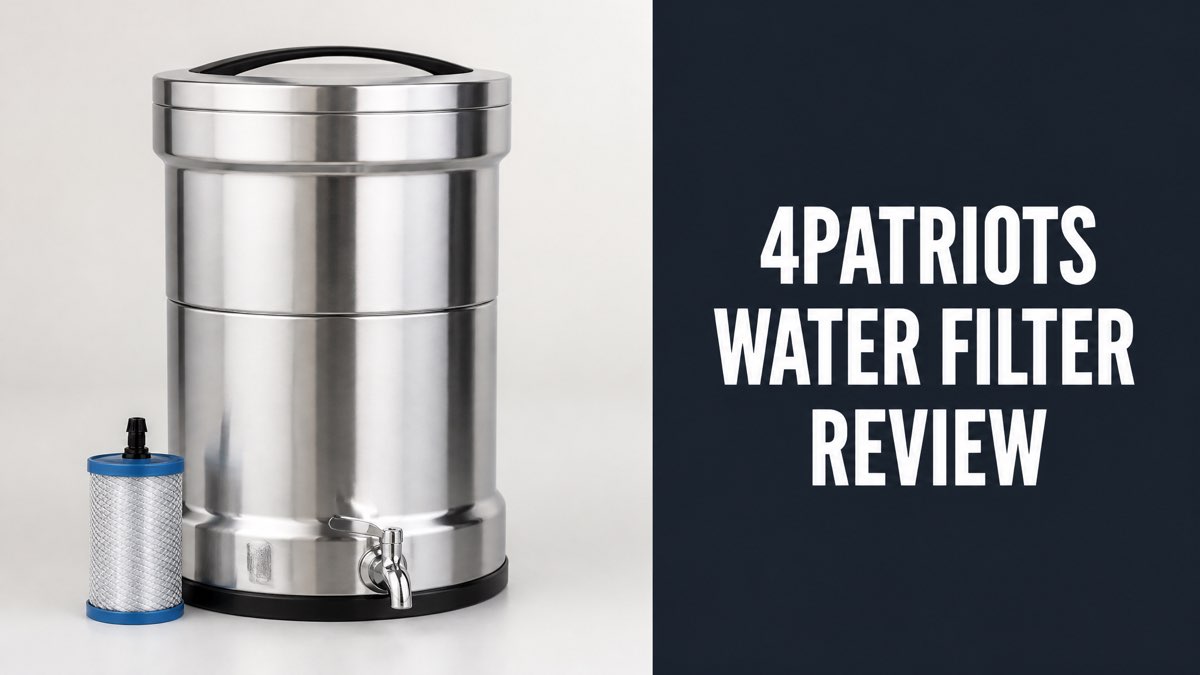
The 4Patriots Patriot Pure Ultimate is a gravity-fed countertop water filter with two stainless steel tanks and Nanomesh carbon filters. The unit needs no electricity, heat or plumbing. The design suits emergency preparers, off-grid households and anyone who wants cleaner tap water.
The filter performs well on chemistry. A 2026 lab test cut chlorine, copper and fluoride to zero, and NSF/ANSI certification covers 75 contaminants. Germs are a different story, since E. coli dropped only 80.61% in pond water. Speed is the other weak spot, because one cup takes about five minutes with two filters. Cost, setup and daily use fill out the picture.
Running costs stay low at about $165 per year for filters. The system plus stand also costs less than the gravity average. Below, the review covers taste, setup, downsides, comparisons and who should skip it. Read on to see whether the trade-offs fit your kitchen, your budget and your emergency plans.
Is the 4Patriots Water Filter Good?
Yes. The Patriot Pure Ultimate filters chemicals, metals and chlorine better than most gravity filters. BOS Water's 2026 lab test scored it 4.08 out of 5. The test ranked it at the top for filtration among 18 gravity systems.
To be clear, filtration earned 4.26 out of 5. Usability earned only 3.26, while costs earned 4.37. The gap explains the mixed opinions. The system cleans water well, but speed is its weak spot.
Certification is the strongest point. The filters carry NSF/ANSI standards 42, 53 and 401 for 75 contaminants. And here's the best part: BOS Water found that count beats every other gravity system it tested. The margin is wide.
Does It Remove Chemicals and Metals?
Yes. The Nanomesh filter removed nine contaminants to below the detection level in a lab test. Chlorine, chloroform, copper, iron, manganese, nitrate and fluoride all dropped to zero. Two disinfection byproducts, bromodichloromethane and dibromochloromethane, did too.
Lab Results:
| Contaminant | Result |
|---|---|
| Chlorine | Below detection |
| Chloroform | Below detection |
| Copper | Below detection |
| Nitrate | Below detection |
| Fluoride | Below detection |
| Barium | 98% reduction |
| Boron | 94% reduction |
| Strontium | 91% increase |
Barium fell 98% and boron fell 94%. Did anything go up? Yes. Strontium rose 91%, from 0.132 to 0.252 mg/L. Even so, the new level sits 5.95 times below the strictest health guideline found (1.5 ppm).
Here's why the certification matters: it covers 75 contaminants. Lead, mercury, PFOA and PFOS reach 99.9% reduction. Arsenic V reaches 97.6% to 99.9%, and fifty VOCs reach 99.5% to 99.9%.
What's more, third-party testing adds data. The tests run to 100% to 400% of filter life and cover nearly 200 contaminants. Some overlap exists between the certified and the tested contaminants.
Does It Remove Bacteria and Viruses?
No. The filter failed to remove E. coli fully in a pond-water test. E. coli fell from 325.5 to 63.1 CFU per 100 mL. The result is an 80.61% reduction, or 0.71-log.
Pond Water Test:
| Measure | Result |
|---|---|
| E. coli reduction | 80.61% (0.71-log) |
| EPA standard for purifiers | 6-log (99.9999%) |
| Turbidity reduction | 92% |
The EPA guide standard for microbiological purifiers is a 6-log reduction (99.9999%). How close did the filter come? Not close. It managed 0.71-log. Viruses are smaller than bacteria, so the filter would likely fail them too.
The bad news: the maker claims the filter traps bacteria, viruses and cysts. No NSF/ANSI certification or verified third-party data backs that claim. The filter manual itself warns against microbiologically unsafe water without disinfection.
But cysts are larger than bacteria, so the filter may still catch them. The test can't confirm that. Turbidity fell 92%, from 9.46 to 0.74 NTU, and the filtered water still carried bacteria.
Does the Water Taste Clean?
Yes. Filtered water tasted clean and had no odor in the BOS Water taste test. Carbon in the coconut shell block core removes chlorine and organics that cause bad flavors.
Some users report a rubber or chemical smell at first. What helps? Flushing. The setup guide calls for one overnight run, then one or two more full tanks of filtered water poured out.
What Is the 4Patriots Water Filter?
The Patriot Pure Ultimate Water Filtration System is a gravity-fed countertop water filter from 4Patriots. The unit needs no electricity, heat or plumbing connection. Two stainless steel tanks stack on each other.
Tap water goes into the upper tank. Where does it go next? Gravity pulls it through the Nanomesh filters into the lower tank. A plastic spigot then dispenses the clean water.
The brand also sells a Patriot Pure Outdoor cooler system. The cooler is a 5-gallon (19 L) rotomolded design, and a personal straw filter completes the line. To be clear, the review covers the countertop Ultimate system.
What Is a Nanomesh Filter?
A Nanomesh filter combines a carbon fiber layer with a coconut shell carbon block. 4Patriots designed the cartridge for gravity systems. Each cartridge works in three stages.
Stage one is a sediment layer that strains dirt and rust. Stage two is the carbon Nanomesh layer. Stage three is the coconut shell carbon block core, and carbon removes chlorine, byproducts and certain metals.
Filter Stages:
- A sediment layer strains dirt and rust.
- A carbon Nanomesh layer filters finer particles.
- A coconut shell carbon block core removes chlorine, byproducts and certain metals.
4Patriots says the Nanomesh layer traps particles down to sub-nanometer size. And the company states that nanofiltration keeps beneficial minerals such as calcium, magnesium and potassium in the water.
How Hard Is the Patriot Pure to Set Up?
Setup is easy, but the instructions are thin. The booklet is one folded sheet with only two illustrations. A YouTube tutorial fills the gaps.
Assembly takes a few steps. Wash the housing, fit the spigot and gaskets, and attach the lid handle. Then screw each filter on finger tight and seat the upper tank on the lower tank.
The first pass may run very slowly. So what's the fix? Run it overnight, then discard that water and run one or two more full tanks through before drinking.
How Fast Does It Filter Water?
The Patriot Pure filters slowly with two filters. One cup took about 5 minutes 10 seconds. Four cups took about 34 minutes 47 seconds. On-demand water is not possible.
The spigot sits above the tank floor. Why does that matter? About 49 oz (1.4 L) must collect before any water pours. The wait lasted about 50 minutes 35 seconds, and the first cup arrived after roughly 55 minutes 45 seconds.
Filtering the whole feed tank took about 3 hours 41 minutes. But more filters speed things up. The system accepts up to four, and four filters roughly double the two-filter speed.
The good news: dispensing from a full clean tank is quick. One cup pours in about 5.25 seconds, without splashing. The last 49 oz (1.4 L), about six cups, stays below the spigot.
Filtering Times (Two Filters):
| Task | Time |
|---|---|
| One cup | About 5 min 10 sec |
| Four cups | About 34 min 47 sec |
| First 49 oz to collect | About 50 min 35 sec |
| First cup from empty | About 55 min 45 sec |
| Entire feed tank | About 3 hr 41 min |
The tanks are roomy. The feed tank holds 1.74 gallons (6.6 L) and the clean tank holds 2 gallons (7.6 L). In plain English, an average household needs one or two refills per day.
What Are the Downsides of the 4Patriots Water Filter?
The main downsides are speed, size and missing monitoring features. Usability scored 3.26 out of 5. The unit stands 20.2 inches (51 cm) tall. Most cabinets offer only 18 inches (46 cm) of clearance.
No sight window or water-level spigot exists. So how is the clean tank checked? The upper tank gets lifted. No filter change indicator warns when the cartridges expire.
The spigot is plastic, and its cover prevents leaks but interferes with pouring. And a 40-oz (1.2 L) bottle or 2-quart (1.9 L) pitcher doesn't fit under the spout, even with the stand.
Customer complaints cover delayed or incomplete shipments, slow filtration, poor customer service and bad taste or odor. To be fair, BOS Water didn't meet most of these problems firsthand.
Main Downsides:
- Slow filtering
- No water-level window
- No filter change indicator
- Plastic spigot
- Too tall for standard cabinets
- Shipping and support complaints
Does It Leak or Rust?
Yes. Minor rust appeared around one plugged hole after minimal use. The stainless steel tanks feel sturdy otherwise. The logo looks like sticker lettering, not embossed metal.
Testing found no leaking or dripping after the spigot closed. But some owners report leaks anyway. A replacement parts kit includes a spigot, stopper, seal washer and lid handle.
One owner stopped a spout leak by using two washers on each side of the container. So the seal washer is the first part to check.
How Much Does the 4Patriots Water Filter Cost?
The system cost $295.93 with two filters for the old model BOS Water priced in July 2026. The optional tank stand adds $49.95, for a $345.88 total. The average across tested gravity systems is $370.33.
Price Breakdown:
| Item | Price |
|---|---|
| System with two filters | $295.93 |
| Optional tank stand | $49.95 |
| System plus stand | $345.88 |
| Tested gravity average | $370.33 |
4Patriots lists $249 as the standard price and runs promotions near $99 with one filter. Do those prices stay put? No. Promotional prices change often, so a price check before ordering matters.
How Long Do the Replacement Filters Last?
Each Nanomesh filter is rated for 200 gallons (757 L). Two filters give 400 gallons (1,514 L). A household using 500 gallons (1,893 L) per year changes them once or twice annually.
Annual filter cost lands near $165 for a two-filter setup. Is that high? No. The average across tested gravity systems is $221.83, so low running cost is the system's best value point.
And 4Patriots claims some contaminants stay reduced up to 800 gallons (3,028 L) per filter. A one-year warranty and a 90-day satisfaction guarantee cover the system.
Swapping filters is simple. Changes need no tools, since the cartridges sit in the upper tank and unscrew by hand.
How Does It Compare to Other Water Filters?
Among gravity filters, the Patriot Pure ranks near the top for filtration and lower for usability. BOS Water tested 18 gravity systems. The Nanomesh filter delivered the most effective filtration of the group.
Price sits near the middle. The system plus stand costs $345.88 against a $370.33 average. And filter running costs fall well below the average, which earned a cost score of 4.37 out of 5.
BOS Water picked other systems for other jobs. Alexapure Pro won for non-potable water, and Phoenix won as the budget pick. By comparison, the Patriot Pure wins on contaminant coverage.
How Does It Compare to Reverse Osmosis?
The Patriot Pure needs no electricity or plumbing, while reverse osmosis does. 4Patriots states that RO systems waste about 4 gallons (15 L) of water for every gallon (3.8 L) they filter.
4Patriots also states that RO strips minerals such as calcium, magnesium and potassium. Does the Patriot Pure do the same? The company says nanofiltration keeps more of them. RO systems also use three to four filters, so more parts can break.
Here is the part most people miss: whole-home RO depends on grid-powered pressure in the pipes. A long outage can leave the taps dry. A gravity filter keeps working because it only needs water poured in.
Who Should Avoid the 4Patriots Water Filter?
People who need on-demand water do not fit the Patriot Pure. Two filters deliver one cup in about five minutes after a long start-up wait. Four filters help but do not make the flow instant.
Small kitchens suffer too. The unit doesn't fit under standard cabinets, and pouring requires the counter edge. The optional stand adds about 6 inches (15 cm) of clearance.
Buyers who want germ removal for untreated water need another system. The Patriot Pure has no verified microbiological data, and BOS Water named Alexapure Pro its pick for non-potable water.
Is It Safe for Pond or Well Water?
No. Untreated pond water stays unsafe after one pass through the filter. The test left 63.1 CFU of E. coli per 100 mL in the filtered water. Total coliforms stayed above the 2,419.6 CFU ceiling.
Well water is different when properly disinfected first. BOS Water says the system can purify tap water and disinfected well water. Other sources may need pre-treatment.
The filter manual states the rule plainly. Water that is microbiologically unsafe or of unknown quality needs disinfection before or after the system.
Is the 4Patriots Water Filter Worth It?
Yes, for the right buyer. The Patriot Pure earns its price as a power-free chemical and metals filter with low running costs. Its 4.08 out of 5 score reflects strong filtration and weaker daily usability.
Bottom line: the Patriot Pure is a smart pick for emergency prep and cleaner tap water. Strong filtration, low running costs and a 90-day guarantee back that up. Slow flow, unproven germ removal and a plastic spigot are the trade-offs. Skip it if speed or germ protection matters most.
Pros and Cons:
| Pros | Cons |
|---|---|
| 75 NSF/ANSI contaminants | Slow filtering |
| Lab zeros for chlorine, copper, fluoride | Germ removal unproven |
| About $165 per year in filters | Plastic spigot |
| 90-day satisfaction guarantee | Support and shipping complaints |
Who Should Buy the 4Patriots Water Filter?
Emergency preparers and off-grid households fit the Patriot Pure best. The unit needs no power. The stainless steel tanks suit outdoor use. The stowed size of 8.75 x 13 x 8.75 inches (22 x 33 x 22 cm) aids portability.
Households that want better tap water also fit. Chlorine, chloroform and metals drop sharply. And daily use works with one or two refills, timed around work hours or bedtime.
Buyers who want speed, a water-level view or germ protection do better with another system. No water-level spigot is offered for this model, and the optional stand helps with pouring only.
Pop Kitchen is a reader-supported platform. Purchases made through our links may earn us an affiliate commission at no extra cost to you.