
Aarke Water Filter Review: Is It Worth It?
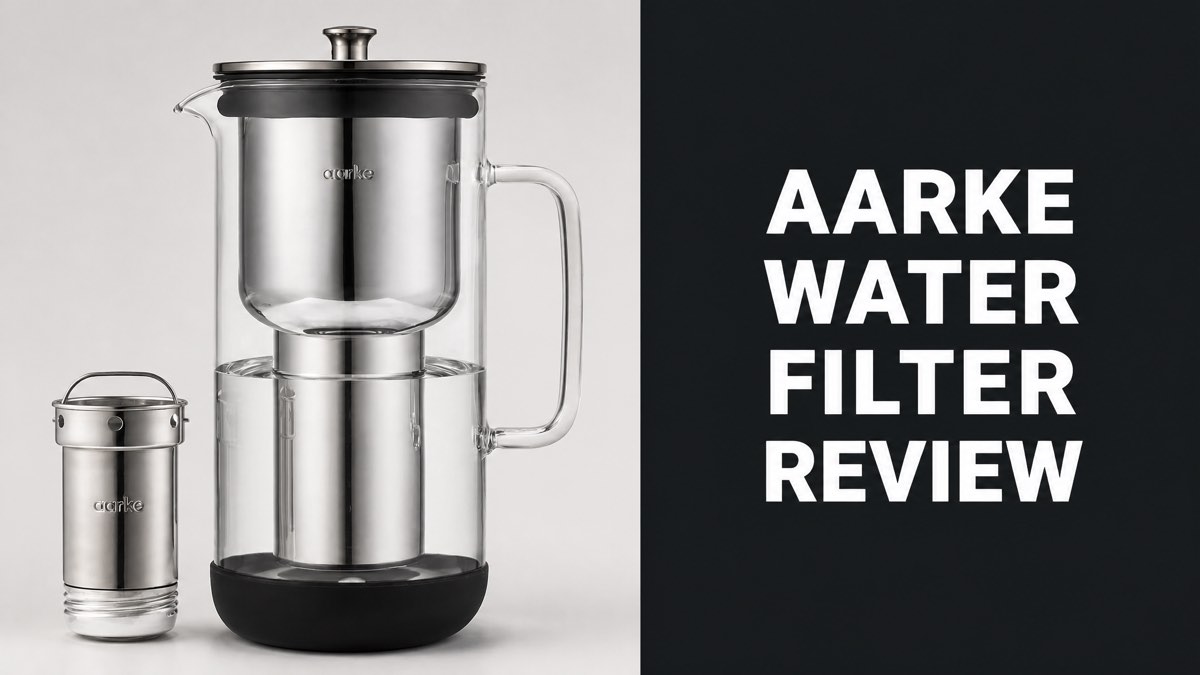
The Aarke water filter is a glass and stainless steel pitcher from a Swedish brand best known for sparkling water makers. A refillable steel cartridge holds loose granules developed with BWT. Aarke sells the Purifier in two sizes, with granules for hard water or for added magnesium.
The pitcher filters water by gravity in 4 to 6 minutes. The Pure granules reduce limescale, chlorine, copper and lead. Testers prefer the taste to fridge-filtered water, and every part goes in the dishwasher. Owners rate it very highly, with 91 percent of ratings at five stars. The price runs $130 to $140, and the pitcher has no NSF/ANSI certification.
Glass adds weight and breakage risk, and rivals like Brita and ZeroWater remove more dissolved solids. This review weighs those trade-offs against refill costs, owner feedback and rival pitchers. By the end, buyers will know who should buy the Aarke and who should look elsewhere.
What Is the Aarke Water Filter?
The Aarke water filter is a premium pitcher made of glass and stainless steel. The Swedish brand designs it for filtering tap water at home. Sparkling water makers made Aarke famous, and the Purifier brings the same clean look to a filter pitcher.
Aarke developed the filter technology with BWT, one of the world's leading water technology companies. The patented ReFilter System pairs a refillable steel cartridge with loose filter granules. So why does that matter? Owners pour the granules in by hand instead of snapping in a sealed plastic cartridge.
And the Purifier comes in two sizes. The standard model holds 80 fluid ounces (2.4 liters) in total and filters 5 cups (1.18 liters) at a time. The Large holds 12 cups (2.84 liters) and filters 7 cups (1.66 liters).
Aarke Purifier Sizes:
| Spec | Purifier | Purifier Large |
|---|---|---|
| Total capacity | 80 fl oz (10 cups) | 12 cups (2.84 L) |
| Filtered capacity | 5 cups (1.18 L) | 7 cups (1.66 L) |
| Height with lid | 10.8 in (27.4 cm) | 9.84 in (25 cm) |
| Width with lid | 6.7 in (17 cm) | 8.27 in (21 cm) |
What Is the Aarke Made Of?
The carafe is made of glass, and the filter housing is made of SUS304 stainless steel. Food-grade thermoplastic and silicone cover the lid details and the bumper. The plastic is BPA-free and meets FDA, California Proposition 65, LFGB and DGCCRF requirements.
Here's the catch: plastic is not fully absent. The granules combine ion exchange resin and activated carbon, and the resin is a type of plastic formed into small solid grains. Is the pitcher plastic-free, then? Not entirely. The Large model also uses recycled ocean-bound plastic.
The box includes the pitcher, one bag of Pure filter granules, a detachable silicone bumper, an instruction manual and a cleaning cloth. So, nothing else is needed to start filtering.
How Does the Aarke Water Filter Work?
The Aarke filters water by gravity through loose granules in a steel cartridge. Tap water goes into the top reservoir and drips through the granules into the glass carafe below. One full pitcher takes 4 to 6 minutes to filter.
The granules combine two materials. What does each one do? Ion exchange resin targets limescale and metals such as lead and copper. Activated carbon targets chlorine, bad taste and odor. Together the two cut the substances that make tap water taste flat or leave scale in a kettle.
Here's a detail that helps at the table. The lid lets water pour from the carafe while the top reservoir is still filtering. Nobody has to wait for the last drops before serving a glass.
How Do You Change the Aarke Filter?
Changing the filter means pouring a fresh bag of granules into the steel cartridge. Each bag lasts up to 8 weeks or 31.7 gallons (120 liters). Water quality and usage change that number. No sealed plastic cartridge goes in the trash.
A manual dial in the lid tracks the schedule. The dial works like a calendar, with numbers for the start of each month and dots for two-week steps. The owner sets the pointer to the date of the last change, or to the date 8 weeks ahead.
But the dial is not an electronic sensor. Consumer Reports lists the pitcher as having no filter-life indicator. Does the dial update itself? No. The owner has to set it after every refill.
What Does the Aarke Water Filter Remove?
The Pure granules reduce limescale, chlorine, copper and lead. Aarke reports a 90 to 100 percent cut in limescale, 80 to 100 percent in chlorine, 80 to 100 percent in copper and 90 to 100 percent in lead. Results depend on the quality of the inlet water.
Those figures follow the European EN 17093:2018 standard. Food & Wine and CNN Underscored both note that the granules meet it. Aarke built the granules with BWT, one of the world's leading water technology companies.
Pesticides, herbicides and PFAS sit in a gray area. Does the carbon remove them? Aarke says the activated carbon reduces some of them, but the brand declines to give a figure. Results vary with the condition of the inlet water and the specific substance.
Now, watch this: CNET measured dissolved solids in a home tap sample that started at 57 ppm. The Aarke cut total dissolved solids by 39 percent. A standard Brita filter cut 45.6 percent, and ZeroWater removed 100 percent.
What Is the Difference Between Pure and Enriched Granules?
The two granule types differ in limescale reduction and mineral content. Pure reduces limescale, chlorine, copper and lead. Enriched reduces chlorine, copper and lead but not limescale. Enriched also adds magnesium to the water.
Enriched granules raise the pH of the water. Aarke lists a pH above 8.5 for Enriched, against 6.0 to 7.0 for Pure when the inlet water sits at pH 7.0. Food & Wine notes that Enriched alkalizes the water.
Hard water favors Pure. Why? Limescale builds up in kettles and coffee machines, and only the Pure granules reduce it. Owners with soft water who want added magnesium have a reason to pick Enriched.
What's more, Enriched costs more. CNET lists a three-pack of Pure granules at $25 on Aarke's website and the Enriched granules at $30. Every Aarke Purifier and Purifier Large accepts both types.
Pure vs Enriched Granules:
| Feature | Pure | Enriched |
|---|---|---|
| Limescale reduction | Yes (90-100%) | No |
| Chlorine reduction | 80-100% | 80-100% |
| Copper reduction | 80-100% | 80-100% |
| Lead reduction | 90-100% | 90-100% |
| Adds magnesium | No | Yes |
| Water pH | 6.0-7.0 | Above 8.5 |
Does the Aarke Have NSF Certification?
No. The Aarke carries no NSF/ANSI certification. Consumer Reports lists it as not certified for chlorine, lead or PFAS reduction. CNET found no NSF/ANSI certification listed for the product.
But the pitcher holds a European credential instead. Both granule types meet parts of the EN 17093:2018 standard. CNN Underscored points out that Aarke is a Swedish brand, so the usual American certifications are missing.
So CNN Underscored ranked the Aarke below its top picks for that reason. The review called the pitcher an interesting option for avoiding plastic, but without the proven contaminant reduction of the leading models.
Does the Aarke Water Filter Improve Taste?
Yes. The Aarke makes tap water taste cleaner and crisper. Food & Wine testers preferred Aarke water to the filtered water from a refrigerator dispenser. The cleaner flavor also showed up when they brewed coffee.
CNN Underscored reached a milder verdict. The tester found that the taste beat tap water without differing wildly. Why does the taste improve at all? Chlorine removal drives most of that gain, and Aarke says the Pure granules reduce chlorine by 80 to 100 percent.
And hard-water owners report a second payoff. Owners describe no limescale build-up in kettles and teapots after the switch. Pure granules reduce 90 to 100 percent of limescale, so tea and coffee equipment stays cleaner.
How Does the Aarke Compare to Brita and ZeroWater?
The Aarke costs far more than Brita or ZeroWater and filters less than ZeroWater. CNET lists it at $130, against $20 for a standard Brita and $25 to $45 for ZeroWater. Dissolved solids fell 39 percent with Aarke, 45.6 percent with Brita and 100 percent with ZeroWater.
Filter cost lands in the same range. CNET prices Aarke granules at $8 or more per refill, Brita filters at $5 to $8 and ZeroWater filters at $13 or more. Each Aarke refill lasts about 2 months, the same as a standard Brita filter.
Design is where the Aarke wins. CNET called it the best-looking pitcher in its test and the only one on the list that is dishwasher safe. Most competitors house the filter in a plastic cartridge, while the Aarke uses loose granules in a steel cartridge.
But certification favors the rivals. CNET lists the Brita and ZeroWater filters as tested against NSF/ANSI standards by independent bodies. The Aarke shows no such listing.
Aarke vs Brita vs ZeroWater:
| Pitcher | Price | Refill cost | Solids cut |
|---|---|---|---|
| Aarke | $130 | $8+ | 39% |
| Brita standard | $20 | $5-$8 | 45.6% |
| ZeroWater | $25-$45 | $13+ | 100% |
What Do Owners Say About the Aarke?
Owners rate the Aarke very highly. On Aarke's own store, 280 of 308 ratings give five stars, which equals 91 percent. Only 3 ratings give two stars or fewer.
Praise centers on three points. Owners like the glass and steel look, the clean taste and the end of plastic cartridges. One buyer said a glass kettle stayed free of limescale. Another called it far better than any filter jug used before.
Complaints exist but stay minor. Owners mention the weight when the pitcher is full, the fragility of the glass parts, a weak bumper ring and a height too tall for some fridges. One buyer received granules without the Enriched type ordered.
What Owners Praise:
- The glass and stainless steel look
- Clean, fresh taste
- No plastic cartridges to throw away
- Kettles and teapots stay free of limescale
A few owners flag routine upkeep. One buyer boils the filter once a week and calls that a slight pain that takes a few minutes. Another noticed a slight taste difference at first, and one shopper still tasted chlorine after filtering.
What Are the Downsides of the Aarke Water Filter?
The Aarke's main downsides are price, weight, fragility and limited certification. Each one shows up in professional tests and in owner feedback. None breaks the product, but all four affect who should buy it.
Main Downsides:
- High price
- Weight when full
- Fragile glass parts
- No NSF/ANSI certification
Capacity runs below the label. How much water does a full pitcher actually give? Slightly less than 5 full glasses. Food & Wine testers refilled it after almost every use, so the 5-cup filtered capacity works as a ceiling, not a typical yield.
Filtration ranks below the top picks. CNN Underscored said neither granule type reduces contaminants as effectively as its leading pitchers. CNET puts the 31.7-gallon (120-liter) granule life about 9 gallons (34 liters) below Brita's claim.
Here is the thing about granules: they only work with Aarke pitchers. Aarke states that the Purifier is designed for its own refill granules alone. Buyers cannot switch to cheaper third-party filters.
Is the Aarke Too Heavy or Fragile?
Yes. The pitcher weighs 2.43 pounds (1.1 kilograms) empty and uses glass parts that can break. Food & Wine calls it slightly heavy, and CNET lists the glass as a breakable weak point. Water adds to the load once the carafe is full.
Owners echo that point. Store reviews mention weight when full and the fragility of the glass components. One owner called a bumper ring weak. The good news? A detachable silicone bumper ships in the box to cushion the glass.
Replacement parts exist. Aarke sells a spare glass carafe for the Purifier. A broken carafe does not force a full pitcher replacement.
Does the Aarke Fit in a Standard Fridge?
Yes. The Aarke fits on a standard fridge shelf when the shelf is tall enough. The standard Purifier stands 10.8 inches (27.4 cm) high and 6.7 inches (17 cm) wide with the lid on. Aarke advises measuring the shelf height first.
The Large needs more width. The Purifier Large stands 9.84 inches (25 cm) high and 8.27 inches (21 cm) wide with the lid on. Its shorter height helps on tight shelves, but the wider body takes more room.
Door storage is out. Will the pitcher fit in the door? Not likely, since the round base is too wide for the narrow storage space. Refrigeration is optional, but the filtered water stays in the pitcher for 24 hours at most, in a cool spot out of direct sunlight.
How Much Does the Aarke Water Filter Cost?
The Aarke water filter costs about $140 for the standard Purifier in the United States. Food & Wine lists $140 at Amazon and $165 at Williams Sonoma. CNET lists $130, and CNN Underscored shows $112 on Aarke's own site.
Aarke Purifier Price by Source:
| Source | Price |
|---|---|
| Amazon (Food & Wine) | $140 |
| Williams Sonoma (Food & Wine) | $165 |
| CNET listing | $130 |
| Aarke's own site (CNN Underscored) | $112 |
Kits bundle the pitcher with extra granules. The Pure Kit pairs the Large pitcher with 3 extra refill bags. Aarke says those bags cover almost 6 months of refills.
Yearly running cost stays modest. What does a year of refills cost? Consumer Reports estimates $40. The rated capacity is 32 gallons (121 liters) per bag.
Are Aarke Refill Granules Expensive?
No. Aarke refill granules cost about the same as Brita filters. CNET lists a three-pack of Pure granules at $25 on Aarke's website. CNN Underscored puts single refills at $10 or $12, and Consumer Reports estimates $40 per year.
And a subscription smooths the supply. Aarke offers a filter subscription with free shipping and the option to skip, change or cancel at any time. The brand lists no subscription fees or hidden costs. One delivery of 3 bags provides up to 24 weeks of use.
Is the Aarke Water Filter Easy to Clean?
Yes. The Aarke breaks down into parts that are dishwasher safe. The carafe and every part of the refillable filter system tolerate temperatures up to 140°F (60°C). Aarke says the stainless steel and glass resist scratching in the dishwasher.
Weekly washing keeps the pitcher hygienic. Food & Wine suggests washing a pitcher once a week and whenever the filter changes. Aarke says that washing every part without scratching helps prevent microbiological growth.
For a deeper clean, boiling is an option. Aarke states that the components can be boiled. One owner boils the filter once a week.
Can You Put the Aarke in the Dishwasher?
Yes. Every part of the Aarke is dishwasher safe up to 140°F (60°C). The list covers the glass carafe and the stainless steel filter cartridge. CNET called it the only pitcher in its test group that is dishwasher safe.
Here's one step that comes first. The granules must come out of the cartridge before the cartridge goes into the dishwasher. Aarke lists this as an important care instruction for the filter system.
A cleaning cloth ships in the box. The small microfiber cloth wipes smudges from the glass and the steel lid. CNN Underscored notes the lid must come off whenever the pitcher needs a refill.
Is the Aarke Water Filter Worth It?
Yes. The Aarke is worth it for buyers who want a plastic-light pitcher that looks good and tastes clean. The pitcher is not the strongest filter or the cheapest one. The value comes from the glass and steel build, easy cleaning and low refill cost.
The good news? The strengths are clear. Water tastes clean, every part goes in the dishwasher, refills avoid plastic cartridges, and the design earned the most stylish title from CNET and the Best Splurge title from Food & Wine.
The bad news? The weaknesses are just as clear. The price runs $130 to $140, CNET's solids test ranks the Aarke below Brita and ZeroWater, and the pitcher has no NSF/ANSI certification. Glass adds weight and the risk of breakage.
Pros:
- Clean-tasting water
- Dishwasher-safe parts
- Refills with no plastic cartridges
- Glass and stainless steel design
Cons:
- High price
- No NSF/ANSI certification
- Less solids reduction than Brita and ZeroWater
- Heavy, breakable glass
Who Should Buy the Aarke Water Filter?
Buyers with hard water and a design-minded kitchen gain the most from the Aarke. The Pure granules reduce 90 to 100 percent of limescale, which protects kettles and coffee machines. CNET says the pitcher is good-looking enough to set out for a dinner party.
But buyers who need certified contaminant removal need to look elsewhere. CNN Underscored and Consumer Reports both flag the missing NSF/ANSI certification. A ZeroWater or a certified Brita fits households that need proven reduction of specific contaminants.
Bottom line: the verdict is a qualified yes. The Aarke is a stylish, easy-to-clean pitcher with clean-tasting water and modest refill costs. Weigh the $140 price and the missing NSF/ANSI certification before buying.
Pop Kitchen is a reader-supported platform. Purchases made through our links may earn us an affiliate commission at no extra cost to you.