
Acuva Water Filter Review: Is It Worth It?
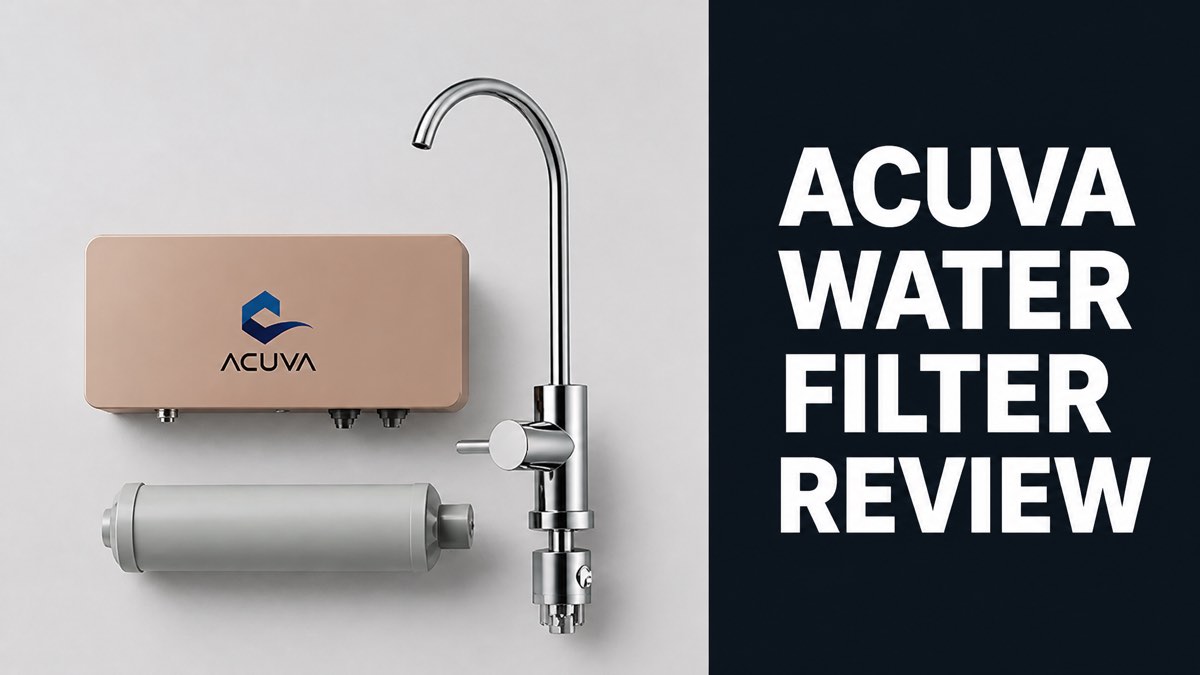
The Acuva water filter is a family of compact UV-LED purifiers that pair a carbon pre-filter with UVC LEDs, built for RVs, boats, and homes. The ArrowMAX models install under a sink and treat water on demand. Watersprint now sells the line after buying Acuva's assets in late 2024.
Acuva works in two stages: a carbon pre-filter first, then UVC LEDs. The LEDs run only while water flows, and the ArrowMAX 2.0 draws about 9 watts while active. The system holds NSF/ANSI 55 Class B and NSF/ANSI 372 certification. Installation is simple for a first-time DIYer, and testing shows more than 99.999% of E. coli inactivated at 6.0 liters per minute.
The downsides are real too. Prices run from about $300 to $800, pre-filter supply got shaky after the ownership change, and well water falls outside the certification. Read on for the specs, the costs, the certification limits, and a clear verdict on who benefits and who needs to look elsewhere.
What Is the Acuva Water Filter?
Acuva is a line of compact UV-LED water purifiers for RVs, boats, and homes. Each unit pairs a carbon pre-filter with a UVC LED reactor. The brand is best known for its ArrowMAX under-sink models.
The range covers several models. The ArrowMAX 1.2 and 2.0 fit under a sink. The Wanderer 2.0 targets RVs and boats. The ArrowMAX Home 10K treats the water entering a whole house.
Main Acuva Models:
- ArrowMAX 1.2 (under sink)
- ArrowMAX 2.0 (under sink)
- Wanderer 2.0 (RVs and boats)
- ArrowMAX Home 10K (whole house)
To be clear, most buyers treat a single drinking tap. Purified water exits through a dedicated Smart Faucet or an existing dispenser. Water used for showers and other tasks bypasses the purifier.
What Type of System Is Acuva?
Acuva is a UV-LED purifier with a carbon pre-filter, not a standalone filter. The pre-filter handles particles, chlorine, and metals. The UVC LEDs then inactivate bacteria, viruses, and cysts in the water that passes through.
UV light doesn't remove everything. What does it miss? UV-LED treatment leaves water hardness, lead, iron, sediment, and chlorine untouched. Every Acuva system therefore ships with a pre-filter ahead of the LED chamber.
The pre-filter also protects the UV step. Particles in the water create shade where bacteria hide from the UVC light. Clear water lets the light reach every microorganism.
Who Owns Acuva Now?
Watersprint, a Swedish water-treatment company, acquired Acuva's assets in late 2024. Acuva was a Vancouver-based company. Its ArrowMAX line now sells under the Watersprint banner.
The core technology dates to a 2014 research initiative with the University of British Columbia. Acuva named the design IntenseBeam Technology. Watersprint now carries that patented design in its own portfolio.
The ownership change left a gap for existing owners. What was missing? Replacement pre-filters sat out of stock at several retailers in late 2024. Some buyers also complain that customer service is hard to reach.
How Does Acuva Work?
Acuva works in two stages: a carbon pre-filter first, then a UVC LED reactor. Water passes through the pre-filter to lose particles, taste, and odor. The LEDs then expose the clear water to UV-C light inside a stainless steel chamber.
UV-C light inactivates microorganisms. Bacteria, viruses, and cysts lose the ability to reproduce. An inactive microbe cannot multiply inside the body of the person who drinks the water.
The LEDs switch on only when water flows. A flow sensor starts the system the moment the faucet opens. Why does that matter? Traditional UV lamps stay on constantly, so the on-demand design saves energy.
What Does the Pre-Filter Remove?
The Advanced Pre-Filter removes lead, heavy metals, chlorine, mercury, and other contaminants. The cartridge also reduces turbidity, odors, and unpleasant tastes. Each cartridge lasts up to 4,000 gallons (about 15,100 liters).
Advanced Pre-Filter Removes:
- Lead
- Heavy metals
- Chlorine
- Mercury
- Turbidity
- Odors and unpleasant tastes
Here is the part most people miss: a standard pre-filter option also exists under a separate part number. The Advanced version is the one rated for heavy metals such as lead. Buyers who want lead reduction need the Advanced cartridge.
The Explore 2 model uses a 1 micron activated carbon filter. The filter removes dirt, bad taste, chlorine, lead, and other heavy metals. A UVC LED unit then inactivates the viruses and bacteria that remain.
How Does the Smart Faucet Work?
The Smart Faucet lights up blue whenever the purifier is active. The light gives visible confirmation that the UV step is running. The main unit carries a second indicator light for the same purpose.
The system runs a self-cleaning cycle every 12 hours. A UV burst sanitizes all the water sitting inside the reactor. After each use, the LEDs stay on for 5 more seconds to treat water still moving through.
Flow-triggered models don't require the Smart Faucet. The unit starts when water begins to flow, so an existing dispenser works fine. What goes missing without the faucet? Only the blue status light.
What Are the Acuva ArrowMAX 2.0 Specs?
The ArrowMAX 2.0 treats 2 liters per minute (0.52 gallons per minute) and up to 120,000 liters (about 31,700 gallons) over its life. The LEDs last 1,000 hours on demand. The UV dose stays above 16 mJ/cm2 even at end of life.
Size and build suit tight spaces. For example, the unit measures 250 x 47.5 x 105 mm (9.8 x 1.9 x 4.1 inches) and weighs 5 lb (2.3 kg). A polymer body wraps a stainless steel reactor.
And operating limits are broad. Water temperature tops out at 40°C (104°F). Working pressure runs from 12 to 100 psi. The inlet and outlet use 1/4 inch push-to-connect fittings.
ArrowMAX 2.0 Specs:
| Spec | Value |
|---|---|
| Flow rate | 2 L/min (0.52 gal/min) |
| Lifetime capacity | 120,000 L (about 31,700 gal) |
| LED life | 1,000 hours on demand |
| Size | 250 x 47.5 x 105 mm (9.8 x 1.9 x 4.1 in) |
| Weight | 5 lb (2.3 kg) |
| Max water temperature | 40°C (104°F) |
| Working pressure | 12 to 100 psi |
Certification covers NSF/ANSI 55 Class B and NSF/ANSI 372. IAPMO R&T handled the testing. A separate CSA B483.1 certificate also exists.
How Much Power Does Acuva Use?
The ArrowMAX 2.0 draws about 9 watts while active and about 0.1 watts on standby. The LEDs run only while water flows. Why does the low draw matter? Battery-powered setups benefit most.
The standard input is 12V DC (11 to 16 volts). An AC adapter version also exists. Solar-friendly operation makes the unit a fit for off-grid and mobile setups.
Wiring into an RV battery needs a 3A fuse. One owner ran the cable into the battery compartment and connected the power and ground leads. Other models offer an AC adapter instead.
What Are the Benefits of Acuva?
Acuva delivers on-demand, chemical-free purification without lamp replacements. The LED unit contains no mercury. The system adds no chemicals to the drinking water, and it works with any compatible faucet or dispenser.
Short answer: size is the main draw. Acuva shrank purification technology built for large water sources into an under-sink box. The unit fits the cramped cabinets of RVs, vans, and boats.
And taste improves too. The carbon pre-filter removes chlorine, odor, and off flavors before the UV step. One owner called the water great-tasting right after installation.
Main Benefits:
- Chemical-free purification
- Mercury-free LEDs
- No lamp replacements
- Compact under-sink size
- Better-tasting water
Does Acuva Kill Bacteria and Viruses?
Yes. Acuva inactivates more than 99.999% of E. coli at 6.0 liters per minute (1.6 gallons per minute), validated by SGS-CSTC. The maker advertises up to 99.9999% of bacteria, viruses, and cysts.
What's more, a field trial backed up the claim. RV owners ran water samples through a unit. One sample carried an extremely high E. coli level. Independent lab testing returned every sample as safe to drink.
The CDC notes that UV purification with pre-filtration is highly effective against protozoa like Giardia and Cryptosporidium. Bacteria like Salmonella and E. coli fall under the same protection. So do viruses like hepatitis A, Norovirus, and Rotavirus.
Is Acuva Easy to Install?
Yes. Installation is simple enough for a first-time DIYer. The main unit snaps onto a metal wall rail with spring-loaded plastic clips. The included tubing screws and press-fits together.
Push-to-connect fittings speed the work. Both ports take 1/4 inch tubing with a simple press-in connection. The kit includes the essential installation components.
Here is the kicker: the electrical hookup is the fiddly step. A 12V DC model needs a fused connection to the RV battery system. An AC adapter version skips that wiring.
Installation Steps:
- Snap the main unit onto the metal wall rail.
- Press-fit the included tubing and connections.
- Wire the 12V DC power through a 3A fuse.
What Are the Downsides of Acuva?
Acuva's biggest weakness is support and parts after the ownership change. Buyers report hard-to-reach customer service and out-of-stock pre-filters. Those problems hit owners who depend on cartridges the hardest.
The bad news? The price is steep for a point-of-use unit. Retail prices run from $299.99 for the Wanderer 2.0 to $719.99 for the ArrowMAX 2.0 at one Canadian retailer. Pre-filter replacements add to the long-term cost.
The system treats only the tap it feeds. So what about showers? Showers, dishwater, and the fresh water tank stay untreated. One RV couple still sanitizes their tank about once every two years.
And a Class B rating limits the use case. The certification covers water already judged acceptable for drinking. Class B systems don't treat contaminated water.
Can You Still Buy Replacement Pre-Filters?
Yes. Several retailers still list the Acuva Advanced Pre-Filter, part 600-1379. Stock gaps hit owners in late 2024, when stores showed the filter as out of stock or discontinued. Availability varies by seller.
Generic inline filters can fill the gap. Any filter with 1/4 inch quick-connect fittings physically fits the system. A generic cartridge doesn't match the Advanced Pre-Filter's heavy-metal removal.
Clear water matters more than the cartridge brand. The primary job of the pre-filter is stripping particles. Why does that matter? Particles shield bacteria from UV-C light, so any working pre-filter keeps the UV step effective.
Is Acuva Safe and Certified?
Yes. Acuva is certified to NSF/ANSI 55 Class B and NSF/ANSI 372 by IAPMO R&T. The system also holds CSA B483.1 certification and EPA establishment number 98339-CAN-1. Class B covers supplemental bacterial treatment of water already deemed acceptable to drink.
In fact, two IAPMO files back the system. File W-10944 covers it as an ultraviolet microbiological water treatment system. File W-10946 covers it as a lead-free water filtration product.
Certification limits matter. Class B systems only reduce normally occurring nuisance microorganisms. Can a Class B unit treat contaminated water? The maker states it cannot.
Does Acuva Work With Well Water?
No. Acuva cannot officially claim certification for well water. The Class B standard covers only water already deemed acceptable to drink. Untested well water falls outside that scope.
Field tests looked promising anyway. RV owners ran river water and deliberately contaminated water through a unit. Both tests impressed them, though neither replaces certification.
Well water adds a second problem. What is it? UV doesn't remove sediment, hardness, or iron. Those contaminants need separate treatment ahead of the LED chamber.
How Much Does Acuva Cost?
Acuva units cost between about $300 and $800 depending on model and seller. The Wanderer 2.0 listed at $299.99 on Amazon. A Canadian retailer lists the ArrowMAX 2.0 at $719.99 against an $800.00 list price.
Camping World priced the 12V ArrowMAX 2.0 at $539.10 before moving it to clearance as a final sale item. Water, Inc. also lists Acuva units under close-out specials. Clearance items carry final-sale terms.
Acuva Price Points:
| Model | Seller | Price |
|---|---|---|
| Wanderer 2.0 | Amazon | $299.99 |
| ArrowMAX 2.0 (12V) | Camping World (clearance) | $539.10 |
| ArrowMAX 2.0 | Canadian retailer | $719.99 |
Running costs are low. Why? The unit has no lamps to replace and draws about 9 watts while active. The main recurring cost is a pre-filter cartridge every 4,000 gallons (about 15,100 liters).
How Does Acuva Compare With Traditional UV Lamps?
Acuva beats traditional UV lamps on power draw and upkeep. Lamp systems stay on constantly. Acuva's LEDs run only while water flows, so the unit sips power.
The LED design also avoids mercury. Acuva advertises a mercury-free build with no ongoing lamp replacements. Lamp upkeep disappears from the owner's to-do list.
At the same time, capacity is the trade-off. The LEDs last 1,000 hours on demand, which equals about 120,000 liters at full flow. Households with heavy use reach that limit sooner than light users.
Is Acuva Worth It?
Yes. Acuva is worth it for RV, boat, and van owners who want extra protection at the tap. The compact size, low power draw, and on-demand LEDs fit mobile life.
Bottom line: the hardware earns its price, but the support picture is shakier. Pre-filter supply and customer service drew complaints after the ownership change.
Owners with years of use report no issues, so the verdict is a qualified yes. Buy it for water already fit to drink, and check cartridge stock first. Well water and contaminated sources sit outside the certification.
Pros and Cons:
| Pros | Cons |
|---|---|
| Compact size | High price |
| 9-watt draw | Shaky pre-filter supply |
| Mercury-free LEDs | Support complaints |
| 120,000 liters of capacity | Well water outside certification |
Who Should Skip Acuva?
Buyers on a tight budget or with untested well water are better off looking elsewhere first. Class B certification does not cover contaminated sources. An inline Omnipure carbon block filter lists for $46.50 at one retailer, though it does not disinfect.
So, households that need whole-house treatment need a different model. The under-sink units treat a single tap. The ArrowMAX Home 10K treats point-of-entry water instead.
Owners who depend on parts support need to weigh the ownership change. Watersprint continues the line, yet pre-filter supply stayed uneven in late 2024. Checking cartridge stock before buying avoids surprises.
Pop Kitchen is a reader-supported platform. Purchases made through our links may earn us an affiliate commission at no extra cost to you.