
Amana Refrigerator Water Filter Review: Is It Worth the Price?
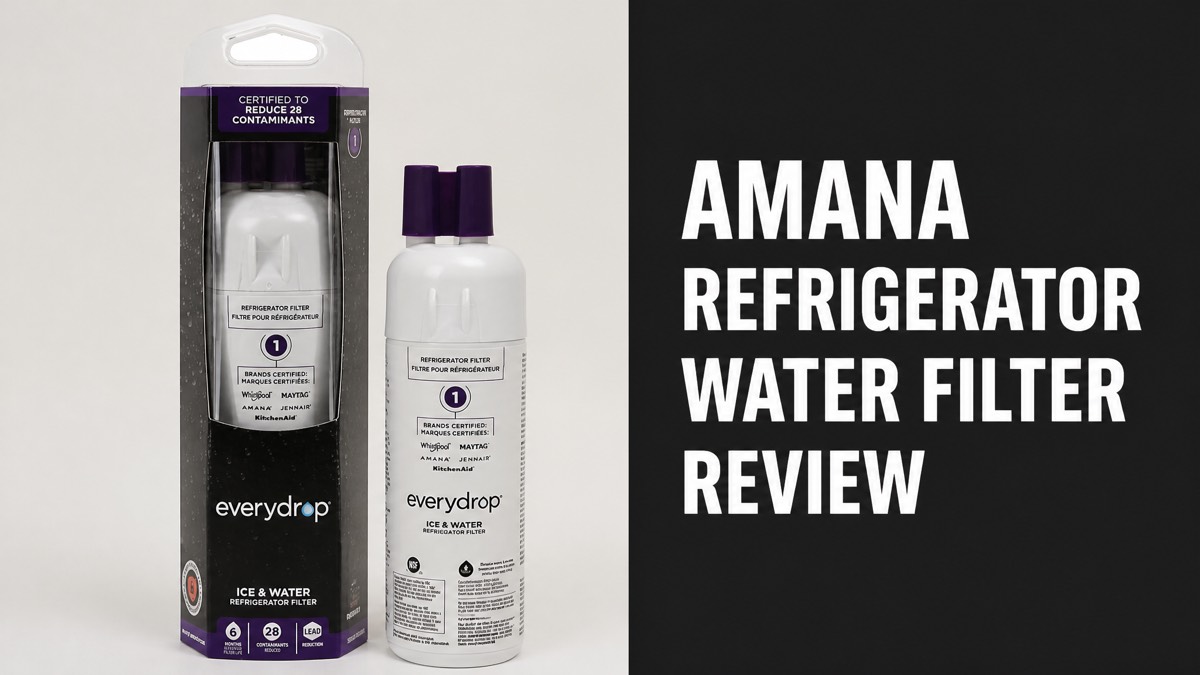
An Amana refrigerator water filter is a replaceable cartridge that cleans the water before it reaches the dispenser and the ice maker. Amana fridges use everydrop filters made by Whirlpool. Amana recommends a new cartridge every 6 months, or sooner when the indicator light comes on.
The right filter number depends on the refrigerator style, and the cartridge sits in the base grille or inside the fridge. Water passes through the media before it reaches the dispenser. The media reduces sediment and chlorine taste and odor. A clogged cartridge shows up as weak water flow and poor ice. Replacement follows one short sequence on every model.
No filter removes every contaminant, so certification and fit decide the result. Generic cartridges cost less, and counterfeits hide behind low prices. The sections below cover filter numbers, replacement, cost and an honest verdict on whether the genuine filter earns its price in daily use.
What Is an Amana Refrigerator Water Filter?
An Amana refrigerator water filter is a replaceable cartridge that cleans the water before it reaches the dispenser and the ice maker. Amana fridges use everydrop filters made by Whirlpool. The cartridge sits in the base grille or inside the fridge compartment.
The filter media fills up with use and loses effectiveness. What happens then? A clogged cartridge slows the water flow to the ice maker and the dispenser. And thin ice cubes and slow pouring are the usual results.
Amana recommends a new filter every 6 months, when the indicator light comes on, or as needed. So, the cartridge is a recurring purchase, not a one-time buy.
Which Filter Number Does Your Amana Fridge Use?
Amana fridges use a filter number that depends on the refrigerator style. Side-by-side models take EDR1RXD1, EDR3RXD1 or EDR4RXD1. French 3-door and bottom-freezer models take EDR4RXD1.
Three places show the right number. The owner's manual lists it in the Accessories section. The side of the old filter carries it. And the everydrop online filter finder matches a number to a model.
To be clear, the brand name alone doesn't settle the match. Why? Different Amana models need different cartridges. A mismatched cartridge can fail to lock into the housing and cause leaks.
How Does an Amana Refrigerator Water Filter Work?
Incoming water passes through the filter cartridge before it reaches the dispenser or the ice maker. The filter media traps sediment and reduces chlorine taste and odor on the way. Every glass of water and every ice cube comes from that filtered line.
Most refrigerator filters use a carbon base. Carbon handles chlorine, sediment and rust well. But the media fills up with use, so cartridges in this class are rated for 6 months or 300 gallons (1,136 liters).
What Does the Filter Remove?
The filter reduces sediment, chlorine taste and odor, and certain contaminants. Those are the three benefits Amana lists for its water filters. Fresh cartridges keep water and ice tasting clean.
Certified cartridges go further. For example, a UKF8001 cartridge listed for Amana fridges carries NSF certification for cysts, class I particulates, lead and mercury. And the same cartridge retains beneficial fluoride.
Here is the part most people miss: not every filter reduces the same substances, so the exact cartridge decides the result. Amana's counterfeit warning names lead, mercury, pesticides, asbestos and pharmaceuticals as contaminants that a fake filter fails to remove.
Where Is the Filter in an Amana Refrigerator?
The filter sits either in the base grille below the refrigerator door or inside the refrigerator compartment. Amana documents both spots. The fridge style decides which one applies.
The filter type points to the spot. EDR1RXD1 ejects and slides out of the bottom grille. EDR3RXD1 releases with a push button, also in the grille. And EDR4RXD1 twists out of a tray at the inside top right.
Amana Filter Types:
| Filter | Location | Removal |
|---|---|---|
| EDR1RXD1 | Bottom grille | Eject and slide out |
| EDR3RXD1 | Bottom grille | Push button to eject |
| EDR4RXD1 | Inside top right | Open tray and twist out |
How Do You Find Your Model Number?
The model number sits on a label inside the fresh-food compartment. Check the left and right walls near the doorjamb first. The tag carries the full model number with every letter and suffix.
If the label isn't there, two backup spots exist. Remove the lower crisper drawer and check the wall and the back for the tag. Otherwise, remove the kick plate at the bottom of the fridge and use a flashlight.
The owner's manual confirms the match. Compare the complete model number with the filter listed there. And never force a cartridge that doesn't slide, rotate or lock as instructed.
How Do You Replace an Amana Water Filter?
Replacement follows one short sequence on every model: open the access cover, remove the old cartridge, insert the new one, flush the line and reset the light. The job ranks among the easiest refrigerator maintenance tasks.
Alignment matters during insertion. The alignment arrow points up for filters at the inside top right. The arrow points left for filters in the grille. Slide or twist the new cartridge in until it stops.
Flushing comes next. Trapped air in the lines makes the dispenser drip. So what fixes that? Running 2 gallons (7.6 liters) of water through the dispenser purges air and residue. Then reset the replacement reminder light to finish the job.
Replacement Steps:
- Open the filter access cover or grille.
- Pull or twist the old cartridge out.
- Align the arrow and slide or twist the new cartridge in until it stops.
- Run 2 gallons (7.6 liters) of water through the dispenser.
- Reset the replacement reminder light.
How Often Should You Replace It?
Amana recommends a new filter every 6 months, when the indicator light comes on, or as needed. Slow water flow is the clearest early sign. And heavy use brings the date forward.
A typical family of four gets about six months from one cartridge. But what about a busier kitchen? Heavy dispenser and ice use drains the cartridge faster. Water conditions and household size shift the timing too.
The reminder light tracks time, not water quality. So, record the installation date and reset the light after every change. Store spare filters in their original packaging.
What Are the Signs of a Clogged Filter?
A clogged filter shows up as weak water flow and poor ice. Amana lists seven symptoms: thin or hollow ice cubes, odd-tasting ice or water, low ice production, no ice, a failing measure fill, no water and slow dispensing.
Clogged Filter Symptoms:
- Thin or hollow ice cubes
- Odd-tasting ice or water
- Low ice production
- No ice
- A failing measure fill
- No water
- Slow dispensing
A simple test confirms the cause. Note the water flow, remove the filter and dispense again. A noticeably stronger stream means the filter is clogged or installed wrong.
Bypass mode covers a short gap. With the filter removed, the system keeps dispensing water and the clogged cartridge stops slowing the flow. Does the water stay filtered? No. The water stays unfiltered until a new cartridge goes in.
Does the Amana Water Filter Actually Work?
Yes. The filter reduces chlorine taste, odor and sediment when it is fresh and fitted correctly. Performance fades as the cartridge fills. And poor seating cuts results as well.
Fit matters as much as the media. A cartridge that sits badly restricts flow or leaks. And here is the good news: a correct install plus a full flush restores normal dispensing.
What Are the Limits of the Filter?
No refrigerator filter removes every contaminant. A basic carbon filter handles chlorine, sediment and rust well. So what falls outside basic carbon? Pesticides and bacteria, which makes certification data the deciding factor.
The water source sets the risk. Homes with a newborn need to check the lead level a cartridge is certified to reduce. And persistent taste or odor problems point to the water supply or the plumbing.
Bottom line: certification data settles the question. Read the exact cartridge's performance data before relying on it for a specific contaminant.
How Does the Genuine Filter Compare With Generic Options?
The genuine everydrop filter is the only filter Amana approves for its refrigerators. Generic cartridges copy the fit and the filter number. The difference lies in approval, warranty and proof of testing.
Generic sellers state it plainly. What do they say? Their cartridges are not OEM parts, and the seller alone backs the warranty. Brand names appear only to show compatibility.
Some generics publish strong certification claims. Waterdrop Plus lists NSF 401, 53, 42 and 372 certification, 97% chlorine reduction and 99.6% lead reduction. And AquaCrest Deluxe lists the same four certifications.
Other options fill the EDR4RXD1 slot. IcePure RWF0900A lists NSF 42 and 372 certification and 97.5% reduction of chlorine, taste and VOCs. Mist UKF8001 fits Amana and lists 300 gallons (1,136 liters) or 6 months of life.
Generic Filter Claims:
| Filter | Key Claims |
|---|---|
| Waterdrop Plus | NSF 401, 53, 42 and 372; 97% chlorine and 99.6% lead reduction |
| AquaCrest Deluxe | NSF 401, 53, 42 and 372 |
| IcePure RWF0900A | NSF 42 and 372; 97.5% reduction of chlorine, taste and VOCs |
| Mist UKF8001 | Fits Amana; 300 gallons (1,136 liters) or 6 months |
Is a Generic Filter Safe?
Yes. A generic filter is safe to use when it carries verified NSF certification and fits the housing correctly. Certification and fit decide the outcome. The generic label alone doesn't.
But Amana takes a firmer position. Amana names everydrop as the only approved filter. And damage from a counterfeit filter may fall outside the refrigerator warranty.
Three checks protect the buyer. Confirm the certification claim, inspect the packaging and match the filter number to the owner's manual. These checks cost nothing and happen before the purchase.
How Do You Avoid Counterfeit Filters?
Counterfeit filters copy genuine labels but skip required testing. Makers use inferior materials. Filtration weakens, appliance efficiency drops and warranty problems follow.
Several signs give a fake away: misspellings, blurry or off-color printing, inconsistent fonts, missing certification logos and nonstandard model numbers. Unsealed or flimsy packaging and badly applied stickers add to the warning list.
Counterfeit Warning Signs:
- Misspellings
- Blurry or off-color printing
- Inconsistent fonts
- Missing certification logos
- Nonstandard model numbers
- Unsealed or flimsy packaging
Price and seller expose fakes too. A price far below normal is a red flag. Approved everydrop retailers ship from the United States. So what does overseas shipping signal? Another red flag. Unknown third-party sellers with thin contact details carry risk.
The stakes are real. A fake filter risks poor water quality, a leaking fridge and a voided warranty. Bottom line: buying from Amana, everydrop or an authorized retailer is the reliable route.
How Much Does an Amana Water Filter Cost?
Retail listings put genuine cartridges between $49.49 and $79.20 each. One retailer lists the EDR1RXD1 at $49.49. Another lists the EDR3RXD1 at $61.19. The UKF8001 cartridge for Amana fridges reaches $79.20.
Generic cartridges cost far less. A three-pack of a non-OEM filter lists at $35.99, which is about $12 per filter. And multi-packs lower the unit price.
Two changes a year set the yearly bill. What does that come to? At the EDR1RXD1 price, genuine cartridges cost $98.98 a year. The generic three-pack route costs about $24 for the same two changes.
Filter Prices:
| Option | Price |
|---|---|
| Genuine EDR1RXD1 | $49.49 |
| Genuine EDR3RXD1 | $61.19 |
| UKF8001 for Amana fridges | $79.20 |
| Generic three-pack | $35.99 (about $12 each) |
Is It Worth the Price?
Yes. The genuine filter costs about $99 a year at the EDR1RXD1 price and removes the compatibility doubt. Buyers pay for fit and approval.
Generic filters save about $75 a year. What's the catch? The buyer verifies certification, packaging and fit. Skipped checks bring counterfeit risk.
Skipping changes is the false saving. A clogged filter slows water flow and cuts ice production.
Where Can You Buy an Amana Water Filter?
Genuine filters come from Amana, everydrop or authorized retailers. Amana lists its own website, the Amana Parts and Accessories site and its Customer Care phone line as reliable sources. Major retailers that Amana names as authorized sellers are also safe.
Parts retailers stock the common numbers too. Listings cover EDR1RXD1, EDR3RXD1 and EDR4RXD1 filters. And cross-reference charts match each one to SpiroPure and Kenmore equivalents.
Are Marketplace Listings Safe?
No. Marketplace listings are not safe by default. Amana advises confirming that the seller is Amana or an authorized seller before buying.
Titles that read 'Replacement for Amana' describe compatible parts. In plain English: one such listing states that the filter is a Denali Pure replacement, not an OEM product. The compatibility claim is real, but the genuine status is absent.
Seller details tell the story. Look for a clear business name, contact details and a consistent history of selling Amana parts. Generic images, vague descriptions and unclear return policies are warning signs.
Is the Amana Refrigerator Water Filter Worth It?
Yes. The genuine filter is worth buying for owners who want a guaranteed fit and approved filtration. The cartridge reduces chlorine taste and odor and keeps ice and water tasting clean.
Bottom line: the price is the main drawback. Two cartridges a year cost about $99 at the EDR1RXD1 price, and a certified generic saves about $75 a year for buyers who verify the details.
What Are the Pros and Cons?
The pros center on fit and approval. The filter number matches the fridge, Amana approves the cartridge and the 6-month schedule is clear. And chlorine taste and odor drop with a fresh cartridge.
Pros:
- Guaranteed fit for the model
- Amana-approved filtration
- Reduced chlorine taste and odor
- Clear 6-month schedule
The cons center on price and care. Genuine cartridges cost more than generics. Filter numbers differ across models, and counterfeit listings circulate online. Each of those needs checking before purchase.
Cons:
- Costs more than generics
- Filter numbers differ by model
- Counterfeit listings circulate online
The choice depends on priorities. Owners who want fit assurance buy genuine. Owners who want savings buy a certified generic and check the details.
Pop Kitchen is a reader-supported platform. Purchases made through our links may earn us an affiliate commission at no extra cost to you.