
American Plumber Water Filter Review: Is It Worth It?
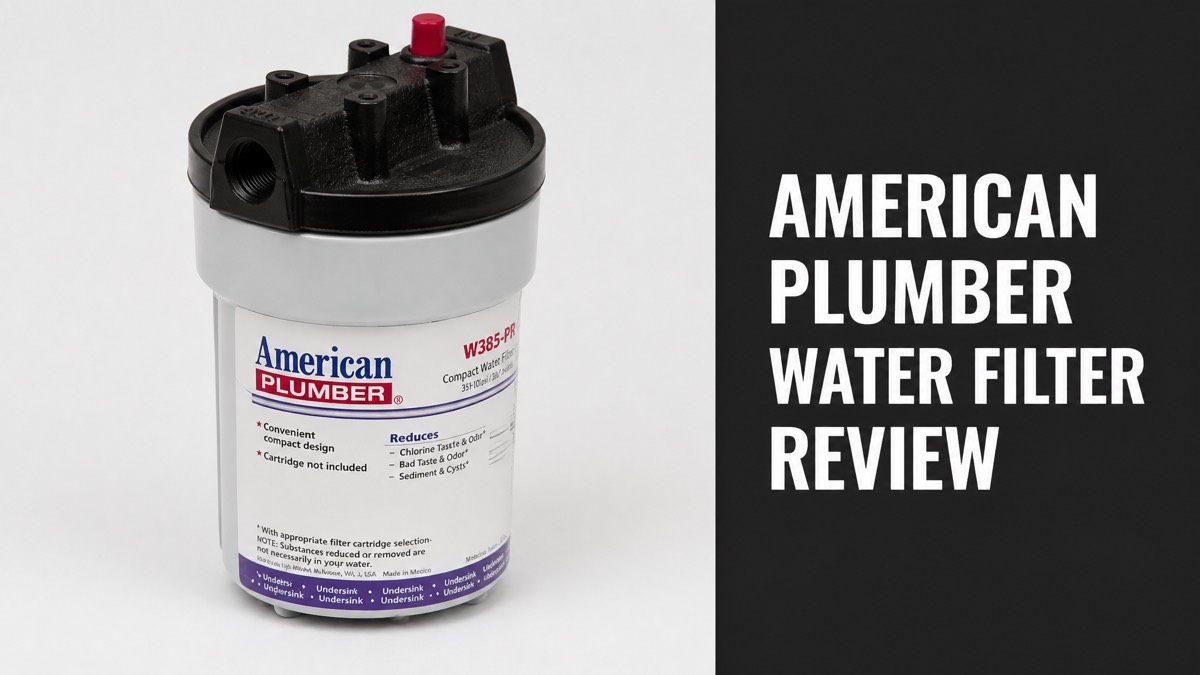
Pentair makes American Plumber water filters as a line of cartridges, housings, and reverse osmosis systems for home use. The brand covers under-sink units like the W385-PR and whole-house housings like the WVC34. Low-cost sediment cartridges fill out the range for most households.
Pentair owns the brand and manufactures the filters. Most listings fall into four model families, and each family targets a different problem. Sediment cartridges trap grit by micron rating. Owners praise low cartridge prices and easy fit. Skeptics doubt whole-house cartridges as full treatment. Prices run from under $2 for a compatible cartridge to about $55 for a compact housing.
The big picture is simple. These American Plumber filters handle sediment, taste, and odor well at a low running cost. They leave minerals and salts alone. Read on for models, safety, replacement timing, and costs. A clear verdict on who should buy and who should skip closes the review.
What Is an American Plumber Water Filter?
An American Plumber water filter is a cartridge, housing, or system sold under the American Plumber name for home use. The line covers whole-house sediment filters, compact under-sink units, reverse osmosis systems, and replacement cartridges.
To put it simply, the brand pitch centers on trade credibility. Water professionals inspired the line, and the name signals a product aimed at installers as much as homeowners. Buyers see a plumber's brand on the box.
Short answer: basic cartridges handle basic jobs. Sediment, chlorine taste, odor, and well water particles are the main targets. Here's the catch: dissolved minerals, salts, and inorganic compounds fall outside what carbon and sediment cartridges remove. Why does that matter? A basic cartridge leaves them in the water.
Who Makes American Plumber Filters?
Pentair owns the American Plumber brand and manufactures the filters. American Plumber operates as a sub brand of Pentek, the Pentair water filter line.
Pentair is moving the line into its wider family of professional filtration products. Some orders arrive labeled Pentair instead of American Plumber. Is that a different product? No. The product inside is identical, and model numbers and part codes stay the same.
And third-party makers also sell compatible cartridges for American Plumber housings. Pentair holds the American Plumber trademark, and those compatible cartridges aren't made or endorsed by the brand.
Which American Plumber Models Are Most Common?
Most American Plumber listings fall into four families. They are the W385-PR under-sink housing, the WVC34 whole-house housing, the W50PEHD sediment cartridge, and the WRO reverse osmosis line. Each family targets a different water problem.
Main Model Families:
| Model | Type | Use |
|---|---|---|
| W385-PR | Compact housing | Under-sink, marine, RV |
| WVC34 | Valve-in-head housing | Main water line |
| W50PEHD | Pleated sediment cartridge | High flow whole-house |
| WRO-4500 | Reverse osmosis filter pack | Reverse osmosis systems |
Reverse osmosis buyers meet the WRO-3167, RO-2127, RO-3000, and RO-3500 systems. The WLCS-1000 is a separate under-counter drinking water system with its own replacement cartridges.
Think of it this way: model prefixes follow a pattern. W-numbers mark housings and cartridges, while WRO and RO prefixes mark reverse osmosis systems. The PR suffix appears on housings with a pressure relief button.
What Is the W385-PR Under-Sink Filter?
The W385-PR is a slim-line compact filter housing for under-sink, marine, and RV use. The opaque housing includes a pressure relief button and fits a small cabinet space.
Let me break that down. Specs are small and clear. The housing measures 7 inches (17.8 centimeters) long by 4.5 inches (11.4 centimeters) across. Ports are 3/8 inch (9.5 millimeters) NPT, and the unit takes 5 by 2.5 inch cartridges.
W385-PR Specs:
| Spec | Value |
|---|---|
| Length | 7 inches (17.8 centimeters) |
| Outside diameter | 4.5 inches (11.4 centimeters) |
| Ports | 3/8 inch (9.5 millimeters) NPT |
| Water pressure | 30 to 125 psi (207 to 862 kilopascals) |
| Water temperature | 40 to 100 degrees Fahrenheit (4.4 to 37.8 degrees Celsius) |
Operating limits matter for placement. Why do they matter? Water pressure must run between 30 and 125 psi (207 to 862 kilopascals). Water temperature must stay between 40 and 100 degrees Fahrenheit (4.4 to 37.8 degrees Celsius).
The housing is made in Mexico. Retailers position the W385-PR as a taste upgrade for drinking water, not a heavy contaminant-removal system.
What Is the WVC34 Whole-House Housing?
The WVC34 is a valve-in-head filter housing for the main water line. Ports measure 3/4 inch (19 millimeters) NPT, and the housing takes a 10 inch (25.4 centimeter) filter.
The WC34-PR and W34PR housings use the same 10 by 2.5 inch (25.4 by 6.4 centimeter) cartridge size. Cartridge shopping starts with that measurement.
Homeowners often inherit the housing with a new house. How do they find out? Many learn the filter has never been changed, then start asking which cartridge fits and what each type does.
How Does an American Plumber Filter Work?
An American Plumber filter pushes water through a replaceable cartridge that traps particles or adsorbs chemicals. The housing seals the cartridge inside the water line.
Sediment cartridges work by size. A lower micron rating catches finer particles. What does that mean in practice? A 3 or 5 micron cartridge filters finer grit than a 10 micron cartridge, which catches larger sediment.
Carbon cartridges work by adsorption. Active carbon removes chlorine, sediment, volatile organic compounds (VOCs), taste, and odor. Carbon doesn't remove minerals, salts, or dissolved inorganic compounds.
Reverse osmosis systems stack stages. The WRO-4500 filter pack pairs a 5 micron pre-filter and a carbon block pre-filter with an in-line GAC post-filter. A membrane, sold separately, completes the system.
What Does a Sediment Cartridge Remove?
A sediment cartridge removes sand, silt, and other visible grit from household water. The W50PEHD is a pleated 50 micron cartridge built for high flow rates.
The W50PEHD can be rinsed and reused. Can that reuse cover drinking water? No. The reuse applies to non-potable applications, so drinking water lines need fresh cartridges. The cartridge fits W10-PR and W15-PR housings and most other heavy duty housings.
The W20CLHD takes a different route. Pleated cellulose media targets chlorinated water supplies instead of plain grit.
A compatible 5 micron cartridge loses under 1 psi (6.9 kilopascals) of pressure. The figure applies at 10 gallons per minute (37.9 liters per minute). Flow stays strong.
What Do Owners Say About American Plumber Filters?
Owner opinion splits by product type. Cheap compatible cartridges earn praise, while whole-house cartridge filters draw doubt as full water treatment.
The good news? Taste results earn the most agreement. An under-sink carbon filter improves the taste of drinking water, and the same cold line feeds ice and cooking water.
Buyers search for model names more than the brand. Related searches name the WLCS 1000, WVC34, W385-PR, W2010-PR, and W10-PR.
What Do Owners Like?
Owners like low replacement prices and easy fit. A compatible 5 micron sediment cartridge costs about $1.79 each in a 24 pack. Home improvement chains charge several times more.
What's more, fit earns repeat orders. Buyers report a perfect fit in W34PR housings and move up from trial packs to full cases.
Clarity gets mentioned too. Household water looks clearer after the switch to a fresh 5 micron cartridge.
What Are the Common Complaints?
The loudest complaint targets whole-house cartridge filters as weak treatment. Skeptics call them close to useless beyond sediment and small particles.
Carbon cartridges carry a bacteria concern. What's the risk? Bacteria can multiply in a carbon filter left in place too long, so overdue cartridges turn into a problem.
The bad news? Neglect causes the rest of the trouble. Owners who skip changes find grains of sand and small white particles in the water.
Part matching adds friction. Pentair labels, compatible cartridges, and long model numbers make the right replacement harder to spot.
Common Complaints:
- Whole-house cartridges treat little beyond sediment
- Old carbon cartridges can grow bacteria
- Neglected housings pass sand and white particles
- Pentair labels and long model numbers confuse part matching
Are American Plumber Filters Safe?
Yes. American Plumber filters are safe for the jobs they were built to do: sediment reduction, chlorine taste, and odor control. Pentair manufactures the line as standard household housings and cartridges.
To be clear, certification varies by product. Replacement packs for the WRO-4500 are listed as NSF certified. The WRO-3167 pack lists NSF 42, the standard for taste and odor.
A lab water analysis comes first. Municipal supplies often need only sediment, chlorine, and chloramine control, and impurities vary from street to street.
Timing protects safety. Carbon cartridges left in service too long become a bacterial risk, so change schedules matter.
Do Compatible Replacement Cartridges Work?
Yes. Compatible cartridges work when they match the housing size and micron rating. A SpiroPure 5 micron cartridge fits W34PR housings. The cartridge measures 9.88 inches (25.1 centimeters) long by 2.44 inches (6.2 centimeters) across.
Trademark rules limit the claims. Who owns the name? Pentair owns the American Plumber name, and third-party cartridges aren't made or endorsed by the brand. Buyers trade the brand label for lower prices.
In fact, price drives the switch. Compatible sediment cartridges sell for about $1.77 to $1.79 each in 24 packs. The seller offers a 30-day money back guarantee.
How Much Do American Plumber Filters Cost?
American Plumber filters cost from under $2 for a compatible sediment cartridge to about $55 for a compact under-sink housing. Whole-house heavy duty cartridges land between $15 and $32 at most stores.
Housing prices drop with pack size. The W385-PR costs $55.02 alone and $44.98 each in a 6 pack. Other listings run from $32 to $55.
Specialty parts cost more. The W50PEHD reaches $44.90 at one retailer, the W20CLHD runs about $29, and a WRO-4500 filter pack costs about $45.
Running costs depend on change frequency. A 5 micron spun polypropylene cartridge needs replacing about every 2 months, while a W50PEHD lasts 6 to 12 months.
Typical Prices:
| Item | Price |
|---|---|
| Compatible 5 micron cartridge | $1.77 to $1.79 each in 24 packs |
| W50PE and W50PEHD cartridges | $15 to $32 at most stores |
| W20CLHD cartridge | About $29 |
| W385-PR housing | $32 to $55 |
| WRO-4500 filter pack | About $45 |
Is It Worth the Price?
Yes. American Plumber filters deliver the most value as low-cost sediment and under-sink solutions. Small purchase prices and cheap cartridges keep yearly costs low.
And standard sizes help. The 10 by 2.5 inch cartridge fits many brands, and compatible cartridges cut running costs sharply.
Value drops when the water problem is bigger. Which problems? Iron, hard water minerals, and dissolved salts need softening, iron removal, or reverse osmosis. A cartridge filter doesn't cover them.
Where Can You Buy American Plumber Filters?
American Plumber filters sell through online filter retailers, big box stores, and Amazon. Search results show listings at Home Depot, Ferguson, Amazon, Waterfilters.net, Discount Filter Store, and US Water Systems.
At the same time, stock varies by part. Several listings, such as the DW-200-R cartridge and the SH153087 sump, show sold out at one retailer. The W385-PR shows high stock at another.
Return rules vary by store. One retailer accepts returns within 30 days with an RMA number, and only for unused items in original packaging.
How Often Should You Replace American Plumber Filters?
Replacement timing depends on cartridge type and water quality. Sediment cartridges run from every 2 months to every 6 to 12 months.
Carbon cartridges need disciplined changes. Why so strict? Bacteria can multiply in carbon left too long. Carbon also catches sediment, so heavy sediment loads shorten cartridge life.
Neglected housings need cleaning. A housing left untouched for years needs a new cartridge and a cleaned casing before it returns to service.
Replacement Timing:
| Part | When to Replace |
|---|---|
| 5 micron spun polypropylene cartridge | About every 2 months |
| W50PEHD cartridge | Within 6 to 12 months |
| Carbon cartridge | Before bacteria can multiply |
| RO membrane | When TDS rejection drops below 75 percent |
When Should You Replace an RO Membrane?
An RO membrane needs replacing when total dissolved solids (TDS) rejection drops below 75 percent. High TDS in the feed water can shift that threshold.
In plain English: the test uses two readings. TDS in the feed water and TDS in the RO water give the rejection percentage.
Filter packs come first in the service routine. A WRO-4500 pack includes a 5 micron pre-filter, a carbon block pre-filter, and a GAC post-filter. The membrane is sold separately.
Is an American Plumber Water Filter Worth It?
Yes, with limits. An American Plumber water filter earns its place for sediment, taste, and odor control at a low running cost.
The pros are clear. Pentair backs the brand, model numbers stay stable, and compatible cartridges cost under $2 each.
The cons are just as clear. Whole-house cartridge systems don't treat minerals, salts, or serious contamination. Neglected carbon cartridges invite bacterial growth.
Pros:
- Pentair backs the brand
- Model numbers stay stable
- Compatible cartridges cost under $2 each
- Low running cost for sediment and taste
Cons:
- No removal of minerals or salts
- Weak treatment for serious contamination
- Bacterial risk from overdue carbon cartridges
Bottom line: the W385-PR suits a small under-sink taste upgrade, and the WVC34 suits sediment control on the main line. A lab water test settles the choice for either one.
Who Should Skip American Plumber?
Households with iron, hard water, or dissolved salts need softening, iron removal, or reverse osmosis instead. Cartridge filters leave those problems untouched.
Buyers who want certified contaminant removal need to confirm the exact model first. Not every model carries an NSF listing.
Owners who forget maintenance also lose out. Change schedules drive results, and an overdue cartridge helps no one.
Pop Kitchen is a reader-supported platform. Purchases made through our links may earn us an affiliate commission at no extra cost to you.