
APEC Water Filter Review: Is It Worth It?
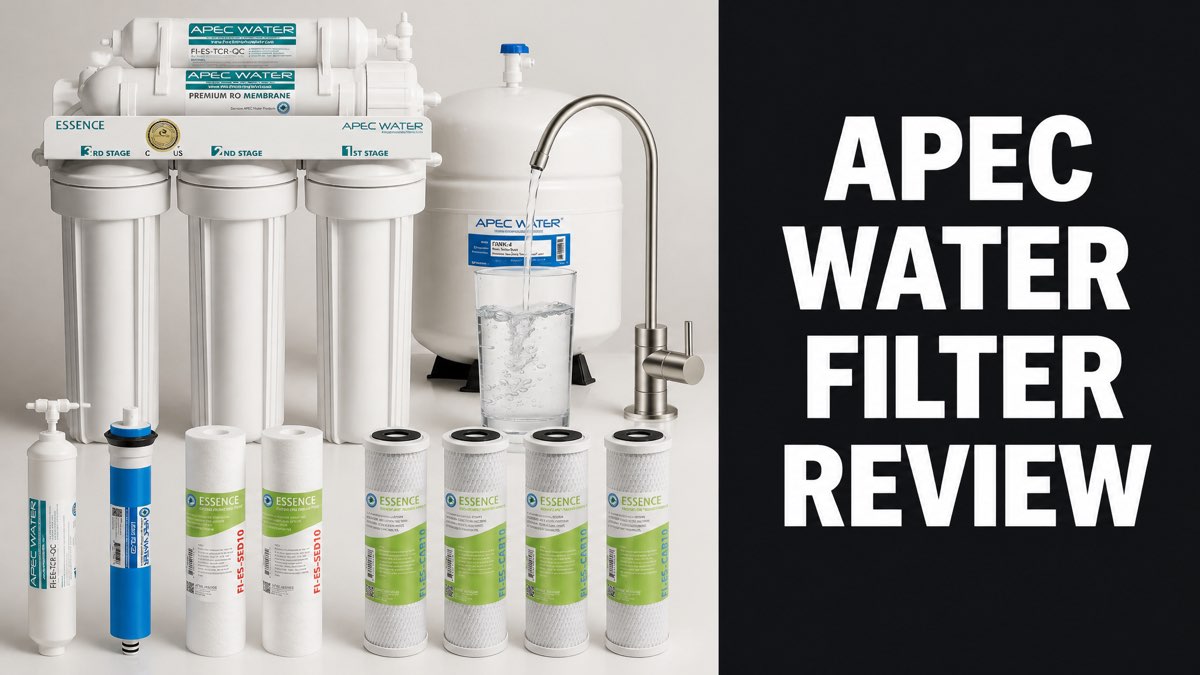
An APEC water filter is a home drinking-water system from APEC Water Systems, a California company known for under-sink reverse osmosis units. The range also covers a countertop RO dispenser, a three-stage filter, and whole-house systems built for everyday tap water. Most buyers shop the under-sink RO models.
Five-stage RO systems push tap water through sediment, carbon, and membrane filters before it reaches a dedicated faucet. Lab data shows strong removal of fluoride, lead, and chlorine, and WQA certification covers several models. Owners praise the taste and the support team, while wastewater and messy housing swaps draw the complaints. Certified models are easy to spot.
Prices run from $79.99 to $417.99, and installation takes about an hour for a handy owner. The sections below cover models, certification, comparisons, upkeep, and who should skip APEC, so the final verdict rests on facts instead of marketing. Each section sticks to measured results and published specs.
What Is an APEC Water Filter?
An APEC water filter is a home drinking-water system made by APEC Water Systems, a California company that designs its units in the USA. The line covers under-sink reverse osmosis, a countertop RO dispenser, a three-stage under-sink filter, and whole-house systems. Most buyers mean the under-sink RO models.
APEC sells through its own site, Amazon, Home Depot, and Lowe's. The model numbers match across retailers, so price and review comparisons stay simple. And lifetime technical support from US-based staff is part of the offer.
APEC reports 20 years of experience building filtration systems. The units use industry-standard parts and filter sizes. What does that mean in practice? Replacement filters are easy to find and affordable.
Which APEC Water Filter Models Are Most Popular?
Five APEC models appear most often in comparisons: the ROES-50, RO-90, ROES-PH75, ROES-100, and ROCT-PLUS. A sixth, the WFS-1000, covers buyers who want a simple filter without reverse osmosis.
The ROES-50 is the entry under-sink RO at 50 gallons per day (189 liters). A recent test ranked it fourth of nine under-sink systems with an 8.9 out of 10 score. Its listing price was $79.99 at the time.
The RO-90 lifts output to 90 gallons per day (340 liters). The ROES-PH75 adds a sixth remineralization stage at 75 gallons per day (284 liters). The ROES-100 pushes capacity to 100 gallons per day (379 liters).
The ROCT-PLUS is a countertop RO dispenser with four water temperatures, priced at $417.99. The WFS-1000 is a three-stage under-sink filter listed at $145. The WFS-1000 skips the storage tank and the wastewater of RO.
APEC Models at a Glance:
| Model | Type | Key Spec |
|---|---|---|
| ROES-50 | Under-sink RO | 50 GPD, $79.99 |
| RO-90 | Under-sink RO | 90 GPD |
| ROES-PH75 | Under-sink RO, 6 stages | 75 GPD |
| ROES-100 | Under-sink RO | 100 GPD |
| ROCT-PLUS | Countertop RO | $417.99, four temperatures |
| WFS-1000 | Under-sink filter | $145, three stages |
How Does an APEC Water Filter Work?
An APEC RO system pushes tap water through pre-filters and a semi-permeable membrane that blocks dissolved contaminants. The pre-filters shield the membrane from sediment and chlorine. Clean water then waits in a 4-gallon (15-liter) pressurized tank until the faucet opens.
The membrane rejects contaminants into a drain line. Flushing keeps the membrane from clogging. And that's the reason every RO system wastes some water.
What Are the Five Stages in an APEC RO System?
The standard APEC RO system runs water through five stages: a sediment filter, two carbon blocks, an RO membrane, and a coconut-shell carbon polish. Each stage has one job.
Stage one is a polypropylene sediment filter that catches dust, rust, and particles. Stages two and three are carbon blocks. They remove chlorine, odors, and VOCs. Together the first three stages protect the membrane.
Stage four is the thin-film composite membrane. The membrane does the heavy work against arsenic, lead, fluoride, and chromium. Stage five is a coconut-shell carbon filter. The last stage removes any leftover taste from the storage tank.
The Five Stages in Order:
- Sediment filter catches dust, rust, and particles.
- First carbon block removes chlorine, odors, and VOCs.
- Second carbon block removes more chlorine, odors, and VOCs.
- RO membrane blocks arsenic, lead, fluoride, and chromium.
- Coconut-shell carbon filter polishes leftover taste.
The ROES-PH75 adds a sixth stage of calcium carbonate that restores minerals and lifts pH. The RO-90 and the ROCT-PLUS have no remineralization stage. Does that matter for taste? Their output water simply has fewer minerals.
What Does an APEC Water Filter Remove?
An APEC RO system removes up to 99% of tap water contaminants by the maker's rating, from chlorine and lead to fluoride and nitrate. The official list runs past 50 items, from PFAS to pesticides and pharmaceuticals.
Independent lab data backs the broad claim. A ROCT-PLUS water test removed 100% of chlorine, copper, nitrate, uranium, and zinc. Total dissolved solids fell 78.99%, from 138 ppm to 29 ppm. That's a big drop, but not the biggest in the category, since many RO systems cut TDS by 95% or more.
ROCT-PLUS Lab Results:
| Contaminant | Result |
|---|---|
| Chlorine | 100% removed |
| Copper | 100% removed |
| Nitrate | 100% removed |
| Uranium | 100% removed |
| Zinc | 100% removed |
| Total dissolved solids | 78.99% lower (138 ppm to 29 ppm) |
Not every item on the list is proven. Claims such as PFAS reduction have no third-party listing behind them. Buyers who need one specific contaminant removed need to check the certification listing for their exact model.
Is an APEC Water Filter Certified?
Yes. Several APEC under-sink systems hold WQA certification to NSF/ANSI Standard 58. The RO-90 listing covers 12 contaminants, such as lead, TDS, and arsenic V.
The RO-90 also holds NSF/ANSI 372 for lead-free materials. NSF and IAPMO databases show no listing for it. WQA is the only certifier on record for the model.
The countertop ROCT-PLUS holds no performance or materials certification. Lab testers marked it down in two scoring categories for that gap. The filtering results were still strong, though.
Certified output can differ from rated output. The WQA-certified production rate for the RO-90 is 33.3 gallons per day (126 liters). The box rating is 90 gallons per day (340 liters). Why the gap? Rated output shifts with feed pressure and temperature.
Does an APEC Water Filter Remove Fluoride and Lead?
Yes. APEC RO systems cut fluoride and lead sharply in both lab data and certification listings. Fluoride and lead both sit on the RO-90's certified contaminant list.
A ROCT-PLUS lab test cut fluoride from 1.4 ppm to 0.2 ppm, an 85.71% drop. The tap sample started above the 0.799 ppm health guideline. The filtered sample finished well under it.
The non-RO WFS-1000 also removed 100% of chlorine, fluoride, copper, and lead in third-party testing. But sulfate removal reached only 39.13%, and iron removal only 46.03%. Those two numbers matter for well water.
What Do APEC Water Filter Reviews Say?
APEC systems earn strong ratings across retail pages and lab-style reviews. Retail ratings average about 4.7 out of 5 stars. The ROCT-PLUS scored 8.58 and the WFS-1000 scored 78 out of 100 in testing.
Praise centers on taste, support, and do-it-yourself setup. Testers called the WFS-1000 water neutral and crisp, like bottled water. And the color-coded tubing and detailed manuals earn steady credit.
What Do APEC Owners Like?
APEC owners praise water taste, simple installation, and responsive customer support. Support staff answer questions years after purchase. Documentation gets high marks.
Numbers back the taste claims. One home measured 380 ppm of dissolved solids in tap water. After the RO system, the same meter read 4 ppm. Was that a fluke? The free TDS meter in the kit made the check easy to repeat.
Running costs stay low. RO-90 replacement filters cost less than many competitors. Low filter prices keep the total cost of ownership down.
What Are the Common APEC Complaints?
Complaints center on wastewater, filter swaps, and refill speed. Wastewater and tank refill time come with any traditional RO system. Filter handling is more specific to APEC's housing design.
Common Complaints:
- Wastewater sent down the drain
- Slow tank refill after heavy use
- Messier housing-style filter swaps
- No filter-change indicator
- Rare cracks or leaks in plastic housings
Housing-style filters are messier to swap than modular cartridges. Water sits inside each housing. A C-spanner wrench and lightly greased threads make the job easier.
APEC filters carry no change indicator. So how do owners know when to swap? A TDS meter comparing inlet and outlet readings is the best check, and rising outlet readings signal a tired membrane.
Some long-term owners report plastic filter housings cracking or leaking after a couple of years. The reports are rare. A routine visual check catches problems early.
How Does APEC Compare to Other Brands?
APEC competes mainly with iSpring and Waterdrop in under-sink reverse osmosis. Model-for-model differences are small. Price, certification, and installation style separate the brands.
Comparison guides stress that the model matters more than the brand name. Each maker sells basic and feature-rich versions. Buyers get a better read by matching tier against tier.
APEC vs iSpring: Which Is Better?
Neither brand wins outright. The APEC ROES-PH75 and the iSpring RCC7AK match on stage count, membrane size, and remineralization. Both are six-stage, 75-gallon-per-day (284-liter) systems with a tank.
The iSpring lists at $241.99 with an NSF listing. The APEC lists at $268.99 with the WQA Gold Seal. The APEC costs $27 more, and the certifier differs.
iSpring RCC7AK vs APEC ROES-PH75:
| Feature | iSpring RCC7AK | APEC ROES-PH75 |
|---|---|---|
| Stages | 6 | 6 |
| Membrane | 75 GPD | 75 GPD |
| Remineralization | Yes | Yes |
| Certification | NSF listing | WQA Gold Seal |
| Listed price | $241.99 | $268.99 |
The iSpring first-stage filter is transparent, so sediment buildup is visible. APEC's sealed first stage hides its condition. Which design is more convenient? The transparent one, since timing the swap is easier.
NSF and WQA are separate organizations. Their labels are not interchangeable. Buyers who care about one contaminant need to read the listing for the exact model.
APEC vs Waterdrop: Which Is Better?
Waterdrop wins on convenience and APEC wins on price. The tankless Waterdrop X12 lists at $1,299, against $279.99 for the APEC ROES-PH75. The gap is more than four times.
The X12 delivers 1,200 gallons per day (4,542 liters) with a 2-year warranty and NSF/ANSI 58 and 372 certification. The ROES-PH75 delivers 75 gallons per day with a 1-year warranty. Output and warranty favor Waterdrop.
The Waterdrop is tankless and pre-assembled, so setup moves faster. APEC's tank design takes more room under the sink. Space-tight kitchens favor the Waterdrop.
How Hard Is APEC Water Filter Installation?
An APEC under-sink RO system installs in about one hour for an average DIYer. Color-coded tubing and quick-connect fittings speed the job. A detailed manual covers each step.
Five video guides walk through the setup. They cover unpacking, filter and membrane fitting, the feed water saddle, the RO faucet, and tubing connections. Watching them first prevents most mistakes.
The RO faucet needs a hole in the sink or countertop. The drilling requirement rules out most rentals. First-time installers in one test needed two to three hours, so budget an afternoon.
Feed water must stay inside published limits. What are those limits? Pressure runs 40 to 85 psi (2.8 to 5.9 bar), temperature runs 40 to 100 °F (4 to 38 °C), pH runs 2 to 11, and TDS tops out at 2,000 ppm.
How Often Do APEC Filters Need Replacing?
Stages one through three need replacing about every six months. The RO membrane and stage five last two to three years. Feed water quality moves those dates.
Filter Replacement Schedule:
| Part | Replace Every |
|---|---|
| Stages one to three | About 6 months |
| RO membrane | 2 to 3 years |
| Stage five | 2 to 3 years |
| WFS-1000 filters | 12 months |
| ROCT-PLUS filter | 1,100 gallons |
A TDS meter replaces guesswork. Readings from the tap and the RO faucet show filter health. A narrowing gap means a swap is due.
Other models run on different clocks. The WFS-1000 filters last 12 months at a low replacement cost. The ROCT-PLUS filter is rated for 1,100 gallons (4,164 liters). The annual cost works out to about $86.
The ROES-50 lists time-based schedules and no gallon capacity. Calendar dates ignore real usage. Heavy-use households need earlier changes.
How Much Does an APEC Water Filter Cost?
APEC prices run from $79.99 for the ROES-50 to $417.99 for the ROCT-PLUS. The WFS-1000 lists at $145. The ROES-PH75 sits near $269 to $280.
Operating costs are modest. The ROCT-PLUS runs about $86 per year, or $0.078 per gallon. What about the RO-90? Its filters cost less than many rivals.
APEC claims an RO system saves homeowners up to $1,029 a year over bottled water. The figure depends on how much bottled water a household buys. Heavy bottled-water buyers recover the cost fastest.
How Much Water Does an APEC System Waste?
The RO-90 wastes about 3 gallons of water for every 1 gallon it purifies. Three to one is an average rate for under-sink RO. The waste goes down the drain.
The ROCT-PLUS flips the ratio. The unit makes 3 gallons of purified water per 1 gallon wasted. Is that good? Only the AquaTru, at 4 to 1, tested better among countertop units.
APEC states the ROES-100 drains at a 1-to-1 ratio. A permeate pump cuts waste on the RO-90. The drain line can also feed a garden container.
Is an APEC Water Filter Worth It?
Yes. For most buyers, an APEC RO system delivers certified filtration, easy upkeep, and low running costs at a mid-range price.
The strengths are taste, support, cheap filters, and DIY installation. Lab and certification data back the core filtering claims. And owners report clean-tasting water.
The weak points are wastewater, messier housing swaps, and no remineralization on base models. The ROCT-PLUS also lacks certification. In plain English: rated output can overstate real output.
Pros:
- Certified filtration on several models
- Clean, crisp taste
- Low-cost filters
- About one hour DIY installation
- Lifetime technical support
Cons:
- Wastewater from the drain line
- Messier housing-style filter swaps
- No remineralization on base models
- ROCT-PLUS lacks certification
- Rated output can overstate real output
Who Should Skip an APEC Water Filter?
Renters, homes without a drain connection, and water outside APEC's feed limits need a different filter. Sinks that cannot take a drilled hole block the RO faucet.
Water of unknown or unsafe microbial quality needs disinfection first. Well water is more prone to the problem. The RO-90 has no UV stage.
Buyers who need certified PFAS reduction need a model with a listing. APEC's PFAS claim sits on the marketed-only list. So what settles it? The certification listing for the exact model.
Rivals at the same price now offer better efficiency and warranties longer than the RO-90's one year. Shoppers who prize those traits have alternatives. Checking current options before buying pays off.
Pop Kitchen is a reader-supported platform. Purchases made through our links may earn us an affiliate commission at no extra cost to you.