
Apex Water Filter Review: Is It Worth It?
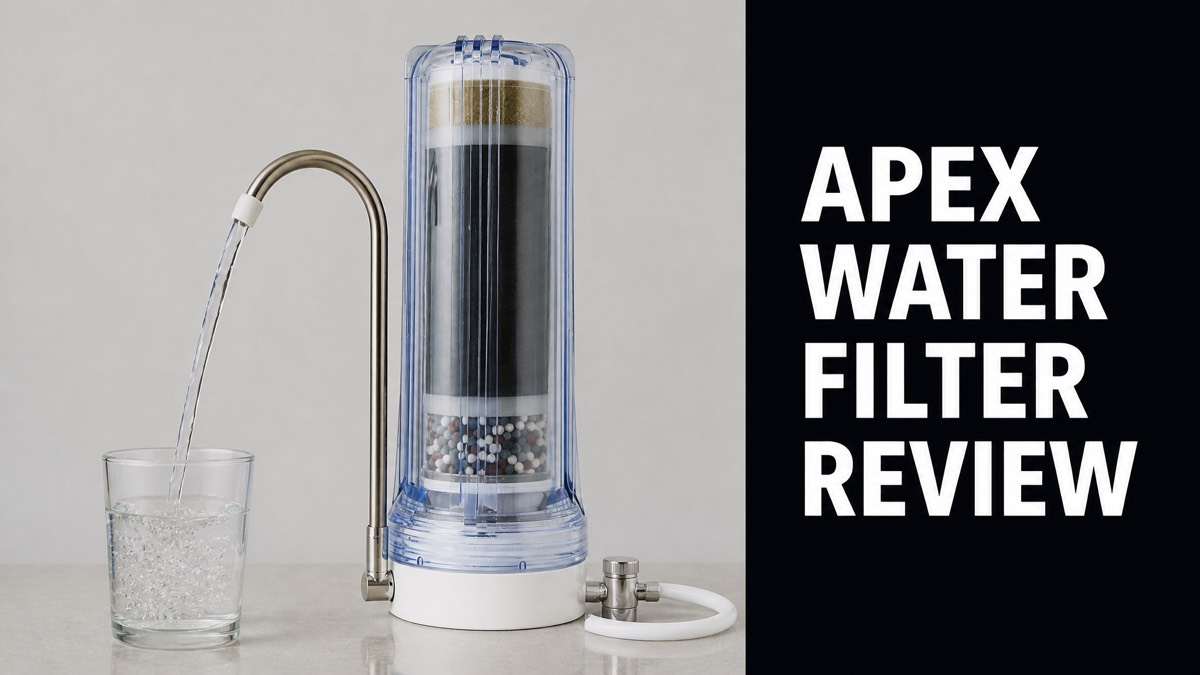
An Apex water filter is a home filtration system from Apex Water Filters Inc., a family-owned California manufacturer in business since 1997. The best-known model, the MR-1050 countertop filter, cleans municipal tap water through five stages and costs about $85. Apex also sells under-sink and whole-house systems.
The MR-1050 pushes tap water through five stages inside one cartridge. The stages run from coarse particle removal to mineral addition. Installation takes a few minutes, and no electricity is required. The filter improves chlorine taste and odor and trims heavy metals. A cartridge lasts four to eight months for an average family. Flow runs near 1 gallon per minute.
Independent proof is thinner than the marketing, and the unit lists no certification for chlorine, lead, or PFAS. The low price and simple setup still make a strong case for tight budgets. Read on to learn who should buy the MR-1050 and who should skip it. Well-water users and large households need other options.
What Is an Apex Water Filter?
An Apex water filter is a home filtration system sold by Apex Water Filters Inc., a California manufacturer. The brand sells systems under both the Apex and Apex Exprt labels. Formats range from countertop units to whole-house tanks.
The range targets tap water. Typical jobs include chlorine taste and odor reduction, sediment removal, and heavy metal reduction, lead included. So how do buyers choose? They pick a format by how much water the household drinks and how much installation the household accepts.
Here's the thing: one model gets most of the outside attention. The MR-1050 countertop filter has the widest coverage of any Apex product, so this review uses the MR-1050 as the main test case for the brand.
Who Makes Apex Water Filters?
Apex Water Filters Inc. is a family-owned company headquartered in Gardena, California. The company has operated since 1997. Apex manufactures and distributes filtration products for households of any size.
The company makes 99% of its products in-house. Why does that matter? In-house production gives Apex control over its parts, but the NSF/ANSI and California Proposition 65 claims are still manufacturer claims, so independent certification carries more weight.
Support runs through bilingual technical staff and after-sale service. For example, countertop and under-sink systems carry a 30-day guarantee and a one-year manufacturer's warranty, and selected tanks and valves carry a lifetime warranty.
Is Apex the Same as Apex Water Systems?
No. Apex Water Filters Inc. and Apex Water Systems are separate businesses with similar names. Apex Water Systems is a Southern California installer of whole-home and drinking water systems. Apex Water Filters ships filters and systems to customers across the country.
The price gap is large. Why? Apex Water Systems quotes $2,000 to $8,000 installed, and whole-home mixed-bed systems start around $3,495 while dual-tank systems start around $3,995. A countertop Apex filter costs a small fraction of those figures.
And a third name adds confusion. APEC Water Systems sells reverse osmosis units and shows up in the same search results, but APEC is a different brand with a different catalog. Check the logo and model number before ordering.
Which Apex Water Filter Models Are Available?
Apex sells five system categories: countertop, under-counter, residential reverse osmosis, whole-house, and commercial reverse osmosis. Shower filters and replacement cartridges fill out the store.
Countertop buyers choose among the single-filter MR-1050 and MR-1060 and the dual MR-2050. Under-counter buyers choose among the MR-2030, MR-2032, and MR-2034. The under-counter units use three stages, push-to-connect fittings, and waste no water.
Reverse osmosis models come in five-stage, six-stage pH+, and seven-stage UV versions. Whole-house models include the MR-3020, the MR-3030 with 20-inch cartridges, and the EZ-3200. The reverse osmosis line targets dissolved solids and soluble gases.
Apex System Types:
| Category | Example Models | Notes |
|---|---|---|
| Countertop | MR-1050, MR-1060, MR-2050 | Single or dual filter |
| Under-counter | MR-2030, MR-2032, MR-2034 | Three stages, no wasted water |
| Reverse osmosis | Five, six, and seven-stage versions | Targets dissolved solids and soluble gases |
| Whole-house | MR-3020, MR-3030, EZ-3200 | MR-3030 uses 20-inch cartridges |
What Is the Apex MR-1050 Countertop Filter?
The Apex MR-1050 is a five-stage countertop water filter that connects to a faucet through a diverter valve. The unit needs no electricity. A pull handle on the diverter switches between filtered and unfiltered water.
The housing measures 5.88 by 4.63 by 11.63 inches (14.9 by 11.8 by 29.5 centimeters). The small footprint suits apartments, offices, and RVs. Portability makes the unit easy to move between locations.
The MR-1050 targets municipal tap water. So what about well water? Well water falls outside the intended use, and well owners need a different system, such as reverse osmosis.
How Does the Apex MR-1050 Work?
The MR-1050 pushes tap water through five filter stages inside one replaceable RF-1050 cartridge. Water enters from the faucet diverter and passes each stage in order. Filtered water exits through the spout on the unit.
The diverter controls the mode. Here's why that's handy: open the faucet and pull the handle to filter, or leave the handle alone and unfiltered water runs for dishes and cleaning.
Tap pressure drives the flow. Does the unit need power? No. There's no pump, power cord, or tank, and electricity isn't required.
What Are the Five Filter Stages?
The five stages run from coarse particle removal to mineral addition. A 5-micron filter pad catches sand, dirt, and rust first. KDF 55 media follows to target bacteria and heavy metals such as lead, iron, and mercury.
Coconut shell carbon works third. What does it handle? The carbon stage reduces chlorine, pesticides, volatile organic compounds, and other chemicals, and chlorine reduction is the headline claim, at up to 99%.
The last two stages add back minerals and finish the taste. A mineral stage restores calcium, magnesium, and potassium. And a calcite stage improves taste and odor and raises pH, which makes the water more alkaline.
MR-1050 Filter Stages:
| Stage | Media | Job |
|---|---|---|
| 1 | 5-micron filter pad | Catches sand, dirt, and rust |
| 2 | KDF 55 | Targets bacteria and heavy metals |
| 3 | Coconut shell carbon | Reduces chlorine, pesticides, and VOCs |
| 4 | Mineral stage | Restores calcium, magnesium, and potassium |
| 5 | Calcite | Improves taste and odor and raises pH |
Is Installation Easy?
Yes. Installation takes a few minutes and uses only the parts in the box. Remove the faucet aerator. Attach the diverter with the adapter that fits. The filter is ready to use.
Installation Steps:
- Remove the faucet aerator.
- Attach the diverter with the adapter that fits.
- Pull the diverter handle to start filtered water.
The kit includes a housing wrench, four faucet adapters, a diverter valve, and an installation manual. The same wrench handles cartridge changes. Apex also publishes an installation manual online.
Standard faucets with a 55/64-inch thread fit directly. The four adapters cover other threads, and Apex support helps when none fit. The bad news? The housing sometimes resists opening during cartridge swaps.
Does an Apex Water Filter Actually Work?
Yes. The MR-1050 improves chlorine taste and odor and trims heavy metals. The company rates the carbon stage at up to 99% chlorine reduction. Clean taste held up over two years for at least one long-term owner.
Independent proof is thinner than the marketing. Why? Consumer Reports tested the MR-1050 in its countertop program, but the detailed scores sit behind a paywall, and the public spec sheet lists no certification for chlorine, lead, or PFAS.
Short answer: match the filter to the problem. Taste, odor, and chlorine complaints suit the MR-1050 well. Verified lead or PFAS concerns call for a filter that carries a certification for those contaminants.
Is the Apex MR-1050 NSF Certified?
No. The MR-1050 is not listed as certified to NSF standards for chlorine, lead, or PFAS reduction. Consumer Reports shows a 'No' for each of the three on its spec sheet.
The manufacturer says its parts comply with NSF/ANSI standards. Is that the same as a certified system? No. Component compliance and finished-system certification are different things, and only the second proves a filter hits its claimed reduction numbers.
To put it simply: shoppers with a specific contaminant concern should check the certification list before buying. Lead and PFAS are the two worth verifying, while taste-focused shoppers can weigh the missing certification less heavily.
What Do Owners Like and Dislike?
Owners of the MR-1050 mostly praise the taste, the easy setup, and the price. The Amazon rating averages 4.6 stars across hundreds of ratings. More than 90% of those ratings give four or five stars.
A related Walmart listing, the EXPRT MR-1060, shows 4 out of 5 stars from 4 ratings. But the sample is tiny, so the score carries little weight on its own.
The complaints are practical, not dramatic. To be clear, the housing can be stiff to open, and the cartridge lasts fewer gallons than some rivals, so replacements add a running cost.
Pros:
- Strong taste ratings
- Easy setup
- Low price
Cons:
- Stiff housing
- Shorter cartridge life than some rivals
- Running cost for replacements
How Long Do Apex Filter Cartridges Last?
An MR-1050 cartridge lasts about four to eight months for an average family. Estimates run from four to six months up to eight months. Household size and water quality decide the real figure.
Rated capacity varies by source. Consumer Reports lists 1,500 gallons (5,678 liters), while other reviews cite 750 gallons (2,839 liters). Plan around the lower number if the household drinks a lot of filtered water.
The unit has no filter-life indicator. So how do owners know when to swap? Owners track the change date themselves, and a total dissolved solids (TDS) reading helps predict the interval, because hard water and high sediment shorten cartridge life.
How Fast Does the MR-1050 Filter Water?
The MR-1050 filters at about 1 gallon per minute (3.8 liters per minute). That rate fills a glass in a few seconds. Large families rarely wait long for drinking or cooking water.
Flow stays near that rate until the cartridge clogs. In fact, Consumer Reports scores flow rate and clogging as separate criteria for countertop filters. Both matter for daily use, because a clogged cartridge slows every glass.
How Much Does an Apex Water Filter Cost?
Apex water filter prices start at about $85 for the MR-1050 countertop unit. The MR-1060 lists at $107 on Walmart. Under-counter, reverse osmosis, and whole-house systems cost more.
Consumer Reports estimates the yearly cost at $85.50. What does that mean for budgeting? The yearly figure sits close to the price of the unit itself, so plan for a cartridge swap every few months.
The monthly cost works out to about $7. And countertop filtering costs less than a steady bottled water habit, the usual alternative. The low running cost is the strongest part of the value case.
Where Can You Buy an Apex Water Filter?
Apex water filters sell on Amazon, Walmart, and the Apex website. Amazon carries the MR-1050, the RF-1050 and RF-1060 cartridges, and the larger systems. Walmart lists the EXPRT MR-1060.
Where to Buy:
- Amazon
- Walmart
- The Apex website
The Apex site advertises free shipping on countertop systems and countertop replacement filters. The site also lists a lifetime warranty on selected tanks and valves. Prices differ between retailers, so compare before ordering.
Buy genuine RF-series cartridges for replacements. Here's why: genuine cartridges fit the housing correctly, and they also protect the manufacturer warranty.
How Does the MR-1050 Compare With Other Countertop Filters?
The MR-1050 is the cheapest of five countertop filters that Consumer Reports lists side by side. The Apex costs $85. The four rivals cost $88 to $195.
Countertop Filter Prices:
| Filter | Price |
|---|---|
| Apex MR-1050 | $85 |
| Pelican PDF-450W-P | $88 |
| Home Master TMJRF2 Jr F2 Elite | $95 |
| Aquasana AQ-CWM2-B | $180 |
| Brita Hub 87340 | $195 |
The Apex spec sheet shows no certification for chlorine, lead, or PFAS and no filter-life indicator. What's the trade-off? Shoppers pay less and verify more themselves.
By comparison, Waterdrop shows what extra money buys. The WD-CTF-01 matches the five stages and adds a higher listed flow of 1.6 gallons per minute (6.1 liters per minute). Its filter lasts 8,000 gallons (30,283 liters).
Which Alternatives Fit Different Needs?
Different needs point to different alternatives. Buyers who want no installation fit the AquaTru countertop reverse osmosis system. The system uses a six-stage process and wastes little water.
Buyers who want the widest contaminant list fit the Big Berkey. The gravity-fed filter claims removal of more than 200 contaminants, and it needs no faucet connection.
Buyers who want longer cartridge life fit the Waterdrop WD-CTF-01. The Waterdrop adds remineralization, a stainless steel body, and an 8,000-gallon filter.
Is the Apex Water Filter Worth It?
Yes. The MR-1050 is worth buying for municipal tap water on a tight budget. The $85 price, five stages, simple faucet install, and mineral add-back deliver solid value. Missing certification keeps the verdict at 'yes, with limits'.
The pros are clear. The unit costs little, installs in minutes, needs no power, fits small spaces, and restores minerals. Taste earns high marks.
The cons are equally clear. No certification is listed for chlorine, lead, or PFAS, and the unit has no filter-life indicator, a shorter cartridge life than some rivals, and a municipal-water limit. Bottom line: a chlorine taste problem gets solved for $85, and a lead or PFAS worry needs a certified filter.
Who Should Skip It?
Three groups should look elsewhere: well-water users, shoppers who need certified lead or PFAS removal, and large households. The MR-1050 does not fit any of those cases well.
Apex points larger households toward its reverse osmosis line. In plain English, reverse osmosis adds removal of dissolved solids and soluble gases, and the countertop filter can't match that scope.
Shoppers who want professional whole-home installation should call an installer such as Apex Water Systems. That company serves Southern California only. Everyone else can use a countertop filter or a reverse osmosis system.
Pop Kitchen is a reader-supported platform. Purchases made through our links may earn us an affiliate commission at no extra cost to you.