
Aquaflo Water Filter Review: Is It Worth It?
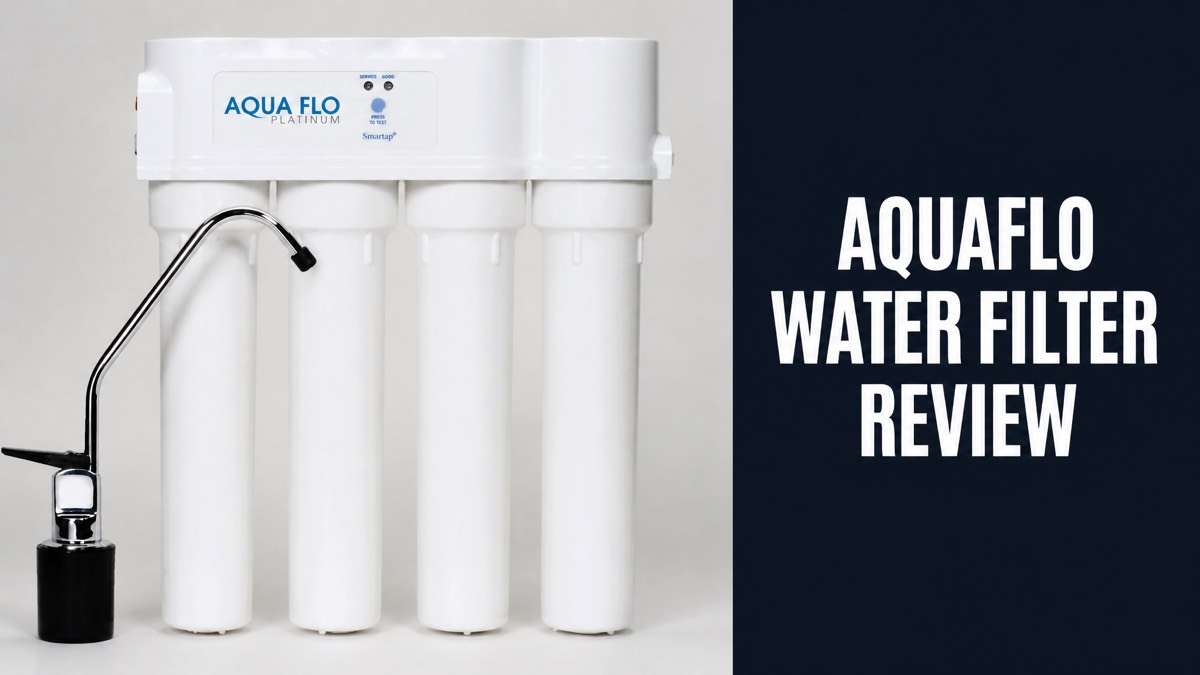
Aquaflo is a common search spelling for Aqua Flo, a line of under-sink drinking water systems built on reverse osmosis and ultrafiltration. The flagship Platinum QCRO pushes tap water through a sediment filter, a carbon block, a thin-film membrane and a carbon post-filter, then stores the result in a tank.
The system runs on quick-change cartridges and ten interchangeable filters. The QCRO carries an IAPMO R&T certification for lead and PFOA/PFOS reduction. Buyer ratings run very high at 4.9 out of 5, while independent testing stays thin. Hard water and untested well water need pretreatment first.
Ultrafiltration models skip the drain line and waste no water, while RO reduces more dissolved solids. The sections below cover how the system works, who needs to avoid it, what parts cost, and where to buy. A clear verdict and a pros and cons list close the review, so the answer to the worth-it question is easy to find.
What Is the Aqua Flo Water Filter?
The Aqua Flo water filter is a line of under-sink drinking water systems that use reverse osmosis or ultrafiltration. Each system runs on quick-change cartridges and mounts out of sight beneath the kitchen sink.
The flagship model is the Aqua Flo Platinum QCRO. The system sends water through four stages: a sediment pre-filter, a carbon block pre-filter, a thin-film composite membrane, and a carbon block post-filter.
To be clear, Aqua Flo sells several model families under similar names. The QCRO, Platinum 1240 and 475QC-4 are separate reverse osmosis (RO) families. The QCUF and 475QC-3 use ultrafiltration instead of RO.
Installation happens under the sink. The 475QC-4 kit includes a chrome faucet, a storage tank and the install hardware. Retailers call the job a relatively easy do-it-yourself project, and a handyman or plumber can handle it too.
What Is the Difference Between Aquaflo and Aqua Flo?
The manufacturer line is spelled Aqua Flo, as two words, with model names such as QCRO and 475QC. Search results for the one-word spelling mix the product line with other businesses.
Several Texas and North Carolina companies trade as Aquaflo. The pages describe services such as water tests, filter installation, softeners and annual maintenance.
A search for aquaflo water filter also surfaces a ReadyRefresh cartridge for the Tempest bottom-load dispenser. The cartridge replaces the internal cold-water contact parts every six months. The RO filter kits are a different product.
How Does the Aqua Flo QCRO System Work?
The QCRO system sends tap water through four filtration stages in a fixed order. Water crosses a sediment filter, a carbon block, the RO membrane, and a carbon post-filter before it reaches the faucet.
The membrane does the heavy lifting. Why does it matter so much? The thin-film composite membrane lists 95% total dissolved solids (TDS) reduction and 25% recovery. A 50 or 75 gallons-per-day (GPD) rating applies, with a 0.5 gallon-per-minute (1.9 liters) minimum flow at 60 psi (414 kPa).
A single manifold houses the four filter technologies in a space-saving design. An automatic shutoff valve stops the system when the reservoir tank is full. A powder-coated steel tank stores the finished water.
The quick-change design keeps service simple. Owners twist off the old cartridge and twist on the new one. No messy sump removal is needed.
What Does Each Filter Stage Do?
Stage one is a 5 micron polypropylene sediment filter that removes sediment and particles. The cartridge holds 2000 gallons (7,570 liters) and protects the later stages from clogging.
Stage two is a 5 micron carbon block. The block reduces chlorine taste and odor. Capacity matches the sediment filter at 2000 gallons, with a 0.5 gallon-per-minute minimum flow.
And stage three is the RO membrane. The 50 GPD membrane reduces dissolved substances and gets replaced about every 24 months. Part number 41407003 covers the replacement.
Stage four is a carbon block post-filter that polishes taste and odor. Optional granular activated carbon (GAC) and pH booster cartridges extend the lineup. The pH booster cartridge changes every 6 months.
Filter Stages at a Glance:
| Stage | Filter | Job | Capacity or Change |
|---|---|---|---|
| 1 | Sediment, 5 micron | Removes sediment and particles | 2000 gallons |
| 2 | Carbon block, 5 micron | Reduces chlorine taste and odor | 2000 gallons |
| 3 | RO membrane, 50 GPD | Reduces dissolved substances | About every 24 months |
| 4 | Carbon block post-filter | Polishes taste and odor | Carbon block cartridge |
What Are the Benefits of the Aqua Flo Water Filter?
The Aqua Flo water filter offers customizable treatment through ten interchangeable filters. Water conditions vary even within one community. The filter mix adjusts to local conditions.
Let me break that down: taste is the everyday payoff. The carbon stages reduce chlorine taste and odor. Specialty filters adjust drinking water flavor to the local supply.
A pH booster cartridge adds a remineralizing option. The cartridge raises pH and removes chlorine, taste and odor. Replacement comes every 6 months.
The hardware adds convenience. The reservoir tank is powder-coated steel in several sizes. Designer faucets come in multiple styles and colors.
Main Benefits:
- Ten interchangeable filters for local water conditions
- Reduced chlorine taste and odor
- Optional pH booster cartridge that remineralizes
- Powder-coated steel tank in several sizes
- Designer faucets in multiple styles and colors
Does the Aqua Flo Water Filter Reduce Lead and PFAS?
Yes. The Aqua Flo QCRO system carries an IAPMO R&T certification for reduction of PFOA/PFOS, lead and other harmful contaminants. The certification applies to the complete system.
The RO membrane supplies the dissolved solids reduction. The membrane specification lists 95% TDS reduction. The carbon stages handle chlorine taste and odor.
Certification covers the complete system, not a lone cartridge. Does a filter-only kit count? Filter-only kits without a membrane skip the membrane's reductions. Contaminants named on a certificate are not necessarily present in a given home's water.
Is the Aqua Flo Water Filter Easy to Maintain?
Yes. The twist-and-lock cartridge design makes filter changes a tool-free job. The 475QC-4 model even allows a change without shutting off the water.
The schedule is predictable. How often do the filters change? Stages one, two and four need replacement every 6 months. The membrane lasts 24 months, and some serve up to 36. Broader guidance gives 6 to 12 months for filters and 2 to 3 years for membranes.
Here's the cue: performance tells owners when a change is due. Reduced flow, a change in taste, or lower TDS performance signal a spent filter. Timely replacement protects membrane life.
What Do Aqua Flo Reviews Say?
Buyer ratings for Aqua Flo run very high at 4.9 out of 5. The figure covers 67 ratings of the Platinum QCRO replacement kit.
Independent testing is thin. Why does that matter? No complete-system lab test of the QCRO turned up. Major buying guides test other brands of RO systems.
Here is the kicker: the ratings describe the kit and the purchase more than the system. Most comments cover shipping, price and service. Long-term output of the complete system gets far less attention.
What Do Buyers Like?
Easy installation earns the most praise from buyers. The directions are clear, and the system works well after the filter swap.
And compatibility earns trust. The replacement kit is a direct replacement for the filters already installed. Matching parts remove guesswork at service time.
Long-term use backs the design. Some owners have run the system for several years. They say the water would be disgusting without it.
Price and shipping lead the praise. Review topics break down as 27% shipping speed, 24% filter quality, 18% service and 15% price. Fast delivery and a fair price appear again and again.
What Are the Common Complaints?
The loudest negative rating targets the COC-10 carbon cartridge for the 475 series. The cartridge holds 2 out of 5 stars across only 3 ratings, so the sample is small.
RO wastes water. How much? The membrane lists 25% recovery, so most of the feed water goes to the drain. The drain line also complicates installation in some homes.
The bad news? Naming confusion trips up buyers. The Aqua Flo and Platinum names cover several system families. A kit bought by name alone can miss the right fit.
How Does Aqua Flo Compare With Other Water Filters?
Aqua Flo competes with well-known RO systems. Rivals include the Cloud RO, the APEC ROES-PH75 and the Waterdrop G3 P800 tankless unit. The Cloud RO carries NSF 58 certification and built-in remineralization.
Efficiency separates the field. The Aqua Flo membrane lists 25% recovery. Who wastes less? The Cloud RO lists a 1:1 efficiency ratio, while the Waterdrop tankless unit lists a 3:1 ratio and an 800 GPD flow rate.
By comparison, Aqua Flo wins on serviceability. Quick-change twist cartridges, an interchangeable filter lineup and dealer service networks set the brand apart. The APEC ROES-PH75 costs $269 upfront and holds WQA certification for TDS reduction.
Aqua Flo vs Rival RO Systems:
| System | Type | Efficiency | Extras |
|---|---|---|---|
| Aqua Flo QCRO | Under-sink RO | 25% recovery | Quick-change cartridges |
| Cloud RO | Under-sink RO | 1:1 ratio | NSF 58, remineralization |
| APEC ROES-PH75 | Tank-based RO | Not listed | $269, WQA certified, remineralization |
| Waterdrop G3 P800 | Tankless RO | 3:1 ratio | 800 GPD flow rate |
Which Is Better, RO or Ultrafiltration?
The right pick depends on how much waste and dissolved solids matter. Ultrafiltration (UF) models such as the QCUF and 475QC-3 use no drain line and waste no water. The 475QC-3 needs no storage tank either.
UF costs less than RO and retains beneficial minerals. The 475QC-3 filters down to 0.2 microns and reduces chlorine, taste, odor, VOCs and sediment. The QCUF lists a 0.1 micron hollow fiber membrane.
But RO goes further on dissolved substances. The QCRO membrane lists 95% TDS reduction. Homes bothered by waste or drain installation pick UF, and homes that need dissolved solids reduced pick RO.
Who Should Avoid the Aqua Flo Water Filter?
Homes with hard water need pretreatment before an Aqua Flo system. The feed water guideline caps hardness at 7 grains per gallon (gpg), or about 120 mg/L.
Untreated sources raise a safety flag. The system must be installed on potable water. What about well water? Well or lake water needs a bacteria test first, and a UV purifier is the suggested add-on for microorganisms.
And renters face an install hurdle. The faucet needs a hole in the countertop or sink frame. Drilling makes the system a poor match for most rentals.
Waste-averse buyers face a trade-off. RO at 25% recovery sends most feed water to the drain. UF models waste nothing.
What Feed Water Limits Apply?
The feed water guideline sets firm limits on dissolved solids and metals. Maximum TDS is 2000 ppm. Iron stays under 0.2 ppm, manganese under 0.05 ppm and hydrogen sulfide at 0.0 ppm.
What's more, physical conditions carry limits too. Turbidity stays under 1.0 NTU and pH between 3.0 and 11.0. Pressure runs 40 to 100 psi (276 to 690 kPa), and temperature runs 40 to 100°F (4 to 38°C).
Pretreatment covers anything outside the range. Local dealers offer a free water analysis before selling a system. The results show whether pretreatment is needed.
Feed Water Limits:
| Condition | Limit |
|---|---|
| Total dissolved solids | 2000 ppm maximum |
| Hardness | Under 7 gpg |
| Iron | Under 0.2 ppm |
| Manganese | Under 0.05 ppm |
| Hydrogen sulfide | 0.0 ppm |
| Turbidity | Under 1.0 NTU |
| Water pressure | 40 to 100 psi |
| Temperature | 40 to 100°F |
| pH range | 3.0 to 11.0 |
How Much Does the Aqua Flo Water Filter Cost?
The 475QC-4 PRO lists at $515.43 and carries a street price of $319.00. The discount saves $196.43 against list price.
The Platinum QCRO carries no public price. So how do buyers get a number? Dealers quote after a water analysis. A plumber's installation adds labor cost.
For example, a budget RO rival sets the reference point. The APEC ROES-PH75 costs $269 upfront and includes built-in remineralization. The Aqua Flo 475QC-4 street price sits above that figure.
How Much Do Replacement Filters Cost?
Replacement parts range from $26.29 to $99.96 depending on the part and pack size. The Platinum 1240 kit costs $61.47, and the 475QC-3 kit starts at $58.98.
The reason is simple: the schedule sets the annual bill. Three filters change twice a year, and the membrane changes every second year. Owners budget for six filter cartridges annually plus a membrane every other year.
Compatible third-party parts exist. A replacement for the 41407003 membrane sells for $57.00. An equivalent 5 micron carbon block for the 41407002 sells for $26.29.
Replacement Part Prices:
| Part | Price |
|---|---|
| Platinum 1240 filter kit | $61.47 |
| 475QC-3 filter kit | From $58.98 |
| COC-10 carbon filter | $34.99 |
| Comparable 50 GPD membrane | $34.99 |
| GAC cartridge 65010089 | $29.99 |
| Carbon block 41407002, 4-pack | $99.96 |
Where to Buy the Aqua Flo Water Filter?
Authorized dealers and plumbers sell and install Aqua Flo systems locally. Manufacturer websites offer find-a-dealer tools for locating one nearby.
Online filter stores sell complete systems and replacement kits. Big marketplaces list kits too. Specialty filter shops list parts by model, which helps matching.
Dealers also test the water. Why bother? Many offer a free at-home water analysis before recommending a system. The results guide which of the ten filters go into the system.
How Do You Match the Right Replacement Kit?
The right kit matches the exact system model and part numbers. The Aqua Flo and Platinum names alone do not identify a system. So what does? The exact model and part numbers do.
The QCRO uses three part numbers. Number 41407001 is the 5 micron sediment filter. Number 41407002 is the carbon block used in stages two and four, and 41407003 is the 50 GPD membrane.
Two kit types cover the schedule. A three-filter kit handles the 6, 12 and 18 month changes. A complete kit with the membrane handles the 24 month change, and the cycle repeats.
Replacement Cycle:
- Install the three-filter kit at 6 months.
- Install the three-filter kit again at 12 months.
- Install the three-filter kit once more at 18 months.
- Install the complete kit with the membrane at 24 months, then repeat the cycle.
What Is the Final Verdict on the Aqua Flo Water Filter?
The Aqua Flo QCRO is a solid four-stage RO system for homes on potable water within its feed limits. Certification, simple cartridge swaps and a flexible filter lineup carry the case.
The honest caveat? One gap remains. No independent complete-system test turned up. Buyer ratings focus on replacement kits, so proof of long-term system output stays thin.
Bottom line: it's a good buy for a household on municipal water that wants quick-change maintenance. Homes with hard water, iron or untested well water need pretreatment first, and waste-averse households look at ultrafiltration.
What Are the Pros and Cons?
The strengths start with certification and easy service. IAPMO R&T certification, twist-and-lock cartridges, ten filter options, 95% TDS reduction and a broad dealer network all count.
The weaknesses are practical. A 25% recovery rate sends most feed water down the drain. Feed limits are strict, installation needs drilling, model families confuse, and no independent test exists.
Short answer: strengths outweigh weaknesses for compatible municipal water. The system earns a recommendation there. Homes outside the feed limits do better with pretreatment or an ultrafiltration model.
Pros:
- IAPMO R&T certification for PFOA/PFOS and lead
- Twist-and-lock cartridge changes
- Ten interchangeable filter options
- 95% TDS reduction
- Broad dealer network
Cons:
- 25% recovery sends most feed water to the drain
- Strict feed water limits
- Installation needs drilling
- Confusing model families
- No independent complete-system test
Pop Kitchen is a reader-supported platform. Purchases made through our links may earn us an affiliate commission at no extra cost to you.