
Aquagear Water Filter Pitcher Review: Is It Worth It?
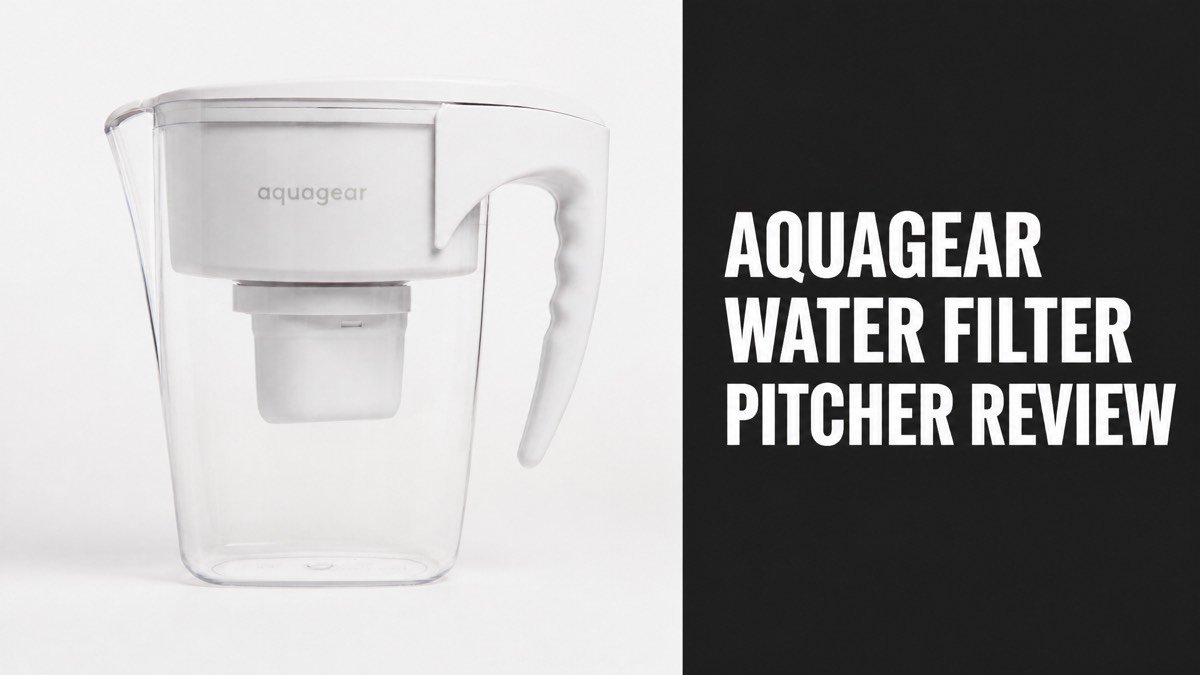
The Aquagear water filter pitcher is a 10-cup gravity pitcher with an activated carbon and ion exchange resin cartridge. The pitcher filters tap water at home with no plumbing or tools. Gravity pulls water through the cartridge into the lower chamber. Aquagear sells it for $69.95 with a lifetime warranty.
The pitcher fits a fridge shelf and filters 4 cups in under five minutes. Lab tests removed nine contaminants to below detection, and the water tasted better in 2025. The filter lasts 120 gallons or 6 months. Aquagear lists lead reduction of 99.35 to 99.41 percent but holds no NSF/ANSI certification for contaminant reduction.
Pouring is messy, no indicator tracks filter life, and hardness rose in lab tests. The upfront price also runs above average. Those trade-offs decide who the pitcher suits. Read on to see how the pitcher scored and what it costs to run. The final section names who is better off elsewhere.
What Is the Aquagear Water Filter Pitcher?
The Aquagear water filter pitcher is a gravity pour-through pitcher with a replaceable filter cartridge. Tap water goes into the upper reservoir. Filtered water collects in the lower chamber.
The pitcher needs no plumbing, no tools, and no permanent changes. So who benefits most? Renters and dorm residents are a natural fit. Households that cannot install an under-sink system get the same fill-and-filter routine.
Aquagear builds the pitcher for potable tap water and properly disinfected well water. Microbiologically unsafe water is off limits. Why? A standard pitcher does not disinfect, so boil-water advisories need another solution.
The pitcher is BPA-free and carries a lifetime warranty. Aquagear claims the filter media is made in the USA. The brand also runs a pre-paid recycling program and a one-to-one clean water program in Tanzania.
How Big Is the Aquagear Pitcher?
The Aquagear pitcher holds 10 cups (80 ounces, 2.4 liters) of filtered water. The upper reservoir takes 7 cups (1.7 liters) of tap water. Both chambers are large and well balanced.
The pitcher measures 5.5 by 10.5 by 11.25 inches (14 by 26.7 by 28.6 centimeters). The pitcher weighs 1 pound 12.44 ounces (0.8 kilograms) with a wet filter. The size fits a standard fridge shelf and the fridge door.
One refill fills a 40-ounce (1.2-liter) bottle. BOS Water estimates 4 to 5 refills a day for an average household. And fewer trips to the faucet follow, compared with smaller pitchers.
Key Specs:
| Spec | Value |
|---|---|
| Filtered water capacity | 10 cups (2.4 liters) |
| Upper reservoir | 7 cups (1.7 liters) |
| Dimensions | 5.5 x 10.5 x 11.25 in (14 x 26.7 x 28.6 cm) |
| Weight with wet filter | 1 lb 12.44 oz (0.8 kg) |
How Does the Aquagear Pitcher Filter Water?
The Aquagear pitcher filters water with a cartridge of activated carbon and ion exchange resin. Gravity pulls the water through the cartridge. In plain English, no pressure or electricity is involved.
Activated carbon removes bad tastes and odors. The carbon also targets chlorine, chloramine, disinfection byproducts, other organics, and certain metals.
Ion exchange resin targets dissolved, unwanted ions. The resin swaps those ions out of the water. Together, the two media cover organic contaminants and some inorganic ones.
What Contaminants Does Aquagear Target?
Aquagear targets PFOA, PFOS, chlorine, VOCs, HAA5, microplastics, lead, and other contaminants. The filter page names these directly. The brand adds that healthy minerals stay in the water.
Aquagear sends its filters to an ISO 17025 accredited third-party laboratory. Those tests produce the reduction rates on the performance data sheet.
The brand claims the filter removes 20 times more contaminants than a traditional pitcher. Marketing pages also use a figure of 2,000 percent more. To be clear, neither number is a certification.
Does Aquagear Keep Healthy Minerals in Water?
Yes. Aquagear keeps calcium and magnesium in the filtered water. The brand states that the pH stays the same as tap water or slightly higher. Reverse osmosis systems strip those minerals out.
Lab tests add a twist. Hardness rose 114 percent in BOS Water's 2024 test and 156 percent in 2025. Why does that happen? BOS Water attributes the rise to ion release from the resin, a pattern that can fade quickly.
Coffee brewers benefit from some minerals, since mineral-free soft water brews a flat cup. But the hardness rise makes the pitcher a weak choice for protecting a kettle or coffee maker from limescale.
Does the Aquagear Pitcher Actually Work?
Yes. The Aquagear pitcher performs well in recent lab tests, though not as well as the top pitchers. BOS Water scored its lab results 3.42 out of 5 in 2024 and 4.07 out of 5 in 2025.
The overall rating lands at 3.35 out of 5. Filtration scores 3.07, usability 3.50, and costs 4.03. Filtration carries 60 percent of the weight. Usability and costs carry 20 percent each.
The pitcher fully removed nine contaminants in testing. Which ones? Chlorine, chloroform, copper, and iron are on that list. Water from the pitcher also tasted better than tap water in 2025.
Still, the pitcher has limits. Standard pitchers do not disinfect water or remove dissolved minerals the way reverse osmosis does. Bottom line: anyone with microbial or hardness concerns needs a different tool.
How Did Aquagear Perform in Lab Tests?
Aquagear reduced nine contaminants to below the minimum detection level in BOS Water's tests. Chlorine, bromodichloromethane, bromoform, dibromochloromethane, and chloroform all hit zero. Copper, iron, manganese, and barium joined them.
Removed to below detection:
- Chlorine
- Bromodichloromethane
- Bromoform
- Dibromochloromethane
- Chloroform
- Copper, iron, manganese, and barium
Other results, though, were partial. In 2025, strontium dropped 50 percent, nitrate 20 percent, fluoride 10 percent, and boron 5 percent. Nitrate was fully removed in the 2024 round, so results vary by water supply.
BOS Water spiked its 2025 sample with chloroform at 1,670 parts per billion. Is that a realistic level? No. The level sits far above realistic tap water, where 100 parts per billion already counts as high. And the pitcher removed all of it.
The filtered water also gained trace zinc and titanium. Zinc reached 0.01 parts per million in 2024, about 500 times below the strictest guideline BOS Water found. Hardness rose in both rounds.
Does Aquagear Improve Taste and Odor?
Yes. Aquagear removes odor and improves taste. Filtered water was odor-free in both the 2024 and 2025 tests. Each round used a different pitcher, water supply, and lab.
Taste results differed between rounds. Did the taste improve? Partly. Some taste remained in 2024. In 2025, the taste was much improved compared with tap water, though not 100 percent perfect.
The good news? Filtering speed is reasonable. The pitcher filtered 4 cups (0.95 liters) in 3 minutes 45 seconds in 2024. The 2025 test clocked 4 minutes 46 seconds.
Is the Aquagear Pitcher NSF Certified?
No. The Aquagear pitcher holds no NSF/ANSI certification for contaminant reduction. A certification confirms a filter against a set standard. Aquagear relies on its own third-party test data instead.
Aquagear's test data is broad. The brand tested about 80 impurities to 100 percent of filter life. The tests used NSF/ANSI standards 42, 53, and 401 plus other non-NSF methods.
The coverage has limits. What is missing? BOS Water notes the tests focus on easier-to-remove organics and only a few heavy metals. Fewer metals appear in the data than organic compounds.
Buyers can check the exact filter model in certification directories before trusting any claim. Brand pages can lag behind product revisions. A listing that does not match the filter counts as unverified.
Does Aquagear Remove Lead and PFAS?
Yes. Aquagear's performance data sheet lists lead reduction of 99.35 to 99.41 percent. PFOA reduction reaches 96.20 percent and PFOS reduction 99.56 percent. The numbers come from third-party testing, not NSF certification.
Other listed rates include mercury at 93.33 to 95.00 percent and cadmium at 96.55 to 96.67 percent. Asbestos and volatile organic compounds reach 99.97 percent. Microplastics reach 99.99 percent.
Listed Reduction Rates:
| Contaminant | Reduction |
|---|---|
| Lead | 99.35-99.41% |
| PFOA | 96.20% |
| PFOS | 99.56% |
| Mercury | 93.33-95.00% |
| Cadmium | 96.55-96.67% |
| Asbestos and VOCs | 99.97% |
| Microplastics | 99.99% |
ConsumerLab tested Aquagear, Brita, Clearly Filtered, and ZeroWater pitchers for PFAS in 2024. The results showed big differences in how well each pitcher removes these forever chemicals.
What Are the Downsides of the Aquagear Pitcher?
The Aquagear pitcher has three main downsides: pouring flaws, no filter life indicator, and a slightly above-average price. The lid is hard to remove and align. The spout cover sticks.
The priming assembly is small. The assembly does not fit large faucets without force. No indicator warns when the filter needs replacing.
The upfront price runs slightly above the tested average. Customer complaints mention taste, slow filtering, clogging, and design flaws. BOS Water did not find slow filtering or clogging in its own tests.
Is the Aquagear Pitcher Hard to Pour?
Yes. The Aquagear pitcher is one of the least pleasant pitchers to pour. BOS Water scored its handling and pouring 0.45 out of 1.15. The lid sometimes pops off mid-pour.
The pour spout cover often sticks or pops out of place. What happens then? Water sprays in every direction. Users occasionally push the cover back into position by hand.
The lid is hard to remove and does not align easily with the pitcher. The plastic handle is comfortable, with finger indentations. The pitcher is also light, at 1 pound 12.44 ounces (0.8 kilograms).
Is the Aquagear Pitcher Hard to Set Up?
No. Aquagear setup scored 0.90 out of 1.00 in BOS Water's usability test. The manufacturer includes clear illustrated directions. A QR code links to a tutorial video.
Priming is the sticking point. Why? The flushing assembly did not fit a large faucet, so the tester pushed it against the faucet with force. BOS Water expects that force to be difficult for older users or users with limited mobility.
Setup takes four steps. First, hold the flushing assembly to the faucet and run cold water for 2 minutes at low pressure. Next, screw the cartridge onto the reservoir and place it in the carafe. Last, secure the lid.
Setup Steps:
- Hold the flushing assembly to the faucet and run cold water for 2 minutes at low pressure.
- Screw the filter cartridge onto the reservoir securely.
- Place the reservoir into the carafe.
- Secure the lid on top of the pitcher.
How Much Does the Aquagear Pitcher Cost?
The Aquagear pitcher costs $69.95, as of September 2025. Retail prices typically range from $50 to $75. Here's the thing: many basic pitchers cost less.
A replacement filter costs $49.95 on Amazon. More than 3,100 buyers rate it 4.5 out of 5 stars. Third-party filters marketed as compatible exist, and their reviews are mixed.
Yearly filter cost lands around $125 for average use. A filter subscription saves 20 percent. The estimate assumes 300 gallons (1,136 liters) of water a year.
How Long Does an Aquagear Filter Last?
An Aquagear filter lasts 120 gallons (454 liters) or 6 months, whichever comes first. Daily use by most families reaches that point in about six months. Aquagear says the life is three times longer than most competitor filters.
BOS Water estimates 2 to 3 filter changes a year at 300 gallons (1,136 liters) of annual water use. Heavy use shortens the schedule. Sediment in the water shortens it as well.
The subscription ships a new filter every 6 months by default. Aquagear recommends changing the filter at the six-month mark, even below 120 gallons. The pitcher has no change indicator. So who keeps track of replacement dates? The subscription schedule does the tracking.
How Does the Price Compare With Other Pitchers?
The Aquagear pitcher costs more upfront than the average tested pitcher. BOS Water priced it at $69.95 against a $58.53 average. The gap is about $11.
By comparison, yearly filter costs sit near the average. Aquagear runs about $125 a year against a $120.13 average. BOS Water scored its value 4.03 out of 5, where 4.00 equals average value.
The bad news? Better-ranked pitchers exist. Among 14 tested pitchers, Clearly Filtered took the top pick and Culligan the runner-up spot. Brita Everyday Elite won the budget pick. Aquagear did not make the top picks.
Aquagear vs. the Tested Average:
| Metric | Aquagear | Average |
|---|---|---|
| Upfront price | $69.95 | $58.53 |
| Yearly filter cost | $125 | $120.13 |
| Value score | 4.03/5 | 4.00/5 |
Is the Aquagear Pitcher Worth It?
Yes. The Aquagear pitcher is worth it for buyers who want better taste, lab-tested filtering, and a lifetime warranty. Better-rated pitchers exist for other priorities.
Short answer: the strengths are real. The 2025 lab results were solid, and a lifetime warranty backs the purchase.
Pros:
- Solid 2025 lab results
- Large 10-cup capacity
- Lifetime warranty
- Pre-paid filter recycling
The weaknesses are real too. No NSF/ANSI certification covers contaminant reduction, and pouring is messy. The overall rating is 3.35 out of 5.
Cons:
- No NSF/ANSI contaminant reduction certification
- Messy pouring
- No filter life indicator
- Above-average upfront price
Who Should Skip the Aquagear Pitcher?
Four types of buyers do better with a different product. Anyone with a microbial risk needs a disinfection method. Private wells, emergency storage water, and boil-water advisories fall in that group.
Buyers fighting hard water or limescale also pass. Pitchers do not reduce dissolved minerals the way reverse osmosis does. Hardness even rose in BOS Water's tests.
Buyers who want spill-free pouring or NSF-certified reduction claims look elsewhere. The lid and spout flaws are the top complaints. The missing NSF/ANSI certification leaves contaminant claims unverified by that standard.
Pop Kitchen is a reader-supported platform. Purchases made through our links may earn us an affiliate commission at no extra cost to you.