
Aquasana Rhino Whole House Water Filter System Review: Is It Worth It?
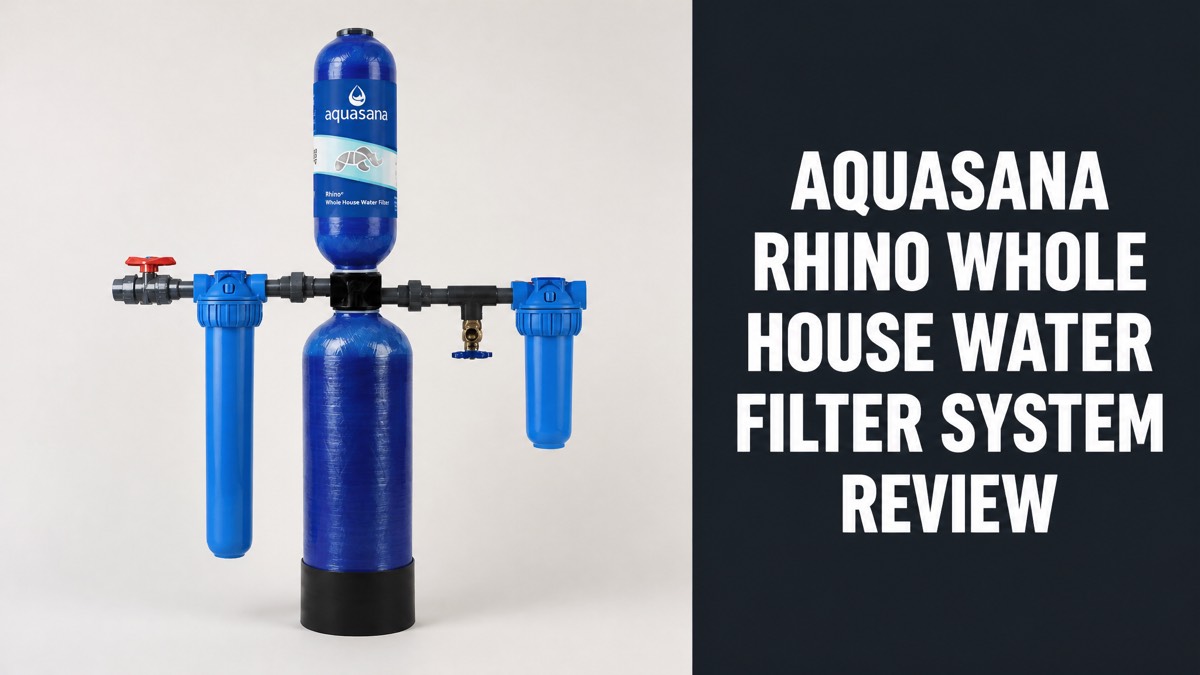
The Aquasana Rhino is a whole house water filter system that treats chlorine, taste, odor, and sediment at every tap. Aquasana rates its carbon and KDF media for 1,000,000 gallons (3.8 million liters) or 10 years. The standard model sells for about $999 on sale and suits city-water homes.
The Rhino uses two upflow tanks, a pre-filter, and a post-filter. Testing shows up to 97 percent chlorine reduction, but the standard model carries no certified claim for lead, PFAS, or fluoride. A DIY install shortens the warranty from ten years to one. The Rhino Max Flow serves homes with three or more bathrooms.
Ahead, you will see how the Rhino works, what it removes, and what owners like and dislike, and how to size it for your home. You will also see costs, comparisons with SpringWell and Pelican, and a clear verdict on who should buy it and who should skip it.
What Is the Aquasana Rhino Whole House Water Filter System?
The Aquasana Rhino is a point-of-entry carbon filtration system that treats every tap in a home. The system installs on the main water line and uses two tall tanks plus a pre-filter and a post-filter. Aquasana rates the main media for 1,000,000 gallons (3.8 million liters) or 10 years.
The system targets chlorine, taste, odor, and sediment in city water. Aquasana sells it for homes with up to 2.5 bathrooms and four or fewer residents. Larger households need the Rhino Max Flow, which covers up to six bathrooms and eight people.
The Rhino needs no electricity, drain line, or backflushing. So what does ownership involve? Swapping cartridges and, years later, the tank media.
Which Rhino Model Is the Standard One?
The standard model is the WH-1000, formerly sold as the EQ-1000. Many retailers and owners still use the older name. Aquasana rates the WH-1000 at 7 GPM (26 liters per minute).
The Rhino family includes several siblings. The Max Flow (WH-1010) raises the rated flow to 14 GPM (53 liters per minute). The Rhino Well Water with UV targets private wells, and the Rhino Chloramines targets cities that disinfect with chloramine.
How Does the Aquasana Rhino Work?
Water passes through a sediment pre-filter, climbs through the two-tank media stack, and exits through a post-filter. The pre-filter catches dirt, rust, and silt. The post-filter polishes any sediment and organic particles that remain.
Water Path:
- Water enters the sediment pre-filter.
- Water climbs through the two-tank media stack.
- Water exits through the post-filter.
The upflow design pushes water from the bottom of each tank to the top. Why does that matter? Contact time with the media grows longer, and Aquasana says clogging and media channeling stay away.
A redesigned divider valve keeps flow fast. Aquasana reports no noticeable change in water pressure. The unit tolerates up to 100 psi (6.9 bar) and water between 40 and 90°F (4 to 32°C).
What Is Inside the Rhino Tanks?
The bottom tank holds activated carbon that reduces chlorine. The top tank holds copper-zinc KDF media. KDF stands for kinetic degradation fluxion.
KDF triggers an electrochemical reaction between copper and zinc. What happens to the chlorine? The media turns it into harmless, water-soluble chloride. And the same media inhibits bacteria and algae growth, which extends the system's life.
The tanks are molded from food-grade HDTE material, and WQA certifies them to NSF/ANSI/CAN Standard 61. Each unit stands about 46 inches (117 cm) tall.
What Does the Aquasana Rhino Remove?
The Rhino reduces chlorine, sediment, and the taste and odor compounds that come with them. Aquasana tests chlorine reduction to NSF/ANSI Standard 42 at up to 97 percent. The figure holds for 1,000,000 gallons (3.8 million liters) or 10 years.
Aquasana's product page lists 78 contaminants, from THMs to pesticides and PFOA. Is every one tested? No. The only tested reduction claim on the standard Rhino is chlorine. Think of the long list as a ceiling, not a promise.
Water conditions change the picture. City water with chloramine needs the separate Rhino Chloramines model. Homes with iron need a specialized filter, and Aquasana points those buyers to its water experts.
Does the Rhino Remove Lead, PFAS, or Fluoride?
No. The standard Rhino carries no certified claim for lead, PFAS, or fluoride. The Rhino is a chlorine, taste, odor, and sediment system. Fluoride passes through carbon and KDF media.
Rhino Claim Status:
| Contaminant | Claim Status |
|---|---|
| Chlorine | Tested to NSF/ANSI 42, up to 97 percent |
| Lead | No certified claim |
| PFAS | No certified claim |
| Fluoride | No certified claim |
A certified drinking-water filter at the kitchen tap closes that gap. Aquasana's Claryum under-sink filters carry lead and PFOA/PFOS certifications. For fluoride, reverse osmosis is the only real fix.
Here's the thing: Aquasana's HealthShield is the whole-house line with certified PFAS and VOC reduction. The Max Flow UV bundle lists at $2,898. Buyers who want PFAS reduction in every shower should look there.
What Are the Benefits of the Aquasana Rhino?
The Rhino delivers chlorine-reduced water to every tap, shower, and appliance. Cooking with filtered water brings out stronger flavors. Showers lose the pool-like smell that chlorine adds.
Aquasana says chlorine in hot water evaporates into shower steam and enters the air. Why does that matter? Filtering the chlorine lowers that exposure. What's more, some owners notice softer-feeling skin and hair.
Aquasana states that chlorine can fade clothing and wear on pipes. Sediment filtering also protects appliances. Both effects add value beyond taste.
Does the Rhino Improve Taste and Smell?
Yes. The Rhino removes the chlorine taste and smell that most city water carries. Owners describe the kitchen tap smelling neutral and coffee tasting less like bleach.
Chlorine drives most of that taste. Here's why: the 97 percent reduction figure explains the change. Water that already tastes fine may show little difference.
What Do Owners Think of the Aquasana Rhino?
Owner feedback centers on cleaner-tasting water, sturdy tanks, and a ten-year media life. The sharpest complaints involve installation, warranty conditions, and fast-clogging pre-filters. Sizing mistakes explain most pressure complaints.
Aquasana's own page shows a 5 out of 5 customer rating. Treat that number with care, since the manufacturer hosts it. Quality Water Lab rates the Rhino 4.5 out of 5.
What Do Owners Like?
Owners praise the clean taste, the rugged tanks, and the long-life media. The tanks feel industrial-grade once mounted. Ten-year media means no annual rebed.
The pre-filter earns comments too. The cartridge traps rust and silt that owners never knew their pipes carried. And the Pro-Grade bypass kit makes filter swaps easier.
What Do Owners Complain About?
Complaints focus on installation difficulty, warranty strings, and recurring pre-filter changes. The Pro-Grade bypass kit leaves out PEX tubing. A DIY install cuts the warranty from ten years to one. Does that matter? The full ten years requires a licensed plumber's proof of installation.
The post-filter clogs fast in sediment-heavy water. The standard pre-filter needs swapping every two months. One well-water owner reported a sulfur smell returning after a year of use.
A Max Flow owner needed a $200 hardware store run for parts missing from the kit. Aquasana paid that cost back. Customer service earned praise for the gesture.
How Does the Aquasana Rhino Compare With SpringWell and Pelican?
The Rhino costs less up front than the SpringWell CF1 but demands more upkeep. Quality Water Lab lists the Rhino at $999 and the CF1 at $1,144. Does SpringWell win later? Its five-year estimate says yes, by about $255 ($1,344 versus $1,599).
SpringWell offers 9 GPM or more, with models reaching 20 GPM, plus a lifetime warranty. The Rhino rates 7 GPM and carries a 10-year warranty. SpringWell also handles chloramine better, while the Rhino leans toward chlorine.
The Pelican PC600 costs $828 and holds an IAPMO certification to NSF/ANSI 42 and 61. The unit rates 8 GPM with 600,000 gallons (2.3 million liters) or 5 years of media. The iSpring WGB32B costs $350 and flows 15 GPM but needs about $126 a year in cartridges.
Rhino vs Alternatives:
| System | Price | Flow | Key Detail |
|---|---|---|---|
| Aquasana Rhino | $999 | 7 GPM | 10-year warranty |
| SpringWell CF1 | $1,144 | 9 to 20 GPM | Lifetime warranty |
| Pelican PC600 | $828 | 8 GPM | 5 years of media |
| iSpring WGB32B | $350 | 15 GPM | $126 a year in cartridges |
Should You Choose the Rhino Max Flow Instead?
Yes. Homes with three or more bathrooms need the Max Flow's 14 GPM rating. The Max Flow uses the same 10-year, 1,000,000-gallon media. The standard Rhino's 7 GPM shows up as pressure drop when several fixtures run at once.
The Max Flow sold for $1,399 on the sale price checked in September 2026. The extra $400 buys headroom for up to six bathrooms and eight people. Smaller homes gain nothing from it.
How Safe and Certified Is the Aquasana Rhino?
The Rhino earns a partial certification score. WQA certifies the tank to NSF/ANSI/CAN Standard 61 for materials safety. Standard 61 covers no contaminant reduction.
The chlorine claim is independently tested to NSF/ANSI Standard 42, not certified. Why does that distinction matter? Tested and certified are different words. Careful buyers should read the Performance Data Sheet.
Aquasana backs the system with a 10-year limited warranty and a 90-day satisfaction guarantee. The warranty requires proof of installation by a licensed plumber. A self-install earns one year of coverage.
Is the Rhino Safe for Well Water?
No. The standard Rhino is built for treated city water. Well water can carry bacteria, iron, and sulfur that it does not treat. Aquasana recommends disinfecting any supply not protected by a municipal source.
The Rhino Well Water with UV adds an ultraviolet filter that sterilizes up to 99.8 percent of bacteria and nonpathogenic viruses. Its UV meets NSF/ANSI Standard 55 Class B. The kit uses a 500,000-gallon (1.9 million liter) tank and a 5-year warranty.
Nothing in that kit treats iron, manganese, or hardness. So, a water test comes first. A well that tests positive for coliform calls for a Class A UV unit instead.
How Much Does the Aquasana Rhino Cost?
The Rhino sells for about $999 at the usual sale price. List price reads $1,998. Does anyone pay it? Aquasana has run roughly 50 percent off for years, so treat the list price as a ceiling.
Add-ons raise the total. The listing shows $774 for the salt-free conditioner, $799 for UV, $124 for the Pro-Grade bypass kit, and $174 for the low-maintenance pre-filter. A fully loaded build passes $2,000 easily.
How Much Does Installation Cost?
Plumbers charge $200 to $500 for a straightforward Rhino install by one estimate. Hard layouts cost more. One Max Flow owner received three $2,500 quotes for a basement install.
Competent DIYers with PEX or solvent-weld experience finish in about an afternoon. But here's the catch: the warranty. A licensed plumber's proof of installation unlocks the full ten years.
Space adds cost too. The tanks need about 50 inches (127 cm) of height and 30 inches (76 cm) of floor space. The unit belongs close to where the main line enters the home.
How Much Do Replacement Filters Cost?
Filters cost roughly $120 to $150 a year. The sediment pre-filter changes about every two months on the standard housing. Why so often? The pre-filter catches the dirt, rust, and silt. The post-filter changes every six months.
The 10-inch pre-filter 3-pack and the post-filter each list near $37. Those two parts add up to about $148 a year at list prices. The low-maintenance 20-inch pre-filter stretches its interval to six months.
The main tank media lasts ten years. A UV lamp, if added, needs replacing every 12 months. The salt-free conditioner media lasts ten years too.
Replacement Schedule:
| Part | Replace Every |
|---|---|
| 10-inch pre-filter | 2 months |
| Post-filter | 6 months |
| Low-maintenance pre-filter | 6 months |
| UV lamp | 12 months |
| Tank media | 10 years |
Is the Aquasana Rhino Worth It?
Yes. The Rhino is worth it for a city-water home with moderate water use. The system delivers chlorine-reduced water from every tap for about $999 on sale. Plumber installation and about $148 a year in filters complete the bill.
The pros are clear. Water tastes and smells cleaner, the media lasts ten years, and no electricity is needed. The cons are just as clear. Warranty conditions, frequent pre-filter changes, and a modest 7 GPM rating limit the appeal.
Pros:
- Cleaner-tasting, better-smelling water
- Media rated for ten years
- No electricity needed
Cons:
- Full warranty requires plumber installation
- Frequent pre-filter changes
- Modest 7 GPM rating
Bottom line: the Rhino is a comfort and appliance-protection system, not a health-contaminant system. Pair it with a certified drinking-water filter if lead or PFAS worry you. With that pairing, the purchase holds up.
Who Should Skip the Rhino?
Three groups should look at other systems. Well-water homes need the UV version. Homes with three or more bathrooms need the Max Flow.
Chloramine cities need the Rhino Chloramines. Buyers who want fluoride or PFAS reduction need reverse osmosis or the HealthShield. And anyone who refuses to hire a plumber should factor in the one-year DIY warranty.
Pop Kitchen is a reader-supported platform. Purchases made through our links may earn us an affiliate commission at no extra cost to you.