
AquaTru Water Filter Review: Is It Worth It?
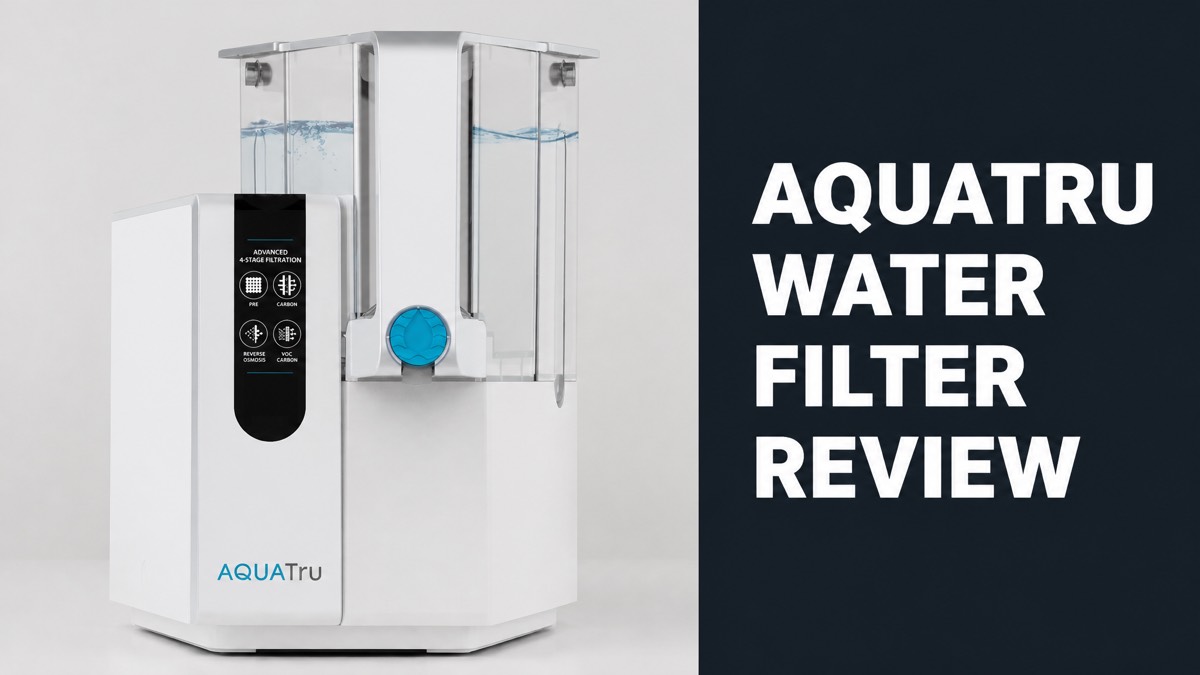
The AquaTru is a countertop reverse osmosis water purifier that runs on a standard outlet and needs no plumbing. The unit pushes tap water through four filtration stages and stores the result in a removable clean tank. Several versions exist, such as the Classic, Connect, and Carafe.
Lab testing scored the filtered water 96 out of 100, against 44 for raw tap water. The system reduces PFAS and fluoride and carries NSF/ANSI certification. Owners praise the clean taste but flag a dripping tap and app glitches. Wastewater runs about 0.6 gallons per gallon, and filters cost about $0.12 per gallon. A one-year warranty backs the unit.
Price, speed, and fit decide the final call. The Classic lists at $475, and a batch takes 10 to 15 minutes. Renters and small households gain the most, while large families fit other setups better. The sections below cover contaminant removal, costs, complaints, rival filters, and the verdict.
What Is the AquaTru Water Filter?
The AquaTru is a countertop reverse osmosis water purifier that needs no plumbing or installation. The unit plugs into a standard outlet and sits on the kitchen counter. Tap water goes into a feed tank, and purified water collects in a separate clean tank.
AquaTru suits renters and apartment dwellers who can't fit an under-sink system. Setup takes under 10 minutes. The filters arrive color-coded, and a QR code in the manual links to tutorial videos.
Before the first drink, the manufacturer recommends four full filtration cycles. Why bother? Each cycle flushes the new filters. And the water from those cycles gets discarded.
Which AquaTru Models Exist?
AquaTru sells six main versions that share one four-stage filtration system. The Classic and Connect hold 96 ounces (2.8 liters), and the Carafe holds 64 ounces (1.9 liters). An Under Sink model serves plumbed installs.
The Connect adds Wi-Fi and an app that tracks filter life and water use. To be clear, the Classic and Connect filter identically. Alkaline versions add a mineral filter that raises the water's pH.
AquaTru Models:
| Model | Reservoir | Wi-Fi | Alkaline |
|---|---|---|---|
| Classic | 96 oz | No | No |
| Connect | 96 oz | Yes | No |
| Classic Alkaline | 96 oz | No | Yes |
| Connect Alkaline | 96 oz | Yes | Yes |
| Carafe | 64 oz | No | No |
| Under Sink | NA | No | No |
How Does the AquaTru Filter Water?
The AquaTru pushes tap water through four filtration stages built around a reverse osmosis membrane. Three cartridges hold those stages. Filtering starts automatically once the full feed tank sits on the base.
The system processes the whole feed tank as one batch. A full cycle takes about 10 to 15 minutes. The wastewater stays in the feed tank and gets discarded before the next refill.
What Do the Four Stages Do?
Stages one and two protect the membrane and strip chlorine from the water. A mechanical pre-filter catches dirt and rust. A coconut-shell carbon filter removes chlorine, chloramines, and disinfection byproducts.
Stage three is the reverse osmosis membrane. Its pores measure about 0.0001 microns. So what gets through? Only water molecules pass freely. The membrane rejects lead, arsenic, uranium, and most dissolved minerals.
Stage four is a coconut-shell carbon block post-filter. The block polishes taste and removes lingering odors and volatile organic compounds. And an optional Mineral Boost filter can replace it and adds magnesium and calcium.
Filtration Stages:
- A mechanical pre-filter catches dirt and rust.
- A coconut-shell carbon filter removes chlorine and disinfection byproducts.
- The reverse osmosis membrane rejects metals and dissolved minerals.
- A carbon block post-filter polishes taste and odor.
Does the AquaTru Actually Remove Contaminants?
Yes. The AquaTru removes the contaminants that independent lab work measured. Third-party testing scored the filtered water 96 out of 100, against 44 for the unfiltered tap sample. How much of the problem disappeared? Five contaminants above health benchmarks dropped to zero.
Chloroform, total trihalomethanes, uranium, arsenic, and copper all fell below detection. A separate lab round cleared 13 impurities, such as chlorine, barium, nitrate, and iron. Total dissolved solids dropped 91 to 94%.
Trace strontium remained in one test year. Aluminum appeared at 0.05 ppm, which sits 12 times below the strictest health guideline found. In fact, results vary with local water, so a home water test gives the clearest picture.
Does It Remove PFAS and Fluoride?
Yes. The AquaTru reduces both PFAS and fluoride. The performance data sheet lists 97.5% or better reduction of PFOA and PFOS. Fluoride reduction reaches 93.5%, and AquaTru's own data claims over 99% for PFOA and PFOS.
The system carries IAPMO certification to NSF/ANSI standards 42, 53, 58, and 401. Those standards cover roughly 84 to 85 contaminants. Lead drops 99.1%, arsenic 98%, and microplastics 96.48%.
Reported Reduction Rates:
| Contaminant | Reduction |
|---|---|
| PFOA and PFOS | 97.5% or better |
| Lead | 99.1% |
| Arsenic V | 98% |
| Fluoride | 93.5% |
| Microplastics | 96.48% |
Carbon pitchers rarely touch fluoride. So what changes with RO? Reverse osmosis membranes handle fluoride well. In plain English: the AquaTru fills a gap that basic filters leave open.
What Do AquaTru Reviews Say?
AquaTru reviews land strongly positive on water quality and mixed on durability and support. The Classic ranks as a top countertop RO system in head-to-head testing. Overall scores reach 4.77 out of 5 for the Classic and 4.85 for the Classic Smart.
The good news? Praise centers on clean taste, easy setup, and low filter costs. The bad news? Complaints center on dripping taps, app glitches, and units that fail after months or years. The next two sections break down each side.
What Do Owners Like Most?
Owners praise the clean taste and the simple daily routine. The filtered water has no odor, no metallic edge, and no chlorine note. Coffee and tea brew lighter and cleaner with it.
Setup needs no tools, and filter cartridges twist in and out. Front-panel lights flag each filter change. The clean tank lifts out by a handle and fits on a standard refrigerator shelf.
And cost earns praise too. Replacement filters run about $0.12 per gallon (3.8 liters). The figure sits well below the countertop RO average.
What Are the Common Complaints?
The most repeated complaints involve leaks, failures, and customer service. The tap can drip for several seconds after release. What's the fix? A gentle rock reseals the tap. Some units stop working after months or years.
The Smart version draws app complaints. Reports include connection problems, crashes, and filter-life resets that fail. Numeric TDS readings are missing, since the app shows only Low, Medium, High, or Very High.
Design splits opinion as well. The unit looks bulky and utilitarian, and the feed tank lid hinges look like the weak spot. The warranty covers only one year.
Common Complaints:
- Tap drips after use
- Units fail after months or years
- Smart app connection problems
- Bulky utilitarian design
- One-year warranty
How Does the AquaTru Compare to Other Filters?
The AquaTru outperforms pitcher filters on contaminant removal and costs more upfront. A lab comparison scored it 96 out of 100, ahead of Waterdrop at 93, Brita at 82, PUR at 76, and ZeroWater at 71. ZeroWater removed only 40.6% of chloroform. Why does that matter? Chloroform is one of the disinfection byproducts the AquaTru cleared below detection.
Speed favors the AquaTru too. The unit filters 1.18 cups per minute, against 1.05 for Brita and 0.80 for ZeroWater and PUR. Filters cost $0.12 per gallon, while Brita and PUR run $0.20 and ZeroWater runs $0.44.
Lab Score and Filter Cost:
| Filter | Lab score | Cost per gallon |
|---|---|---|
| AquaTru | 96 | $0.12 |
| Waterdrop | 93 | $0.05 |
| Brita | 82 | $0.20 |
| PUR | 76 | $0.20 |
| ZeroWater | 71 | $0.44 |
How Does It Compare to Under-Sink RO and Berkey?
Under-sink RO systems offer continuous flow and similar filtration but need installation. Homeowners who can drill for a dedicated faucet get faster output. Long-term cost runs similar or lower, while the AquaTru wins on convenience.
Berkey is a gravity-fed system that needs no electricity. The Berkey handles chlorine, heavy metals, and bacteria. But fluoride and dissolved solids pass through more easily than with RO.
How Much Water Does the AquaTru Waste?
The AquaTru wastes about 0.6 gallons (2.3 liters) per gallon of purified water. A lab test pushed 128 ounces through the unit. The run yielded 74 ounces of purified water, 48 ounces of wastewater, and 6 ounces of loss.
The ratio matches the average for countertop RO systems. Some RO designs run far worse. How bad? The worst send up to 10 gallons to the drain per gallon purified. The reject water can go to plants or cleaning.
How Fast Does the AquaTru Filter?
A full feed tank filters in about 10 to 15 minutes. The 1.09-gallon (4.1-liter) feed tank yields roughly 12 cups. A timed test measured 1.18 cups per minute.
Capacity limits larger households. The clean tank holds 0.75 gallons (2.8 liters), so a family of four or more refills often. The unit works in batches. Can it feed an ice maker? No.
Dispensing runs quick once water is ready. One cup pours in 3 seconds, and four cups pour in 14.5 seconds. The low spout (6.5 inches or 16.5 cm) needs the unit near the counter edge for tall glasses.
How Much Does the AquaTru Cost?
The AquaTru Classic lists at $475, and the Classic Smart lists at $525 as of mid-July 2026. Both sit above the $317 average for countertop RO systems. By comparison, the Carafe costs less upfront.
Filters add an estimated $75 per year, well below the $145.66 average for countertop RO systems. The pre-filter lasts 6 months, the carbon post-filter 12 months, and the membrane 2 years. Rated capacity is 600 to 1,200 gallons (2,271 to 4,542 liters).
Filter Replacement Schedule:
| Filter | Replace every | Rated capacity |
|---|---|---|
| Stages 1 and 2 composite | 6 months | 600 gallons |
| Stage 3 membrane | 2 years | 1,200 gallons |
| Stage 4 carbon block | 12 months | 600 gallons |
The warranty covers one year of parts and labor. Is that enough? Not for an appliance at this price. Five-year ownership lands in the low four figures with filters included.
Is the AquaTru Cheaper Than Bottled Water?
Yes. The AquaTru costs about $0.12 per gallon in filters, versus $1.07 per gallon for bottled water. Water delivery runs $1.40 to $4.00 per gallon. At that gap, the unit pays for itself within about a year.
But pitcher filters cost less upfront. Brita cartridges run $0.20 per gallon, and Waterdrop runs $0.05. The extra AquaTru spend buys far broader contaminant removal.
Who Is the AquaTru Best For?
The AquaTru suits renters, apartment dwellers, and households upgrading from a pitcher. Nothing attaches to the plumbing, so no landlord permission or plumber is needed. Areas with known PFAS contamination benefit from the certified reduction.
Households of one or two people get enough water from one or two refills a day. Coffee and tea drinkers notice the cleaner flavor. Buyers building a low-toxin kitchen often treat clean drinking water as the next step.
Who Should Skip the AquaTru?
Homeowners who can install under-sink RO get better flow and similar long-term cost from a plumbed system. Families of five or more face constant refills with a batch unit. Budget buyers who only need chlorine removal can use a pitcher at a fraction of the price.
Anyone expecting whole-home treatment needs a different product. Here's why: the AquaTru handles drinking and cooking water only. Shower and laundry water need separate filters or a whole-house system.
Is the AquaTru Worth It?
Yes. The AquaTru is worth buying for households that want certified, lab-proven filtration without plumbing. Filtration earns top scores, filter costs run below average, and setup takes minutes. Where does it fall short? The weak points are a dripping tap, a short warranty, and batch-only output.
Short answer: for renters and small households, the verdict is a clear yes. Large families and homeowners who can plumb an under-sink system fit a different setup better.
What Are the Pros and Cons?
The AquaTru's pros outweigh its cons for the right household. Filtration, taste, setup, and filter cost lead the strengths. Upfront price, a 168-square-inch (1,084 square cm) footprint, and batch production lead the weaknesses.
Pros:
- Lab-proven contaminant removal
- Clean, odor-free taste
- Tool-free setup
- Low filter cost per gallon
Cons:
- High upfront price
- Large counter footprint
- Batch-only production
- Dripping tap and short warranty
Here is the kicker: reliability remains the open question. Some owners report failures and leaks. Controlled testing found only a dripping tap and one unit that needed drying after water reached the sensor.
Pop Kitchen is a reader-supported platform. Purchases made through our links may earn us an affiliate commission at no extra cost to you.