
Aro Water Filter Review: Is It Worth It?
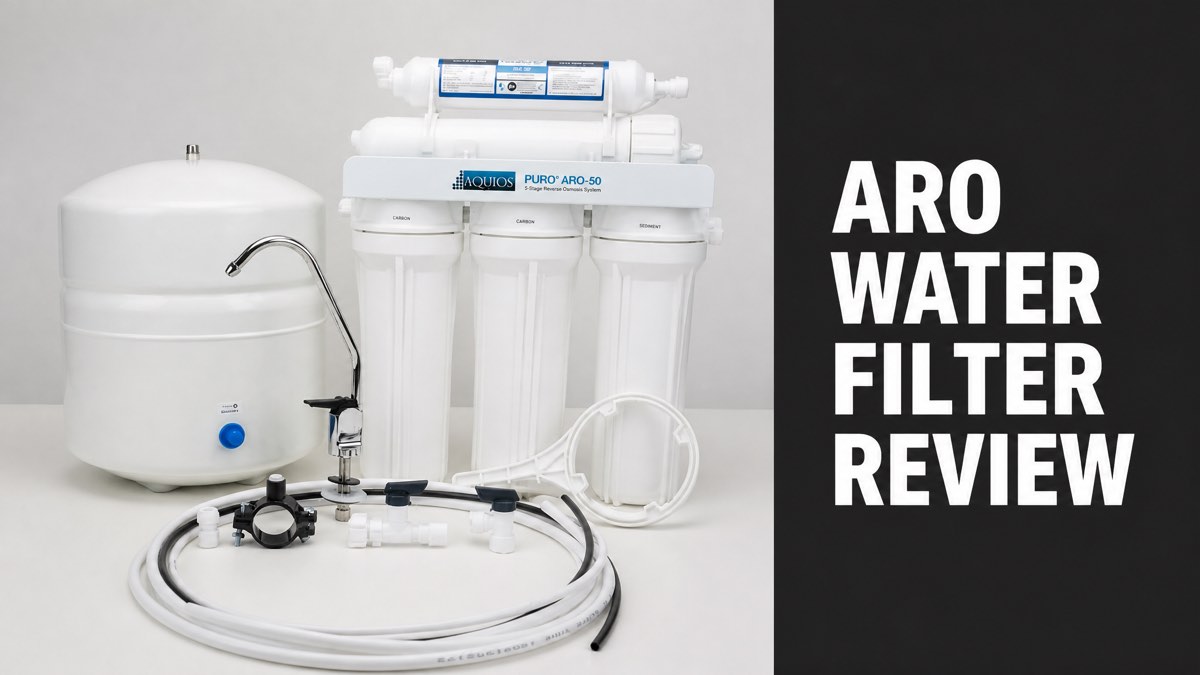
The Aro water filter is the Aquios PURO ARO-50, a five-stage undercounter reverse osmosis system for drinking and cooking water. Aquios sells it fully assembled with a 4.5 gallon (17 liter) tank and a chrome faucet. The system targets homes on city or well water.
The membrane is rated at 50 gallons (189 liters) per day. Five stages handle sediment, chlorine taste, and dissolved solids. Reverse osmosis wastes water, and the ARO-50 listing gives no wastewater ratio. The price is $216.30, and replacement filters cost little.
Customer ratings and lab results for this model are scarce, so the spec sheet carries most of the evidence. The review weighs price, upkeep, installation, and safety claims against better-documented systems. Read on to see who benefits from the ARO-50 and who needs something else.
What Is the Aro Water Filter?
The Aro water filter is the Aquios PURO ARO-50, an undercounter reverse osmosis drinking water system. Aquios sells the unit fully assembled with an installation kit. The brand targets homes on private well water or chlorinated city water.
The part number ARO-50 gives the product its short name. The 50 marks the membrane rating of 50 gallons (189 liters) per day.
A reverse osmosis system treats drinking and cooking water at one dedicated faucet. The ARO-50 ships with a chrome RO faucet, a tank, tubing, and fittings. Buyers receive the parts needed for a do-it-yourself install.
Who Makes the Aro Water Filter?
Aquios makes the Aro water filter and sells it through its own online store. The ARO-50 carries the PURO name, which Aquios uses for its residential reverse osmosis line. The same brand also sells salt-free water softeners.
Aquios also lists ARO200 and ARO300 whole house reverse osmosis systems. Those larger units rate at 200 and 300 gallons per day. The ARO-50 is the small kitchen model of that family.
Aquios sells replacement cartridges labeled ARO-50Q at its own store, so refills do not depend on a third party. Sediment, carbon block, post-polishing carbon, and membrane parts each have a separate listing.
How Does the Aro Water Filter Work?
The Aro water filter pushes tap water through a semi-permeable membrane using household water pressure. Contaminants stay behind the membrane and flow to the drain with a small stream of wastewater. Clean water collects in a storage tank until the faucet opens.
Here's why the membrane matters: its pores measure 0.0001 micron. How small is that? Far smaller than bacteria. Dissolved salts and minerals also stay out of the clean water.
The Automatic Shut Off valve stops production once the tank fills. Why does that matter? The ARO-50 stops sending water to the drain when no one is drinking. Production resumes after the tank drains. The parts list includes no pump.
What Are the Five Filtration Stages?
The ARO-50 runs water through five listed stages before the water reaches the faucet. A 5 micron sediment filter comes first. Two split sediment and carbon block pre-filters follow. The thin film composite membrane sits fourth, and a granular activated carbon filter finishes the process.
Filtration Stages:
- A 5 micron sediment filter catches particles first.
- The first split sediment and carbon block pre-filter follows.
- The second split sediment and carbon block pre-filter follows.
- The thin film composite membrane rejects dissolved contaminants.
- A granular activated carbon filter polishes the water.
The sediment stages catch particles such as sand and rust before the water reaches the membrane. The carbon stage reduces chlorine taste and odor.
The final granular activated carbon filter polishes the water after the membrane. The final stage cleans up taste before the water reaches the glass.
What Features Does the Aro Water Filter Have?
The Aro water filter combines a 50 gallon per day membrane, a 4.5 gallon (17 liter) tank, and a chrome faucet in one kit. Quick disconnect fittings handle most connections. Buyers need no special plumbing skills to assemble the unit.
Key Features:
- 50 gallon per day membrane
- 4.5 gallon (17 liter) storage tank
- Automatic Shut Off valve
- ShokBlok system protection valve
- Chrome RO faucet
- Quick disconnect fittings
A ShokBlok system protection valve guards the unit. Water hammer and pressure spikes hit supply lines. What protects the unit? The valve absorbs them, and Aquios lists the feature as protection for the whole system.
The kit adds color-coded tubing, a drain saddle, a feed water adapter, a tank shut-off valve, and a spanner wrench. Every part comes in the box. Buyers do not need to source fittings separately.
How Big Is the Aro Water Filter?
The filter assembly measures 18 by 16 by 6 inches (46 by 41 by 15 centimeters). An integrated mounting bracket holds the unit on the cabinet wall. The assembly is wide but shallow.
The storage tank measures 16 inches by 11.5 inches (41 by 29 centimeters). The tank sits apart from the filters and connects with tubing. Cabinet owners must measure both parts, because pipes and bins already use that space.
Does the Aro Water Filter Actually Work?
Yes. The ARO-50 uses the membrane design behind reverse osmosis' reputation for thorough filtration. Membrane systems reduce dissolved solids, metals, and many chemicals. The listing publishes no lab results for this exact model.
Aquios names the water sources the system suits. Private well water and chlorinated city water both appear in the product description. The listing does not claim to make unsafe water safe to drink.
Taste improves in most RO setups because the carbon stages cut chlorine taste and odor. Reduced dissolved minerals add to the effect. Results still depend on the home's source water.
How Fast Does the Aro Water Filter Make Water?
The membrane produces up to 50 gallons (189 liters) per day under rated conditions. The rate works out to about one gallon every 30 minutes. The storage tank covers the gap between production and demand.
The faucet draws from the tank, not the membrane. Pressurized tanks reserve room for air, so a typical 5 gallon tank stores about 3 gallons (11 liters) of water. The 4.5 gallon tank follows the same design, so usable water falls below the label.
What Do Aro Water Filter Reviews Say?
Customer feedback on the Aro water filter barely exists online. The Aquios product page carries no customer ratings, and no independent lab test of the ARO-50 appears in search results. Claims of proven long-term performance go beyond the evidence.
To be clear, that gap matters for a purchase. A system with thousands of ratings reveals leaks, noisy faucets, and slow tanks. Does the ARO-50 offer that evidence? Not yet. So a buyer relies on the spec sheet and the general record of reverse osmosis.
Aquios products with ratings sit in a different category. The RCFS220 salt-free softener cartridge shows a 98 percent rating across 9 reviews. The score says nothing about reverse osmosis performance.
What Are the Drawbacks of Reverse Osmosis?
Reverse osmosis systems waste water while they make water. Traditional units send 3 to 5 gallons (11 to 19 liters) to the drain for every gallon filtered. Does every RO system waste that much? No. Newer designs cut the waste to 1 or 2 gallons per gallon filtered.
Reverse osmosis also removes minerals along with contaminants. The membrane rejects minerals and salts that regular filters leave in the water.
Main Drawbacks:
- Wastewater sent to the drain
- Minerals removed with contaminants
- Regular filter and membrane changes
- No wastewater ratio listed for the ARO-50
The bad news? Maintenance adds work. The sediment filter lasts about 6 months, carbon filters last 9 to 12 months, and the membrane lasts about 2 years. The ARO-50 listing gives no wastewater ratio, so buyers cannot check its efficiency against newer designs.
Is the Aro Water Filter Safe?
Yes. The ARO-50 ships with NSF approved components and a standard reverse osmosis layout. Aquios states the component approval on the product page. The listing does not state a certification for the finished system.
The system poses no unusual risk when installed correctly. Leaks and loose fittings are the practical hazard. Quick disconnect fittings and the ShokBlok valve address both.
Safety also depends on the source water. A household RO system is not a complete treatment plan for water that is unsafe because of microorganisms. A TDS reading likewise does not prove that water is safe.
Is the Aro Water Filter NSF Certified?
No. Aquios lists NSF approved components but makes no Standard 58 claim for the finished system. In plain English, the two statements differ. Component approval covers parts, while certification covers the whole system.
Standard 58 is the certification protocol for reverse osmosis drinking water systems. Wirecutter requires NSF/ANSI certification for every filter it recommends, and its top reverse osmosis pick, the Cloud RO, holds Standard 58.
Buyers who want certainty can ask Aquios for a test report on the complete ARO-50. A document that names Standard 58 closes the gap. What backs the safety claim today? Only the component approval.
How Much Does the Aro Water Filter Cost?
The Aro water filter sells for $216.30 at the Aquios store, down from a list price of $309.00. Is that cheap? The sale price sits at the low end of the typical $200 to $600 range for an undercounter or countertop RO system. Prices were checked in November 2026.
Installation adds to the first-year bill. A plumber charges up to $100 or more for an under-sink RO install. A confident DIY owner skips that fee.
The listing shows a one-time purchase with no subscription. Bottled water buyers weigh that price against years of recurring purchases.
How Much Do Replacement Filters Cost?
Replacement parts for the ARO-50 cost $8.54 for the sediment filter, $11.10 for the carbon block, and $12.06 for the post-polishing carbon filter. A full set of the three comes to $31.70. What about the membrane? The membrane costs $42.28 and lasts about 2 years.
Replacement Parts:
| Part | Price | Typical Life |
|---|---|---|
| Sediment filter | $8.54 | 6 months |
| Carbon block filter | $11.10 | 9-12 months |
| Post-polishing carbon filter | $12.06 | 9-12 months |
| Membrane | $42.28 | 2 years |
Typical RO schedules replace the sediment filter every 6 months and the carbon filters every 9 to 12 months. Aquios stocks every part at its own store, so owners skip the hunt for compatible third-party sets. Yearly upkeep lands well under the $150 industry average.
How Does the Aro Water Filter Compare to Other Systems?
The Aro water filter competes on price, not on tested performance. Wirecutter's top pick, the Cloud RO, holds NSF/ANSI Standard 58 certification and uses a permeate pump for a wastewater ratio near 1:1.
The Cloud RO delivers 2 liters (68 ounces) of water in one minute with a full tank. The ARO-50 listing gives no flow rate for the faucet. Why does that matter? A buyer cannot compare speed without that number.
The Cloud RO also offers Bluetooth app monitoring and filters that expire together. The ARO-50 lists neither feature. By comparison, the Aquios system stays a plain, manual unit with a chrome faucet.
Is Reverse Osmosis Better Than a Regular Water Filter?
Yes, for thoroughness. Reverse osmosis removes more contaminants than a standard water filter. The removed contaminants include dissolved salts, metals, and many chemicals. Regular filters trap fewer contaminant types.
A regular filter keeps healthy minerals, wastes no water, and costs $100 to $200 for an under-sink model. RO systems average $200 to $600.
RO vs Regular Filter:
| Factor | Reverse Osmosis | Regular Filter |
|---|---|---|
| Typical price | $200-$600 | $100-$200 |
| Wastewater | Yes | None |
| Minerals | Removed | Kept |
| Contaminants removed | Wider range | Narrower range |
Short answer: the right pick depends on the problem. Chlorine taste and odor often need only a carbon filter. Heavier contamination such as arsenic, nitrates, or PFAS calls for a membrane.
Can You Install the Aro Water Filter Yourself?
Yes. Aquios designs the ARO-50 for do-it-yourself installation. The unit arrives completely assembled, and quick disconnect fittings remove the need for special plumbing skills. The kit includes every adapter and tube.
But the job still involves real plumbing. Installation means tapping the cold water line, mounting a drain saddle, and drilling a hole for the faucet in the sink or counter.
And space matters before any tool comes out. The assembly needs 18 by 16 by 6 inches (46 by 41 by 15 centimeters) plus room for the tank. Owners also need clearance to change filters later.
Where Can You Buy the Aro Water Filter?
Aquios sells the Aro water filter directly through its own online store. The store lists the unit in stock under SKU ARO50. The brand also runs a retail partners page for other sellers.
Aquios lists a toll-free customer support line and a product registration page. Buyers can call before ordering to confirm fit.
Is the Aro Water Filter Worth It?
Yes. For the right buyer, the ARO-50 delivers a complete five-stage RO system at a low price. The missing piece is tested proof of performance, and a shopper must accept that gap.
Bottom line: the price, the complete kit, and the cheap replacement parts make it a fair deal. The weaknesses are all about missing information. No customer ratings, no system certification claim, no wastewater ratio, and no faucet flow rate appear on the listing.
Pros:
- Low price for a five-stage system
- Complete kit with every fitting
- Low-cost replacement parts
- Automatic Shut Off valve
Cons:
- No customer ratings
- No system certification claim
- No wastewater ratio
- No faucet flow rate
The weaknesses are all about missing information. What is missing? No customer ratings, no system certification claim, no wastewater ratio, and no faucet flow rate appear on the listing.
Who Should Skip the Aro Water Filter?
Buyers who need certified contaminant reduction are better served by a Standard 58 system such as the Cloud RO. The ARO-50 offers only a component approval. A certified system documents its claims.
Renters and anyone unwilling to cut a hole in a sink also have better choices. Countertop filters need no installation at all. Pitcher filters cost under $100.
Households with water-quality concerns beyond taste need a lab test of their tap water first. A TDS reading alone does not identify every contaminant. The test result then decides whether RO is necessary.
Pop Kitchen is a reader-supported platform. Purchases made through our links may earn us an affiliate commission at no extra cost to you.