
Avalon Water Filter Review: Is It Worth It?
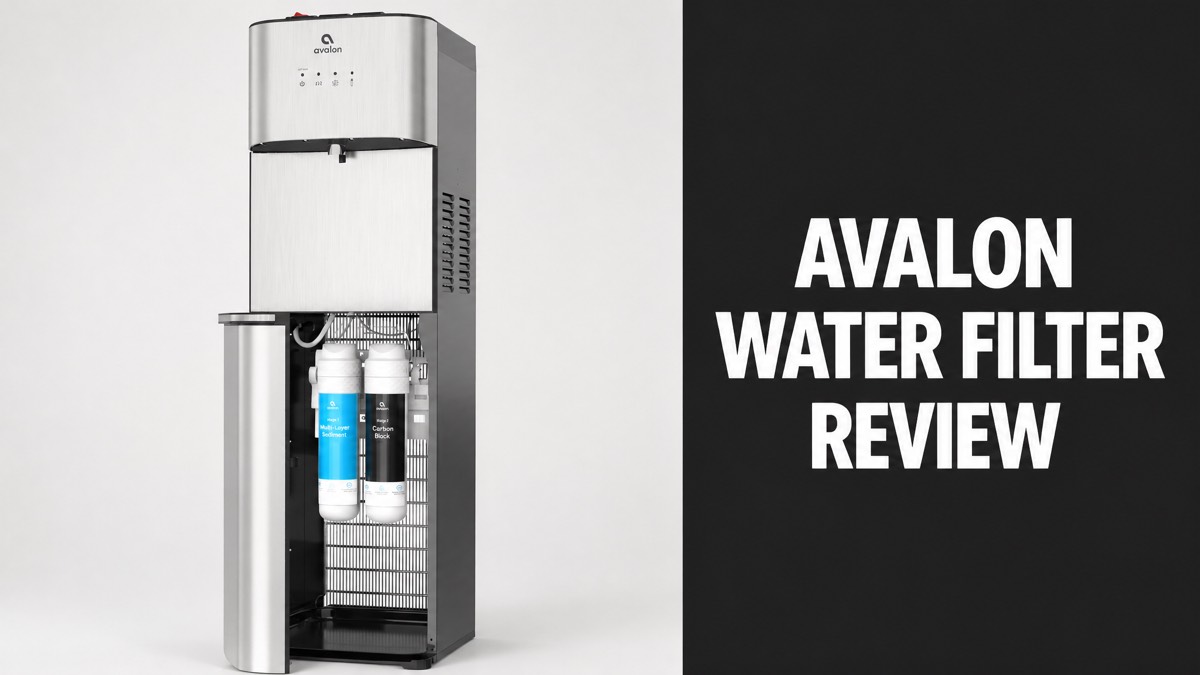
The Avalon water filter is the two-stage filtration system built into Avalon bottleless water coolers. Tap water from a home water line passes through a sediment cartridge and a carbon block cartridge before it reaches the hot and cold tanks. Avalon began in 2008 as an office product and breakroom distributor.
The filters carry NSF certification, and the coolers carry UL listing. The A5 chills water to 50-54°F (10-12°C) at 200 fluid ounces (6 liters) per hour. The hot water reaches 198°F (92.2°C). Owners praise the cold output, the easy filter swaps, and the sanitary nozzles. Complaints center on leaks, dripping spouts, and a drip tray that slips out of the cabinet door.
Avalon coolers start at $129.99, and the filters need a change every six months. A dual filter set costs $99.99. Bottleless units stay off limits during a boil advisory. Read on for the filter stages, the real complaints, the costs, and a final verdict on whether the Avalon is worth the money.
What Is the Avalon Water Filter?
The Avalon water filter is the two-stage filtration system built into Avalon bottleless water coolers. The cooler connects to a home water line. Tap water passes through the filters before it reaches the hot and cold tanks.
Avalon started in 2008 as an office product and breakroom distributor. Its early cooler sales showed an average return and defect rate above 35%. So what did the brand do next? It set out to build more reliable dispensers.
Which Avalon Models Include It?
Most bottleless Avalon coolers use the same dual-filter setup. The A5, A6, A8, A13CT, and B8 each pair a sediment cartridge with a carbon block cartridge. Both cartridges ship in the box.
Models With Dual Filters:
- Avalon A5
- Avalon A6
- Avalon A8
- Avalon A13CT
- Avalon B8 countertop
Here's the twist: bottle-based models filter differently. The bottom-loading A3 ships with a refillable 3-gallon (11.4-liter) bottle. The owner fills the bottle from the tap, and the built-in dual filters clean the water. The A3 needs no water line.
The B8 countertop unit arrives with a full installation kit. To be clear, the kit covers a water line, adapters, and a flushing tool. Under-sink installation needs only a few hand tools.
How Does the Avalon Water Filter Work?
Tap water passes through two filter cartridges before it enters the cooler tanks. A sediment filter handles the first pass. A carbon block filter handles the second pass.
The design offers no bypass. Why does that matter? Water must cross both filters to reach the tanks. A red indicator light signals when the cartridges need a change.
Here's the part most people miss: both tanks are stainless steel. The first fill takes 12 to 15 minutes. After that, the tanks refill as the cooler dispenses water.
What Do the Two Filter Stages Remove?
The sediment stage removes rust and large particles of dirt. The A5FILTER cartridge fills this role. Coarse debris stops here, before the water reaches the carbon stage.
Next, the carbon block stage targets chlorine, lead, and other contaminants. The A4FILTER cartridge carries NSF 42 and 53 certification. NSF 42 covers taste and odor, while NSF 53 covers health-related contaminants.
New carbon cartridges shed black specks, so the first glasses can look cloudy. Is that a problem? No, the specks are harmless. Flushing for three to five minutes (one to two gallons, or 3.8 to 7.6 liters) clears the residue.
What Are the Benefits of the Avalon Water Filter?
The main benefit is filtered hot and cold water on demand without bottle deliveries. Buying bottled water is a recurring cost. What does a bottleless Avalon change? The tap supplies every glass.
And safety features add value. The B8 hot spout carries a child safety lock. The coolers are UL listed. A built-in night light lights the spouts, and the filter indicator tracks cartridge life.
Bonus: self-cleaning models sanitize themselves with ozone. The cycle runs for 90 minutes and works on the tanks and water lines. Avalon suggests running the cycle once a week. Ozone returns to oxygen when the cycle ends.
Main Benefits:
- Filtered hot and cold water without bottle deliveries
- Child safety lock on the hot spout
- UL listed coolers
- Night light for the spouts
- Filter indicator that tracks cartridge life
- Ozone self-cleaning on select models
Does It Heat and Chill Water Well?
Yes. The A5 chills water to 50-54°F (10-12°C) at 200 fluid ounces (6 liters) per hour. The A5 output serves up to 20 people. Cold performance earned the A5 a perfect 10 in testing.
The A5 handles hot water too. How hot does it get? Hot water holds at 198°F (92.2°C), the top temperature for this class of cooler. One draw delivers 23 fluid ounces (680 ml). A refilled hot tank needs 7 minutes 40 seconds to reheat.
For comparison, Avalon rates its hot water at 185°F (85°C) and its cold water at 47°F (8°C). Hot and cold switches sit on the back of the cooler. The cold switch is green, and the hot switch is red.
What Do Avalon Water Filter Reviews Say?
Scores run high on performance and lower on ease of use and upkeep. The B8 countertop model averages 4.1 out of 5 stars across 1,382 ratings. The bottom-loading A3 averages 3.8 stars across 83 ratings.
In plain English: bench testing shows the same split. The A5 scored 9.6 for performance, 8.7 for design, and 8.3 for ease of use. The A1 scored 8.9, 8.6, and 7.6 in the same three categories.
What Do Owners Like?
Owners praise the cold water output, the easy filter installation, and the sanitary nozzle design. The A5 stainless steel panel and ozone sanitation also score well.
Setup earns credit across the range, and it's a big reason owners stay happy. The B8 ships with an installation kit. The A3 needs no installation at all. The A5 arrives with filter heads and a bracket already mounted.
And support backs every machine. Avalon coolers carry a one-year warranty on the entire unit. A claim needs proof of purchase. The brand also publishes manuals and troubleshooting videos.
What Are the Common Complaints?
Complaints center on leaks, dripping spouts, and sudden loss of dispensing. Avalon publishes troubleshooting help for each. A leak sensor sounds a beeping alarm with every light flashing when it detects even a little water.
Here's what no one tells you: the A5 drip tray attaches to the cabinet door. Pulling the door can slip the tray out. The cramped cold tank area also makes tank cleaning difficult.
Cold water can stop while hot water keeps flowing. What causes that? A failed temperature sensor freezes the cooling reservoir. A do-it-yourself sensor swap costs about $15, while a new cooler costs over $200.
Common Complaints:
- Leaks
- Dripping spouts
- Sudden loss of dispensing
- Drip tray that slips out of the cabinet door
- Cramped cold tank that is hard to clean
- Frozen cooling reservoir
How Does Avalon Compare With Avida H2O, Brio, and Euhomy?
Avalon offers two filter stages while the Avida H2O countertop unit offers four plus UV sterilization. The Avida H2O also holds WQA and NSF/ANSI 42 certification. The unit ships with a full installation kit.
By comparison, Brio and Euhomy build bottle-based coolers. Brio sells top-loading and bottom-loading models. Euhomy sells a self-cleaning bottom-loading unit with three temperature settings. Neither brand sells a bottleless design in this comparison.
The good news? Ratings land close together. The Avalon A8 leads at 4.2 stars. The Avalon B8 follows at 4.1. The Avida H2O, the Brio bottom-loading cooler, and the Euhomy unit each hold 4.0 stars.
Rating Comparison:
| Model | Stars | Design |
|---|---|---|
| Avalon A8 | 4.2 | Bottleless |
| Avalon B8 | 4.1 | Bottleless countertop |
| Avida H2O | 4.0 | Four stages plus UV |
| Brio bottom-loading | 4.0 | Bottle-based |
| Euhomy | 4.0 | Bottle-based, self-cleaning |
How Does the Avalon A5 Compare With the A1?
The A5 wins on hot water and bottleless filtration, while the A1 wins on price. The A5 floor-standing bottleless unit listed at $199.99 at the time of testing. The A1 top-loading cooler listed at $129.99.
Which cooler wins on hot water? The A5. It reaches 198°F (92.2°C) and delivers 23 fluid ounces (680 ml) per draw. The A1 reaches 192°F (88.8°C) and delivers 15 fluid ounces (447 ml). The A1 does heat one cup faster, at 2 minutes 20 seconds.
But cold water stays close. The A5 produces 200 fluid ounces (6 liters) per hour for 20 people. The A1 produces 193 fluid ounces (5.7 liters) per hour for 19 people. The A1 uses a top-loading bottle, while the A5 connects to a water line.
A5 vs A1:
| Spec | Avalon A5 | Avalon A1 |
|---|---|---|
| Listed price | $199.99 | $129.99 |
| Hot water temperature | 198°F (92.2°C) | 192°F (88.8°C) |
| Hot water per draw | 23 fl oz (680 ml) | 15 fl oz (447 ml) |
| Cold water per hour | 200 fl oz (6 L) | 193 fl oz (5.7 L) |
| People served | 20 | 19 |
| Water source | Water line | Top-loading bottle |
Is the Avalon Water Filter Safe?
Yes. The system carries NSF certification on its filters and UL listing on its coolers. Certain models add a child safety lock on the hot spout. The lock keeps children from hot water burns.
The A5 also protects itself. Three blinking indicators mean trouble. What kind of trouble? When the heating, cooling, and filter indicators blink together, the cooler has detected a leak, and the tanks then switch off automatically.
Bottom line: cleaning keeps the system sanitary. Self-cleaning models need a manual clean every six months. Models without the feature need one every three months. A vinegar and water mix or a baking soda and water mix works, followed by a clear water rinse.
Can You Use It During a Boil Advisory?
No. Avalon advises against using bottleless units during a boil advisory. Bottled units remain usable. Why is a filter not enough? A filter will most likely not remove the contaminants behind the advisory.
So who do owners call? The local health department is the right contact. Avalon points owners there for details on the contaminants. Boil advisories deserve serious attention.
How Often Should You Change the Avalon Water Filter?
Owners replace both cartridges every six months or after 1,500 gallons (5,678 liters), whichever comes first. Offices and gyms reach the gallon limit sooner. Why does the schedule matter? A saturated carbon cartridge can release trapped contaminants.
For example, a red indicator light signals the change. Holding the reset button for a few seconds clears the timer. Countertop models place the button on the left side. Other models place it inside the bottom cabinet, below the drip tray.
The swap starts with shutting the water valve and unplugging the unit. Holding the cold lever depressurizes the lines. Both old cartridges twist out counterclockwise by a quarter to half turn. The new sediment cartridge goes in first, then the carbon block, and each twists clockwise until it locks.
Don't skip the last step. Flushing finishes the job. Running cold water for three to five minutes clears trapped air and carbon fines. The unit then returns to normal heating and cooling cycles.
Steps:
- Shut the water valve and unplug the unit.
- Hold the cold lever to depressurize the lines.
- Twist both old cartridges out counterclockwise by a quarter to half turn.
- Install the sediment cartridge first and the carbon block second, and twist each clockwise until it locks.
- Run cold water for three to five minutes to flush the new cartridges.
How Much Do Replacement Filters Cost?
A dual filter set costs $99.99 directly from Avalon. Single-filter coolers use an $89.99 cartridge. At one set every six months, filters cost $199.98 per year.
Pay attention to this: only Avalon filters fit the cooler. Avalon warns that other brands can damage the unit and void the warranty. The A4FILTER set is discontinued at some stores, and compatible Neo-Pure sets fill the gap.
And it gets better: Avalon also runs a subscribe and save program. Deliveries arrive every three or six months. Shipping is often free, and the subscription cancels at any time.
How Much Does the Avalon Water Filter Cost?
Avalon coolers start at $129.99 for the A1 and reach $199.99 for the A5. The A5 costs $70 more than the A1.
In fact, running costs center on filters. A $99.99 dual set every six months adds up to $199.98 per year. The filter cost replaces the cost of buying bottled water.
As for power, the B8 countertop unit draws 520 watts. Any standard three-prong, 115-volt outlet powers it. No special wiring is needed.
Where Can You Buy It?
Avalon coolers sell through Avalon's own store and major retailers. Walmart lists 26 Avalon water filter items. Home Depot, Lowe's, Menards, Office Depot, and Amazon carry coolers or replacement cartridges.
Short answer for the best source: Avalon's own store sells filters on subscription. The site also offers manuals, troubleshooting videos, and parts support. Owners can also register a cooler there.
Is the Avalon Water Filter Worth It?
Yes. For most homes and offices with a water line, the Avalon delivers strong cold water, simple filter upkeep, and an entry-level price. NSF and UL certification add trust.
The downsides are real, though. Seals can leak and spouts can drip. The A5 drip tray slips out. Filters cost $99.99 twice a year.
Bottom line: the Avalon is worth it. Strong cold output and easy setup outweigh the upkeep cost.
Pros:
- Strong cold water output
- Simple filter upkeep
- Entry-level price
- NSF and UL certification
Cons:
- Seals that can leak and spouts that can drip
- Drip tray on the A5 that slips out
- Filters that cost $99.99 twice a year
- No bottleless use during a boil advisory
Who Should Skip It?
Buyers in boil advisory areas need to skip a bottleless Avalon. The filters cannot answer the contaminants behind an advisory. A bottled unit is the safer Avalon choice there.
Heavy hot water users need a different pick. The A1 draws only 15 fluid ounces (447 ml) of hot water at a time. Buyers who want more filter stages can look at the Avida H2O with four stages and UV.
Pop Kitchen is a reader-supported platform. Purchases made through our links may earn us an affiliate commission at no extra cost to you.