
Berkey Water Filter Review: Is It Worth It?
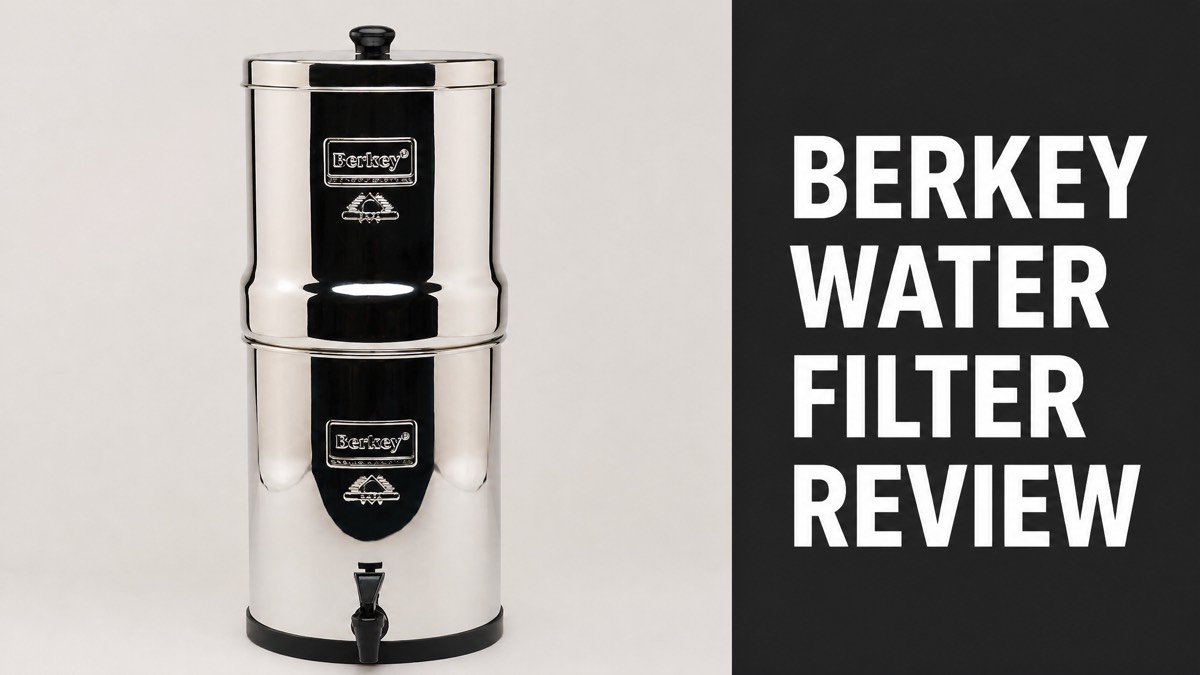
The Berkey is a gravity-fed countertop water purifier built from stainless steel by New Millennium Concepts, Ltd. The system runs without electricity, plumbing, or installation. Six sizes range from 1.5 gallons (5.7 liters) to 6 gallons (22.7 liters), and households and off-grid buyers use it for daily drinking water.
Black Berkey elements pull contaminants out as gravity moves water through them. Berkey's lab reports show over 99.9% PFOA removal and strong lead results. The standard elements carry no NSF listing, though. Flow is slow, and fluoride removal needs an add-on filter. Cost runs about 2 to 6 cents per gallon over the life of the filters.
Owners praise the taste, the steel build, and the low long-run cost. They also flag smudges, manual refills, and a high price at checkout. The sections below cover lab proof, price math, upkeep, and the buyers who are better off elsewhere, so every reader can decide with the facts.
What Is the Berkey Water Filter?
The Berkey is a gravity-fed countertop water purifier made from stainless steel. New Millennium Concepts, Ltd. manufactures the line. The system needs no electricity, no plumbing, and no installation.
Here's how it works: water enters an upper chamber and drains through filter elements into a lower chamber with a spigot. The housing uses polished 304 stainless steel. The spigot is BPA-free polypropylene.
The manufacturer no longer sells direct. So where do buyers get one? Authorized dealers carry the systems, and a published dealer list also names known unauthorized sellers. To be clear, knock-off and damaged units from those sellers drive much of the online doubt about the brand.
Which Berkey Sizes Are Available?
Berkey sells six main systems from 1.5 gallons (5.7 liters) to 6 gallons (22.7 liters). All of them use the same black purification element. Capacity and the number of elements the upper chamber accepts are the real differences.
Here's why the model matters: more elements raise the filtering speed. The Travel Berkey takes 2 elements, while the Crown Berkey takes up to 8. The Big Berkey (2.25 gallons, 8.5 liters) takes 4 and suits households of 1 to 4 people.
Berkey Sizes:
| Model | Gallons | People | Max Elements |
|---|---|---|---|
| Travel Berkey | 1.5 | 1-3 | 2 |
| Big Berkey | 2.25 | 1-4 | 4 |
| Berkey Light | 2.75 | 2-5 | 4 |
| Royal Berkey | 3.25 | 2-5 | 4 |
| Imperial Berkey | 4.5 | 4-8 | 6 |
| Crown Berkey | 6 | 6-12 | 8 |
How Does the Berkey Water Filter Work?
Gravity pulls water through the filter elements in the upper chamber. Treated water collects in the lower chamber. The process uses no pump, no pressure, and no membrane.
The Black Berkey elements blend coconut shell carbon with five proprietary media types. Contaminants adsorb onto the porous surface and stick to it instead of passing through. A network of tiny pores also blocks microbes.
Does the Berkey use reverse osmosis? No. Reverse osmosis forces water through a membrane under pressure and strips out nearly everything. The gravity design leaves minerals such as magnesium in the water, so the taste stays full.
How Long Do Black Berkey Elements Last?
Each Black Berkey element is rated for about 3,000 gallons (11,356 liters). A pair covers 6,000 gallons. A family of four using 1 gallon per person daily replaces a pair after more than 4 years.
Flow slows before the rated volume when the source water carries rust or silt. What fixes it? Scrubbing the outer shell restores speed. And muddy water needs a cloth pre-filter first.
Now, watch this: the 3,000-gallon figure is the maker's rating. The lab reports behind the brand tested far smaller volumes, such as 25 gallons (94.6 liters) for PFOA and 200 gallons (757 liters) for lead.
Does the Berkey Water Filter Actually Work?
Yes. Berkey's own lab reports show strong removal of the contaminants they tested. The standard Black Berkey elements carry no NSF listing, so the proof rests on maker-supplied reports.
The good news? Owners describe water that tastes cleaner, with no chemical aftertaste. One owner compared filtered and tap water side by side and detected a faint taste in the tap sample only.
A 2019 glyphosate test compared gravity systems, pitchers, and sports bottles. The Big Berkey removed 100% of the glyphosate. The best sports bottle removed only 52.9%.
What Do Berkey's Lab Reports Show?
Berkey's evidence is a set of 2016 reports from Envirotek Laboratories. Tap water spiked with PFOA ran through a Black Berkey element, and PFOA dropped by more than 99.9%. The PFOA result covers the first 25 gallons only.
The lead test ran 200 gallons of water spiked with about 1,000 µg/L of lead. Filtered water stayed under 0.5 µg/L through 150 gallons. The level reached 10.1 µg/L at 180 and 190 gallons, and the test ended at 200 gallons.
Was PFOS itself measured? No. PFOS and seven other PFAS appear on the report only as surrogates of the PFOA result. Chlorine removal sits above 85%. Berkey's test results page lists no bacteria or virus report.
Lab Report Results:
| Contaminant | Result | Report |
|---|---|---|
| PFOA | Over 99.9% in the first 25 of 3,000 gallons | Envirotek, 2016 |
| PFOS and other PFAS | Not measured | Envirotek, 2016 |
| Lead | Under 0.5 µg/L to 150 gallons; 10.1 µg/L at 180-190 | Envirotek, 2016 |
| Fluoride | Not covered | PF-2 add-on needed |
But these reports cover Black Berkey elements only. The Big Berkey also ships with Phoenix Gravity New Millennium Edition elements, made in India. None of the report figures apply to that version.
Does Berkey Remove Fluoride?
No. The Black Berkey elements do not cover fluoride, so buyers who need it must add the PF-2 fluoride filter.
The PF-2 filter removes fluoride, arsenic, MTBE, and other heavy metal ions. So what does the add-on cost? A set of 2 runs about $84, which works out to roughly 8 cents per gallon.
What's more, one review puts fluoride reduction at up to 97% for up to 1,000 gallons (3,785 liters) per PF-2 filter. One owner skipped the add-on because the home city, Montreal, does not add fluoride to its supply.
What Are the Downsides of the Berkey Water Filter?
The Berkey has five clear downsides: no NSF listing, a large footprint, slow flow, a high upfront price, and manual upkeep. None of them affect the water directly. All of them affect daily convenience.
Main Downsides:
- No NSF listing
- Large countertop footprint
- Slow gravity flow
- High upfront price
- Manual refilling and cleaning
The polished steel shows every fingerprint. Why do owners wipe the housing so often? Handling oils leave smudges each time the lid comes off for refilling. Owners wipe the housing down often.
Refilling is manual. A low faucet may not clear the Travel Berkey, which stands about 18 inches (46 cm) tall. Owners fill a bowl at the sink and pour, and the routine gets tedious over the years.
Is the Flow Rate Slow?
Yes. Gravity filtration moves slower than a pressurized system. A Travel Berkey with two elements produces up to 2.75 gallons (10.4 liters) per hour when the filters are clean.
Owners report about an hour to filter a full 1.5 gallons with clean elements. Clogged elements slow the flow to a crawl. Cleaning fixes it.
In plain English: households that need a lot of water fast hit this limit first. A larger system with more elements raises the rate. One review credits the Crown Berkey with 6 gallons per hour on two elements.
Is the Berkey Water Filter Safe and Legit?
Yes. The Berkey is a real, established product that adds nothing to the water. Where does the scam talk come from? Knock-offs and unauthorized sellers, not the filter itself.
Buyers verify a seller against the manufacturer's authorized dealer list. A call to customer service also confirms a dealer. Amazon buyers check that the listing title includes the words Big Berkey.
For example, the materials are food-grade 304 stainless steel and a BPA-free spigot. The real caution is certification, not toxicity. No NSF/ANSI listing exists for the standard Black Berkey version.
Why Is Berkey Banned in California and Iowa?
Berkey chose not to sell certain products in both states. Both states require certification from an independent third party, such as NSF, before a filter can be sold.
Why did the manufacturer opt out? Certification costs money and needs upkeep. The decision is a regulatory one and does not show that the filter fails.
Iowa buyers cannot get the Travel Berkey. Buyers who need a certified system pick a listed model instead. The Aquasana Claryum, for example, carries NSF 53 for lead and PFOA/PFOS.
How Does Berkey Compare to Pitchers and Reverse Osmosis?
Berkey beats pitchers on cost per gallon and filter life, and beats reverse osmosis on mineral retention and simplicity. At the same time, pitchers win on the price tag today. Certified systems win on paper proof.
One owner's old pitcher purified 150 gallons for $80, and each new filter cost $45. The pitcher cost works out to about 30 cents per gallon. The Big Berkey ran about 2 to 3 cents per gallon.
Reverse osmosis forces water through a membrane and strips out nearly all contents. Some drinkers find the result flat. The Berkey keeps minerals and needs no pressure, but fluoride removal needs the add-on filter.
Is Berkey Better Than Brita?
Yes. The Berkey system performs better than Brita in the one glyphosate test available. In that test the Big Berkey removed 100% of the glyphosate.
Berkey elements last about 3,000 gallons each. A pitcher cartridge in one owner's comparison handled 150 gallons (568 liters). The Berkey costs more upfront and less over time.
By comparison, ZeroWater and the Aquapail also scored 100% in the same test. Berkey does not stand alone on that contaminant. Price and filter life separate the options.
How Much Does a Berkey Water Filter Cost?
A Big Berkey costs roughly $220 to $526 depending on the seller and the condition. A factory blemished unit with 2 filters sold for $220. Another owner paid about $350 for a full-price system, and an Amazon listing showed $526.
Replacement Black Berkey filters cost $120 per pair. The cost works out to about 2 cents per gallon over their rated life. The PF-2 fluoride set adds $84 for 2.
Berkey Cost Breakdown:
| Item | Price | Cost per Gallon |
|---|---|---|
| Blemished Big Berkey with 2 filters | $220 | 3 cents |
| Replacement Black Berkey pair | $120 | 2 cents |
| PF-2 fluoride set of 2 | $84 | 8 cents |
| Travel Berkey | $327 | Not stated |
Is a blemished unit a bad deal? Not necessarily. Blemished systems carry cosmetic flaws only. They lose the lifetime warranty, but the filters keep a 2-year warranty. Full-price stainless systems carry a lifetime warranty that needs only an order number.
Is a Berkey Worth the Price?
Yes, for most long-term users. The Berkey costs far less per gallon than bottled water or pitcher filters. Bottled water runs $1 or more per gallon, while the Berkey runs about 2 to 6 cents.
The first 6,000 gallons (22,712 liters) cost the system price and nothing more. One owner calculated $1,680 saved against a pitcher over the same volume.
Short answer: the price still stings at checkout. Payback depends on daily volume. Light users wait longer to break even, and emergency-only buyers pay for readiness more than savings.
How Do You Set Up and Maintain a Berkey?
Setup takes assembly, priming, and one dye test. Assembly goes easier than the manual suggests. One owner followed a video tutorial because the printed instructions confused.
Priming is the key step, and it is where most setups go wrong. A thick tan priming button seals against the faucet, and the Prime Rite kit uses a blue silicone sleeve. Water forces through the element from the inside until the surface sweats evenly. What goes wrong when priming is rushed? The first batches taste sweet.
Setup Steps:
- Assemble the chambers and install the elements.
- Prime each element with the tan priming button or the Prime Rite sleeve.
- Run water until the element surface sweats evenly.
- Run the red dye test to confirm the elements work.
The red dye test confirms the elements work. Dye mixes in a separate glass, then pours between the filters. Clear water coming out confirms a correct setup.
How Often Do Berkey Filters Need Cleaning?
Berkey recommends cleaning the elements every 6 months or when flow slows. Dirty water shortens that gap. One owner with rusty city water scrubbed the elements monthly.
Let me break that down: cleaning means scrubbing the outer shell with a Scotch-Brite pad or a toothbrush under cold running water. Speed returns to like-new. The brown slime on the shell is the trapped sediment.
The stainless chambers need a wash with warm soapy water every few months. Elements that reach saturation after many years need replacing. Compatible cross-brand elements fit the same steel housing.
Berkey Water Filter: Final Verdict
The Berkey earns a qualified yes. Bottom line: the system delivers cleaner-tasting water with no electricity, a low long-run cost per gallon, and a durable steel build. Missing NSF certification and slow flow hold it back.
Pros:
- Cleaner taste
- No electricity needed
- Low cost per gallon
- Durable stainless steel
Cons:
- No NSF listing
- Slow gravity flow
- High upfront price
The pros win for most households. Buyers who need certified proof for lead or PFAS look elsewhere.
Who Should Buy a Berkey?
Renters, off-grid users, and emergency planners get the most from a Berkey. The system needs no plumbing or installation, and it works during power outages.
Best Fit:
- Renters without plumbing options
- Off-grid and camping users
- Emergency planners
- Small households (Travel) or up to 4 people (Big)
Small households fit the Travel Berkey, and households of up to 4 fit the Big Berkey. Counter space and patience with manual refills are the entry requirements.
Buyers who need NSF certification, fast flow, or a tiny footprint choose other systems. Iowa residents cannot buy some models at all.
Pop Kitchen is a reader-supported platform. Purchases made through our links may earn us an affiliate commission at no extra cost to you.