
Big Berkey Water Filter Review: Is It Worth It?
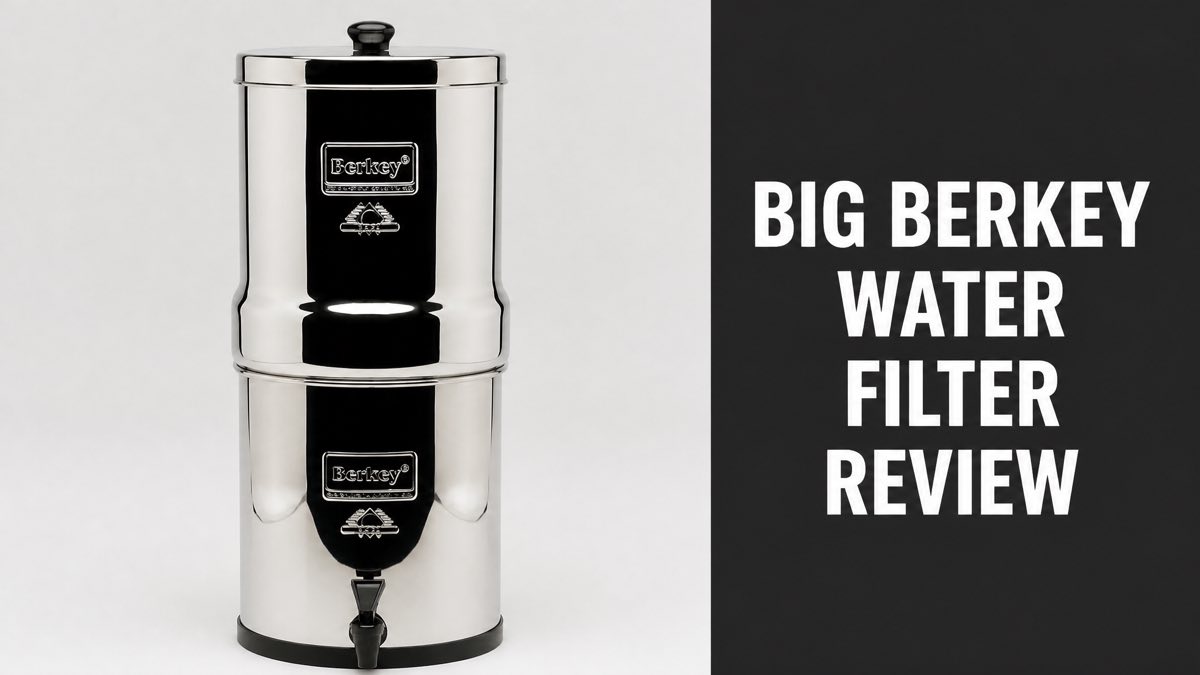
The Big Berkey is a 2.25-gallon (8.5-liter) gravity-fed countertop water filter made by New Millennium Concepts. It needs no electricity or plumbing. Two Black Berkey elements sit inside a stainless steel tower and clean the water as gravity pulls it through. Households use it daily and during outages.
The system suits households of up to four people. Its elements last up to 6,000 gallons per pair. Berkey cites lab reports for PFOA and lead, but the unit holds no NSF listing. Flow is rated at 3.5 gallons per hour, and owners measure closer to one or two. Upfront cost sits near $350.
Setup takes under 30 minutes, and maintenance stays light. The real trade-offs are certification, speed, and counter space. Read on to see what it removes, what it costs, and how the sizes compare. Then check who should skip it.
What Is the Big Berkey Water Filter?
The Big Berkey is a 2.25-gallon (8.5-liter) gravity-fed countertop water purification system. It needs no electricity and no plumbing. So how does the water move? Gravity does the work. A user fills the top chamber, and the water drips through the filter elements into the bottom chamber.
New Millennium Concepts makes the unit from polished AISI 304 stainless steel. The standard Big Berkey ships with two Black Berkey purification elements. The body is BPA-free and built for daily countertop use.
Here's the thing: the footprint is substantial. The Big Berkey stands 19.25 inches (49 cm) tall and 8.5 inches (21.6 cm) wide. Empty weight sits near 6.5 pounds (2.9 kg), and some listings state 7.35 pounds (3.3 kg).
Key Specs:
| Spec | Value |
|---|---|
| Capacity | 2.25 gallons (8.5 liters) |
| Height | 19.25 inches (49 cm) |
| Width | 8.5 inches (21.6 cm) |
| Material | AISI 304 stainless steel |
| Included elements | 2 Black Berkey |
Who Is the Big Berkey For?
The Big Berkey suits small to medium households of one to four people. The 2.25-gallon reservoir covers a day of drinking and cooking water for that group. Larger families usually step up to a bigger Berkey.
Renters gain the most from the design. Why? Nothing attaches to the faucet, and nothing mounts under the sink. Preppers value the same trait, since the system keeps working during a power outage.
The unit also accepts untreated water. Well water, rainwater, creek water, and pond water all pass through the Black Berkey elements. Municipal tap water is the common choice for daily use.
How Does the Big Berkey Work?
The Big Berkey pulls water through its filter elements with gravity alone. The top chamber holds untreated water. Gravity forces that water through the elements, and clean water collects in the bottom chamber with a spigot.
Now, the Black Berkey elements carry the filtration load. Berkey states they use coconut shell carbon and five other media. Only one of those media is named publicly. Which one? Ion exchange resin. Millions of micropores block particles while water passes.
Fluoride and arsenic need an add-on. The optional PF-2 filters attach to the stem of each Black Berkey element as a post filter. Berkey recommends them when source water holds more than 0.5 milligrams per liter of fluoride.
How Do You Set Up and Prime the Big Berkey?
Assembly takes under 30 minutes and needs no tools. The process includes rinsing every part and priming the elements. Instructions in the box walk through each step. The unit then sits on a stable, level surface.
Priming flushes loose carbon dust and fills the pores with water. Two methods work. A brown washer pressed onto a faucet does the job, and a primer bladder works without a sink. To be clear, skipping this step hurts taste and flow.
And extra priming pays off. One owner ran each element for 15 minutes instead of the suggested five. The first batch otherwise carries a slight metallic taste. A first fill in the sink also catches any spigot leak.
Priming Steps:
- Rinse every part of the unit.
- Prime each element with a brown washer on a faucet or with a primer bladder.
- Run water until the outer wall is soaked and the bubbles are gone.
- Make the first fill over a sink to catch any spigot leak.
What Does the Big Berkey Remove?
Berkey states the Black Berkey elements reduce more than 200 contaminants. The list covers pathogenic bacteria, viruses, chlorine, chloramine, pesticides, herbicides, volatile organic compounds, pharmaceuticals, and heavy metals. These figures come from lab reports Berkey publishes itself.
The bad news? Independent confirmation is thinner. One owner sent filtered pond water to a local lab. The test found 99.9 percent of bacteria removed. Is that a certification? No. It is a single result from one source.
There are gaps in the public paperwork too. Berkey's test results page holds no bacteria report and no virus report. Fluoride sits outside the standard elements, and fluoride reduction needs the PF-2 add-on.
Does the Big Berkey Remove PFAS and Lead?
Yes, partly. A 2016 Envirotek Laboratories report shows PFOA dropped by more than 99.9 percent through a Black Berkey element. That result covers only the first 25 gallons (95 liters) of a 3,000-gallon rated life.
PFOS and seven other PFAS appear on the same report as surrogates of the PFOA result. Was PFOS tested directly? No. Buyers with a PFAS concern should treat those figures as an estimate.
The lead report is stronger but still limited. Filtered water stayed under 0.5 micrograms per liter through 150 gallons (568 liters). It reached 10.1 micrograms per liter at 180 and 190 gallons. The test then stopped at 200 gallons.
Lab Report Results:
| Contaminant | Result | Test volume |
|---|---|---|
| PFOA | Over 99.9% reduction | First 25 gallons |
| PFOS and other PFAS | Not measured directly | Surrogate only |
| Lead | Under 0.5 micrograms per liter | Through 150 gallons |
| Lead | 10.1 micrograms per liter | At 180 and 190 gallons |
Is the Big Berkey NSF Certified?
No. The Big Berkey holds no NSF listing. Berkey cites its own lab reports instead. Why does that matter? An NSF listing means a third party verified the claim against a published standard.
One version of the unit falls outside even those reports. Berkey sells a Big Berkey with Phoenix Gravity New Millennium Edition elements, made in India. The published lab figures apply only to Black Berkey elements.
Certified alternatives exist. The Aquasana Claryum carries NSF 53 for lead and PFOA/PFOS. Buyers who require a certificate for a specific contaminant should start with a listed system like that one.
How Fast Is the Big Berkey?
The Big Berkey is rated at 3.5 gallons (13 liters) per hour with two elements. Installing four elements doubles the rating to about 7 gallons (26.5 liters) per hour. These numbers describe a clean, freshly primed setup.
But real-world speed runs lower. One owner measured roughly 1 to 2 gallons (3.8 to 7.6 liters) per hour. A full batch can take up to three hours. So how do owners cope? They pour water in the evening or overnight.
Speed drops further as the elements load with sediment. A dramatic flow reduction signals a dirty element. A scrub and a re-prime restore most of the original flow.
How Much Water Does the Big Berkey Hold?
The lower chamber holds 2.25 gallons (8.5 liters) of filtered water. The upper chamber holds a similar volume of untreated water. Both chambers nest together for storage and transport.
In plain English: that capacity matches a small household. A family of three or four typically fills the unit once in the morning. The supply then lasts through the day, with a refill ready by evening.
What Are the Downsides of the Big Berkey?
The Big Berkey carries four real drawbacks: no certification, a big footprint, slow flow, and a high upfront price. None of them breaks the product. All four should shape the decision before checkout.
The footprint costs counter space. Will it fit a small kitchen? Often not, since a 19-inch tower struggles to sit next to a stove and appliances. Owners in RVs and studios made it work, but they gave up counter space.
Price and taste complete the list. The system costs around $350 up front. The first filtered batches also carry a metallic taste until the elements are properly primed.
Main Drawbacks:
- No NSF listing
- Large countertop footprint
- Slow gravity flow
- Upfront price near $350
Does the Big Berkey Leak or Rust?
Sometimes. The plastic spigot is the usual leak point. A loose fit lets water seep, and overtightening risks damage to the plastic. Owners recommend a first fill in the sink so a leak never reaches the floor.
Some buyers report rust on the stainless steel parts. Is that universal? No, the complaint is not universal. Checking every seal at setup also stops filtered water from bypassing the elements.
There's one more quirk. Some unfiltered water sits stagnant at the bottom of the upper chamber, below the base of the elements. Regular cleaning keeps that standing water from building a biofilm.
Which Berkey Size Fits Your Home?
Berkey sells five main sizes, and the Big Berkey sits in the middle. The Travel Berkey holds 1.5 gallons (5.7 liters) and serves up to two people. The Big Berkey holds 2.25 gallons and serves up to four.
From there, the larger models scale up. The Royal Berkey holds 3.25 gallons (12.3 liters) for up to six people. The Imperial holds 4.5 gallons (17 liters) for up to ten. The Crown holds 6 gallons (22.7 liters) for 12 or more.
Each size ships with two Black Berkey elements. Bigger units accept more elements as add-ons. The Imperial takes up to six, and the Crown takes up to eight.
Berkey Sizes:
| Model | Capacity | Household |
|---|---|---|
| Travel Berkey | 1.5 gallons | Up to 2 people |
| Big Berkey | 2.25 gallons | Up to 4 people |
| Royal Berkey | 3.25 gallons | Up to 6 people |
| Imperial Berkey | 4.5 gallons | Up to 10 people |
| Crown Berkey | 6 gallons | 12 or more people |
Big Berkey vs Royal Berkey: Is the Bigger One Better?
Not by default. The Royal Berkey adds one gallon of capacity and a larger footprint. The Royal holds 3.25 gallons against the Big Berkey's 2.25. Both ship with two elements rated at 3.5 gallons per hour.
Short answer: household size decides the winner. Four people fit the Big Berkey comfortably. Five or six people run out of water faster and gain more from the Royal. Tight counters favor the smaller tower.
How Much Does the Big Berkey Cost?
The Big Berkey typically costs between $280 and $367. A listing near $350 is the common figure. That price includes the stainless steel body and two Black Berkey elements.
Per-gallon math softens the sticker price. How? Two elements treat up to 6,000 gallons (22,700 liters), which works out to roughly 6 cents per gallon. Bottled water costs $1 or more per gallon.
Pay attention to this: listings need a second look before buying. Confirm the title says Big Berkey with Black Berkey elements. Some versions ship with different elements that carry no published lab reports.
How Much Do Replacement Filters Cost?
A pair of Black Berkey elements costs about $170. That price buys 6,000 gallons of capacity. The cost is fair against filters from other systems, which last only 500 to 700 gallons.
The optional PF-2 fluoride filters cost about $80 per set. They last up to 1,000 gallons (3,785 liters) or 12 months. Buyers without a fluoride concern can skip them entirely.
Price Breakdown:
| Item | Price | Capacity |
|---|---|---|
| Big Berkey with 2 elements | $280-$367 | 6,000 gallons |
| Black Berkey pair | About $170 | 6,000 gallons |
| PF-2 fluoride pair | About $80 | 1,000 gallons |
How Do You Maintain the Big Berkey?
Maintenance stays light and mostly monthly. Clean the stainless steel chambers with a sponge and soapy water. Calcium crust gathers near the spigot, and vinegar softens it after a 20-minute soak.
The elements need even less attention. Particles build up on the outer wall as a dark layer. A medium-strength toothbrush and running water remove that layer. A Scotch-Brite pad also works.
Always reprime after scrubbing. Priming clears leftover particles and refills the pores. Clean the elements about every six months, or sooner when the flow slows noticeably.
How Long Do Black Berkey Elements Last?
Each Black Berkey element lasts up to 3,000 gallons (11,400 liters). A pair therefore covers 6,000 gallons. A family of four reaches that mark in roughly two to three years.
Keep in mind that water quality changes that estimate. Muddy or sediment-heavy sources clog elements sooner. Replace every element at the same time, whether the setup uses two or four.
Is the Big Berkey Worth It?
Yes, for the right buyer. The Big Berkey delivers backup-ready, no-power filtration with unusually long element life. It improves taste, handles untreated water, and costs only cents per gallon over its life.
The weaknesses are equally clear. The system has no NSF listing, runs slowly, and takes real counter space. The upfront price of about $350 is steep against a pitcher.
Pros and Cons:
| Pros | Cons |
|---|---|
| No electricity needed | No NSF listing |
| 6,000 gallons per pair of elements | Slow gravity flow |
| Handles untreated water | Large countertop footprint |
| Improves taste | Upfront price near $350 |
Bottom line: the verdict follows from those trade-offs. Off-grid households, renters, campers, and outage planners get strong value. Buyers who need a certified contaminant claim should look elsewhere.
Who Should Skip the Big Berkey?
Buyers who need certification should choose an NSF-listed system instead. The Big Berkey cannot show a third-party listing. A certified under-sink or countertop filter documents its claims on paper.
Small counters and fast-flow needs also rule it out. The tower is tall, and gravity flow is slow. A pressure-driven filter fills a glass quicker and fits a tighter space.
Pop Kitchen is a reader-supported platform. Purchases made through our links may earn us an affiliate commission at no extra cost to you.