
Bluevua Water Filter Review: Is It Worth It?
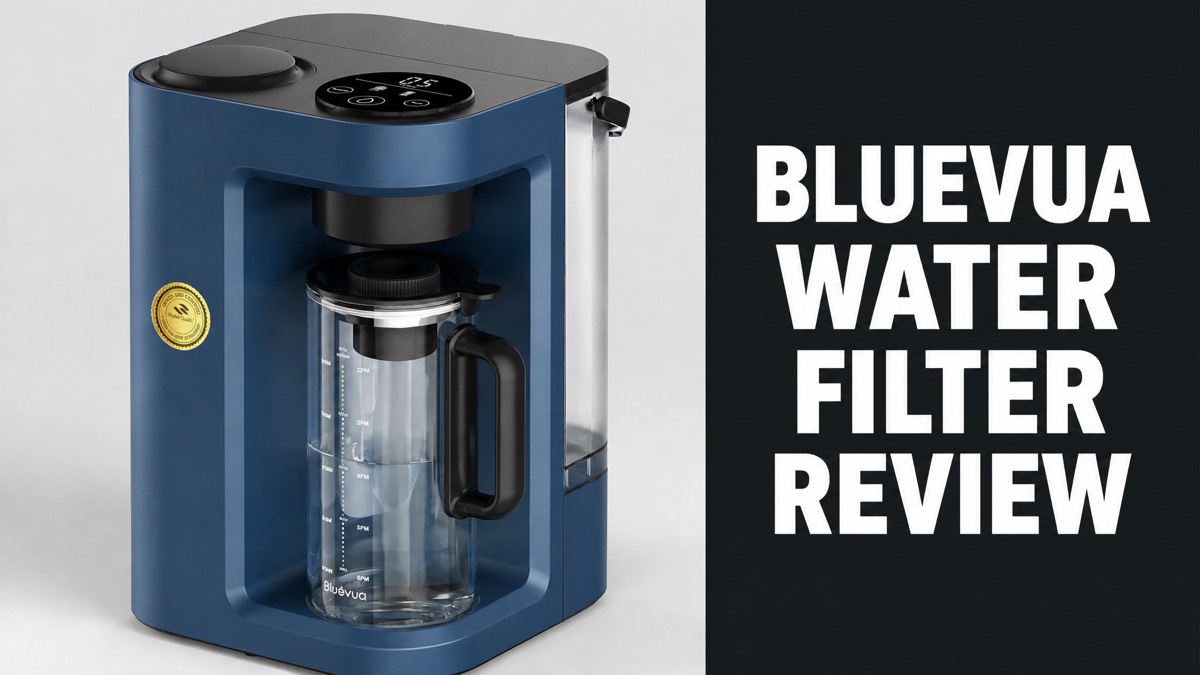
The Bluevua water filter is a countertop reverse osmosis system that purifies tap water without plumbing. Bluevua sells several models, such as the ROPOT-Lite and the ROPOT (UV). Each unit plugs into an outlet, needs no installation, and collects filtered water in a glass carafe.
Bluevua removes most contaminants in lab tests and adds minerals back through a remineralization filter. Owners praise the TDS meter, the glass carafe, and the compact design. Complaints center on slow dispensing, wasted water, and reliability. AquaTru wins on certification and efficiency, while Bluevua wins on size and design.
Bluevua stays safe in testing, with one methylene chloride trace below health guidelines. The ROPOT-Lite costs $299 and the ROPOT (UV) costs more. Read on for the full lab results, the certification gaps, the filter costs, and the buyers who should skip it, so the final call feels simple.
What Is the Bluevua Water Filter?
The Bluevua water filter is a countertop reverse osmosis system that purifies tap water without plumbing. Bluevua specializes in this one category. Each unit plugs into a wall outlet, holds a removable feed tank, and collects water in a glass carafe.
Setup needs no drilling. Why does that matter? A renter can place the unit on a counter, fill the tank, and start filtering. That plug-and-play design is why apartment dwellers pick countertop reverse osmosis over an under-sink system.
The numbers are decent. The ROPOT-Lite earned a 4.22 out of 5 rating in lab-backed testing. The ROPOT (UV) scored 8.68 out of 10 against AquaTru's 9.54 in a head-to-head test. In plain English: solid to very good.
Which Bluevua Models Are There?
Bluevua sells several countertop models, such as the ROPOT, the ROPOT (UV), the ROPOT-Lite (RO100ROPOT-Lite), and the portable ROPOT-Travel. The Lite is the compact, lower-priced version. The UV model, by comparison, adds an ultraviolet light inside the unit.
The ROPOT-Lite measures 9.5 by 13.8 by 9.5 inches (24 by 35 by 24 cm) and weighs 15.8 pounds (7.2 kg) with a wet filter. Its glass carafe holds 0.36 gallons (1.4 liters). Bluevua recommends it for one or two person households.
The ROPOT (UV) stands just over 15 inches (38 cm) tall and 10 inches (25 cm) across. Its glass carafe holds 0.4 gallons (1.5 liters). The price at testing time was $454, with remineralization and the UV light included.
Model Comparison:
| Spec | ROPOT-Lite | ROPOT (UV) |
|---|---|---|
| Price | $299 | $454 |
| Height | 13.8 inches (35 cm) | Just over 15 inches (38 cm) |
| Carafe | 0.36 gallons (1.4 liters) | 0.4 gallons (1.5 liters) |
| Remineralization | Optional extra | Included |
How Does the Bluevua Water Filter Work?
A Bluevua unit pushes tap water through several filter stages with an electric pump. Sediment and carbon stages come first. A reverse osmosis membrane then removes most dissolved contaminants, and a carbon stage polishes the water before the carafe.
Picture the membrane as a very fine sieve. Dissolved minerals and impurities get rejected. Where do they go? Straight to the wastewater tank. Total dissolved solids (TDS) dropped 94% in one lab round and 98% in another on the ROPOT-Lite.
And a built-in TDS meter shows the filtered water reading on the display. For example, one long-term owner sees tap water near 170 parts per million (ppm) fall to 1-3 ppm. A separate meter confirmed the display within 15-20 ppm.
What Filter Stages Does Bluevua Use?
The ROPOT-Lite uses one composite cartridge that packs five filtration stages. A 5-micron sediment layer comes first. A 0.5-micron coconut shell carbon block, a 1-micron sediment layer, the RO membrane, and a 0.1-micron carbon block follow in that order.
Filter Stages:
- 5-micron sediment layer
- 0.5-micron coconut shell carbon block
- 1-micron sediment layer
- Reverse osmosis membrane
- 0.1-micron carbon block
An optional remineralization post-filter sits in the carafe lid. Water passes through it as it pours into the carafe. The ROPOT (UV) lists four separate cartridges instead: sediment, carbon block, RO membrane, and post-carbon.
Here's the upkeep difference. The Lite needs one twist-in swap for its main stages. The ROPOT (UV) has more individual cartridges to replace, and each one adds a small cost.
What Does the UV Light Do?
The UV light in the ROPOT (UV) exposes filtered water to ultraviolet light to protect the unit from bacterial growth. Microorganisms can accumulate in damp filters over time. The light targets that buildup inside the system.
The UV feature doesn't make unsafe water drinkable. What's the rule? Bluevua should not receive untreated or microbiologically unsafe water. Tap water and properly disinfected well water remain the intended supply.
How Hard Is Setup and Upkeep?
Setup takes about 36 minutes and needs no technical skill. The ROPOT-Lite ships mostly assembled with illustrated directions and a QR-code video tutorial. Users wash the tank and carafe, plug in the unit, and run flush cycles.
Flushing is the slow part. Why? The unit needs five flush cycles to clear the protective liquid from the filters. The water isn't drinkable during flushing. And don't panic at gray or black water in cycles three and four: normal carbon dust causes it.
Filter swaps are quick, at about five minutes. The cartridge twists out through the top panel, and a filter wrench comes in the box. Indicator lights announce each replacement. The unit also backflushes itself for 30 seconds after every cycle.
What Are the Benefits of Bluevua?
Bluevua delivers reverse osmosis water in a small, no-installation package. The glass carafe keeps filtered water away from plastic. The built-in TDS meter lets owners verify results instead of trusting marketing claims.
Portability matters for renters. In fact, one owner reports the unit weighs under 10 pounds (4.5 kg) empty. The ROPOT-Lite weighs 15.8 pounds (7.2 kg) with a wet filter, which is lighter than the average countertop RO system tested.
Taste is a strength. The filtered water is odorless and tastes clean. And in taste tests against tap water, pitcher filters, and other RO systems, the Ropot's flavor ranked among the best.
Main Benefits:
- No installation needed
- Glass carafe
- Built-in TDS meter
- Light, portable body
- Clean, odorless taste
Does Bluevua Remove Contaminants?
Yes. Bluevua removes most contaminants in lab tests. The ROPOT-Lite cut 13 impurities to below detection: chlorine, chloroform, copper, barium, nitrate, and uranium.
Fluoride results vary by test. How much disappears? The ROPOT-Lite removed 86% to 99% in one round and all of it in another. The ROPOT (UV) cut fluoride 83%, from 1.2 ppm to 0.2 ppm.
Bluevua's third-party test reports list further reductions. For example, PFOA falls over 97%, PFOS over 99%, lead 99.97%, and arsenic 98.53%. But only some of that data covers the full filter life.
The bad news? Boron and strontium fall short of full removal in places. Boron dropped 66% to 67% in both rounds. Strontium fell 97% in one round and disappeared in the other.
Lab Results:
| Contaminant | Result |
|---|---|
| Chlorine | Below detection |
| Chloroform | Below detection |
| Copper | Below detection |
| Nitrate | Below detection |
| Uranium | Below detection |
| Fluoride | 86-99% in round one, fully removed in round two |
| Boron | 66-67% reduced |
| TDS | 94-98% reduced |
Does Bluevua Add Minerals Back?
Yes. Bluevua adds minerals back through a remineralization filter that restores calcium, magnesium, potassium, sodium, and zinc. The filter also lifts the pH to prevent acidic water.
Minerals stay below tap water levels. With remineralization, calcium dropped 86% and magnesium dropped 60% on the ROPOT. Does the pH still rise? Yes, from 7.1 to 9.0.
The filter is optional on the Lite. The filter lasts 260 gallons (984 liters) or six months and costs about $34 per year. But the glass infuser basket can't be used together with it.
What Do Bluevua Reviews Say?
Bluevua's scores sit between solid and very good, with caveats on certification. The Ropot took the top spot in Bob Vila's comparison of countertop water filters. The ROPOT-Lite earned a bottom line of solid from BOS Water.
Scores vary by model and by test. The ROPOT-Lite earned 4.14 for filtration, 4.60 for usability, and 4.08 for cost, all out of 5. Bottom line: its final 4.22 rating comes with the conclusion that better options exist.
What Do Owners Like?
Owners praise the TDS meter, the glass carafe, and the compact design. And long-term use backs the praise. One owner reports nearly two years of daily use with no drift in TDS readings and a carafe that held up.
Speed and weight get credit too. In fact, the carafe fills in three to five minutes. The unit moves easily between kitchens, which suits renters who relocate.
Upkeep earns praise, too. One owner replaced the main RO filter once at about 9 to 11 months and changed the remineralization filter a couple of times. Each swap took about five minutes with no tools or priming.
What Are the Common Complaints?
Complaints center on slow dispensing, wasted water, and reliability. Dispensing straight into a glass takes 44 to 55.5 seconds per cup. Is there a workaround? Yes, a pre-filled carafe pours instantly.
Reliability complaints exist, and they're specific. Users report leaking and malfunctioning units. Others say the display underreports filtered water TDS and flatters the results. But lab testing found only minor TDS creep and mostly accurate readings.
Water use draws criticism. Here's why: flushing produces wastewater, and the ROPOT wastes 1 gallon (3.8 liters) for every 2 purified. The Lite wastes about 0.4 gallons (1.5 liters) per gallon purified. Both beat conventional systems that waste up to 4 gallons.
And footprint and price also draw complaints. The Ropot takes substantial counter space and flows slower than a pitcher. The Ropot was one of the more expensive units in a comparison of countertop filters.
Common Complaints:
- Slow dispensing into a glass
- Leaking and malfunctioning units
- TDS underreporting claims
- Wastewater from flushing
- Large counter footprint
Bluevua vs AquaTru: Which Is Better?
AquaTru wins on contaminant reduction, certification, and efficiency, while Bluevua wins on size and design. AquaTru scored 9.54 overall against 8.68 for the Bluevua ROPOT (UV). The gap comes mostly from contaminant reduction: 9.91 against 8.23.
Certification separates them most. The reason is simple: AquaTru is certified to NSF/ANSI 42, 53, 58, and 401 for all 83 contaminants it claims to reduce. The Bluevua ROPOT had no performance certification in that test and held only a lead-free design certificate.
Efficiency favors AquaTru too. How big is the gap? AquaTru runs a 4:1 pure-to-wastewater ratio and Bluevua runs 2:1. Cost per gallon follows: $0.14 against $0.27.
But Bluevua wins on convenience. Its carafe collects water automatically, and filtering runs slightly faster at 0.06 gallons (0.23 liters) per minute against 0.04. The glass carafe also earned Bluevua a 10.00 design score against 9.70.
Head-to-Head:
| Factor | AquaTru | Bluevua ROPOT (UV) |
|---|---|---|
| Overall score | 9.54 | 8.68 |
| Contaminant reduction score | 9.91 | 8.23 |
| Certification | NSF/ANSI 42, 53, 58, 401 | Lead-free design only |
| Pure-to-wastewater ratio | 4:1 | 2:1 |
| Cost per gallon | $0.14 | $0.27 |
| Filtration rate | 0.04 gallons per minute | 0.06 gallons per minute |
| Design score | 9.70 | 10.00 |
Who Should Pick Bluevua Over AquaTru?
Bluevua suits buyers who value a slim glass-carafe design and built-in UV protection over top certification. The ROPOT stands 15 inches (38 cm) tall and 10 inches (25 cm) wide. AquaTru measures 14 by 12 by 14 inches (36 by 30 by 36 cm).
Here's the deciding factor: fluoride. AquaTru fully removed fluoride in testing, and the Bluevua ROPOT cut it 83%. Buyers without fluoride concerns lose little by choosing Bluevua. Buyers with fluoride in their water gain more from AquaTru.
Design appeals to some owners, too. An extra pitcher fits beside the Bluevua, and the rectangular body looks cleaner on a counter. AquaTru's glass carafe model costs about $100 less than its full-size unit.
Is Bluevua Safe?
Yes. Bluevua passes lab testing for safety, with one leaching flag that stays under health guidelines. The ROPOT-Lite showed methylene chloride in filtered water that was absent in the tap water.
The flag is methylene chloride. How high did it measure? 2.41 parts per billion (ppb) in the first round and 1.24 ppb in the second. The strictest health guideline found, from OEHHA, is 4 ppb. Effects above that level include an increased cancer risk.
And materials carry a lead-free certificate. The WQA certified the ROPOT to NSF/ANSI 372 for lead-free design. Components include a borosilicate glass carafe and polyamide and polypropylene housings.
How Many Certifications Does Bluevua Hold?
The ROPOT-Lite holds four NSF/ANSI 58 performance certifications: TDS, chromium 3, cadmium, and lead. Everything else rests on Bluevua's own third-party test data. At least some of that data covers only the start of filter life.
The ROPOT (UV) held no performance certification in a separate head-to-head test. The WQA Gold Seal applies to lead-free design only, not contaminant reduction. Water Filter Guru called Bluevua's certification marketing language misleading.
Certification claims conflict across pages. The Amazon listing calls the Lite WQA and NSF certified. Bob Vila credits the Ropot with NSF and WQA certification. Here's the part most people miss: the narrower four-contaminant list is the verifiable claim.
How Much Does Bluevua Cost?
The Bluevua ROPOT-Lite costs $299, and the ROPOT (UV) cost $454 at testing time. The price was current on July 13, 2026 and sits slightly below the $317.09 average across 18 countertop RO systems tested.
Discount codes lower the entry price. By how much? A 15% code brings the Lite to $254.15. Shipping is free to the continental US. A 30-day return window and a one-year limited warranty cover each purchase.
Value depends on the model. The ROPOT (UV) costs more, but it includes remineralization and the UV light. Bob Vila called the Ropot one of the more expensive filters in its comparison.
What Do Replacement Filters Cost?
Replacement filters cost about $80 per year on the ROPOT-Lite, based on 500 gallons (1,893 liters) of use. The main cartridge lasts 1,056 gallons (3,997 liters) or 12 months. The average across tested countertop RO systems is $145.66.
A conservative schedule doubles the bill. The reason is simple: limited long-term test data makes a six-month swap the safer choice. Two swaps per year bring the Lite to about $160 annually. The remineralization filter adds $34 yearly.
And the ROPOT (UV) costs more per gallon to run. Its filters total $0.27 per gallon, against $0.14 for AquaTru. Four of the five stages cost $0.05 per gallon each, and the remineralization filter costs $0.07.
Is the Bluevua Water Filter Worth It?
Yes. The Bluevua water filter is worth buying for renters and small households that want simple countertop reverse osmosis. The ROPOT-Lite offers easy setup, a glass carafe, TDS monitoring, and low wastewater for $299.
Bottom line: strong lab results, clean taste, and easy upkeep outweigh partial certification, a methylene chloride trace, slow glass dispensing, and reliability complaints. BOS Water's verdict is solid, but better options exist.
Pros:
- Strong lab results
- Clean, odorless taste
- Easy setup and upkeep
- Low wastewater
- Glass carafe
Cons:
- Partial certification
- Methylene chloride trace
- Slow dispensing into a glass
- Reliability complaints
AquaTru beats Bluevua on certification and efficiency. Households that need fluoride removal or full performance certification should compare AquaTru first. Everyone else gets a well-built, low-effort system.
Who Should Skip Bluevua?
Buyers who need full performance certification or reliable fluoride removal should skip Bluevua. AquaTru removed fluoride fully in testing, and the Bluevua ROPOT cut it 83%. Certification covers only four contaminants on the Lite.
Large households outgrow the carafe. The Lite holds 0.36 gallons (1.4 liters) and suits one or two people. By comparison, an average US household needs about three tank refills per day.
Budget shoppers have cheaper options. A pitcher filter improves taste for less money. And homeowners who want a whole-home setup do better with an under-sink RO system, which offers higher flow rates.
Pop Kitchen is a reader-supported platform. Purchases made through our links may earn us an affiliate commission at no extra cost to you.