
Body Glove Water Filter Review: Is It Worth It?
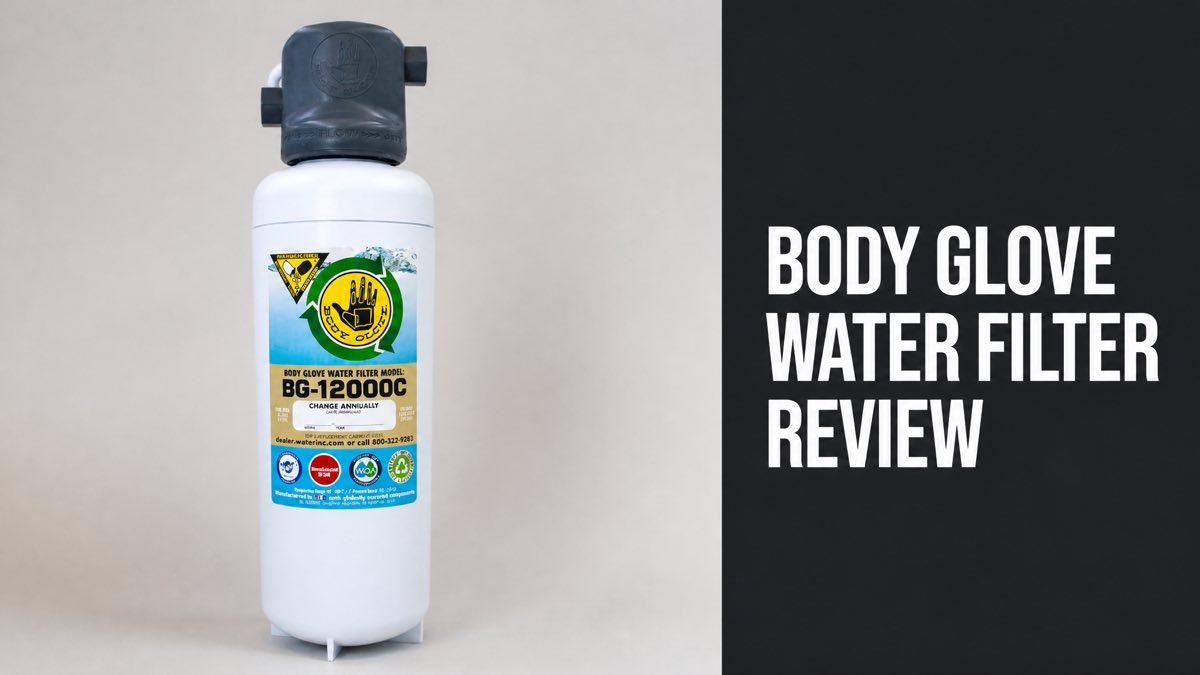
A Body Glove water filter is an under-sink carbon block drinking water system sold by Water, Inc. under the Body Glove brand. The line runs from the entry BG-1000 to the top-tier BG-12000, and each system uses a single replaceable cartridge to treat water for drinking and cooking.
Water enters a head unit and passes through one cartridge that strips sediment and chemicals in layers. The systems reduce chlorine taste, lead, cysts, and volatile organic compounds, and the BG-12000 also reduces microplastics through a 0.2 micron membrane. Owners praise reliability and fit. Cost and cartridge availability draw the most complaints.
Prices, cartridge costs, safety limits, and rival options all shape the verdict. Systems run about $445 to $570, and cartridges run about $109 to $245 each. The sections below weigh every point so buyers can decide whether a Body Glove system earns its place under the sink and which model fits their water.
What Is a Body Glove Water Filter?
A Body Glove water filter is an under-sink carbon block drinking water system sold under the Body Glove brand. Water, Inc. supplies the line. The units mount compactly beside the kitchen sink and treat water for drinking and cooking.
To be clear, each system pairs a head unit with one replaceable cartridge. The kit also includes an installation kit, a digital filter change indicator, and an owner's manual. What is missing from the box? The faucet, which must be bought separately.
The range is wider than it first looks. The line spans four under-sink systems, a portable CounterFilter, and a one-gallon pitcher. Every system uses Micro-Filter Technology, an engineered media that delivers cleaner, more sediment-free drinking and cooking water.
The BG-12000 measures 4.5 by 4.75 by 18.75 inches (11.4 by 12.1 by 47.6 centimeters). Flow runs 0.75 gallons per minute (2.8 liters per minute), and a cartridge treats 1,000 gallons (3,785 liters) or one year.
Which Body Glove Models Exist?
Water, Inc. sells four Body Glove under-sink systems: the BG-1000, BG-3000, BG-6000FF, and BG-12000. The BG-1000 is the entry model at Level 1, the BG-3000 sits at Level 2, and the BG-12000 is the top-of-the-line Level 3 system. The BG-6000FF is a full flow system.
Body Glove Systems:
| Model | Tier | Key Feature |
|---|---|---|
| BG-1000 | Level 1 | Tri Stage, most economical |
| BG-3000 | Level 2 | 0.5 micron reduction |
| BG-6000FF | Full flow | Full flow system |
| BG-12000 | Level 3 | Quad Stage, 0.2 micron membrane |
Start with the entry model. The BG-1000 uses Tri Stage filtration, and the system reduces chlorine taste, sediment, rust, cysts, lead, and 0.5 to 1.0 micron particles. The maker calls the BG-1000 its most economical model.
The BG-12000 adds a fourth stage, a 0.2 micron pharmaceutical-grade membrane. An electronic flow meter and a filter change indicator come with the system. The meter tracks how many gallons remain.
Here's the part most people miss: the three main cartridges share a universal head unit. A buyer starts with a BG-1000 cartridge and upgrades to the BG-3000 or BG-12000 later. The head stays in place.
How Does a Body Glove Water Filter Work?
Water enters the head unit and passes through one cartridge that strips sediment and chemicals in layers. A pre-filter wrap catches particles first. A patented carbon block then handles chlorine taste, odor, and organic chemicals.
A patented in-head shut-off valve stops the flow when the cartridge comes out. Why does that matter? The design makes cartridge changes quick and tool-free, and no plumbing expertise is required.
Here's why owners rarely forget a swap: a digital filter change indicator tracks the cartridge. The unit alerts the owner when replacement is due, normally once a year or sooner if flow slows. The BG-12000 adds an electronic flow meter.
What Is Quad Stage Filtration?
Quad Stage filtration combines four treatment steps inside one recyclable polymer housing. The BG-12000 is the premium model that uses it. The BG-1000 uses Tri Stage filtration, which leaves out the fourth step.
Stage 1 treats the water with a polyphosphate scale inhibitor for bacteriostatic and scale control. Stage 2 is a Micro-Filter-Wrap that traps sediment particles while holding the flow rate steady.
Now, watch this. Stage 3 is a patented 0.2 micron pharmaceutical-grade membrane. Stage 4 is a high-efficiency carbon block. The pairing forms what the maker calls IMPACT technology, short for Integrated Membrane Pre-Activated Carbon Technology.
Steps:
- The polyphosphate scale inhibitor treats the water for scale and bacteriostatic control.
- The Micro-Filter-Wrap traps sediment particles and holds the flow rate steady.
- The patented 0.2 micron pharmaceutical-grade membrane filters the water.
- The high-efficiency carbon block finishes the treatment.
IMPACT technology comes from the pharmaceutical and wine making industries. Why borrow it? Water, Inc. adopted the approach so the BG-12000 can reach the 0.2 micron level.
What Does a Body Glove Water Filter Remove?
The BG-12000 and BG-3000 reduce chlorine taste and odor, sediment, rust, cysts, lead, and volatile organic compounds. Both also cover total trihalomethanes (TTHMs). Lime scale, asbestos fibers, and oxidized iron, manganese, and sulfide appear on the list too.
Main Reductions:
- Chlorine taste and odor
- Sediment and rust
- Giardia and cryptosporidium cysts
- Lead
- Volatile organic compounds and TTHMs
- Lime scale and asbestos fibers
In fact, cysts such as giardia and cryptosporidium fall within the reduction claims. The BG-12000 reaches a 0.2 micron particulate level, while the BG-3000 reaches 0.5 micron. Only the BG-12000 lists methyl tertiary-butyl ether (MTBE).
The systems carry NSF International certification, and the BG-12000 is rated to NSF/ANSI Standards 42, 53, and 401. Capacity and performance depend on incoming water conditions.
Does a Body Glove Water Filter Reduce Lead?
Yes. Every main system lists lead reduction among its claims. The BG-1000 is the cheapest of the three and still includes lead reduction.
Lead sits alongside chlorine and cysts on each product list. The BG-12000 adds a pharmaceutical-grade 0.2 micron membrane. Where are the exact numbers? In the performance data sheet that the maker supplies for each system.
Does a Body Glove Water Filter Remove Microplastics?
Yes. The BG-12000 reduces microplastics under NSF/ANSI Standard 401. The maker states the system was newly certified to that standard.
And it gets better: the same system also reduces 1,2,3-trichloropropane (1,2,3 TCP) under NSF/ANSI Standard 53. The pollutant persists in groundwater and is likely carcinogenic to humans. Bisphenol A and nonyl phenol appear on the 401 list.
The maker names only the BG-12000 as a microplastic system. So which cartridge covers microplastics? The BG-12000.
What Do Body Glove Water Filter Reviews Say?
Owner feedback is strongly positive on convenience and reliability, with mixed views on taste. The BG-3000C cartridge averages 4.8 out of 5 across 62 ratings. Praise centers on fit, delivery, and long-term reorders.
The bad news? Complaints cluster around cost and availability. Taste gains stay subtle for some households. Supply delays make cartridges hard to find at times.
Most feedback concerns the replacement cartridge, since the system installs once. The cartridge is the product owners buy again and again, so its price and stock shape the experience.
What Do Owners Like?
Owners praise reliable performance, a clean fit, and better-tasting water. A fresh cartridge restores the taste of the water. Long-term owners call the system reliable and effective, and many treat the cartridge as a continual reorder.
And cartridge life earns credit too. The rated life is 450 gallons (1,703 liters) or one year for the BG-3000C. A long-term household gets about a year and a half with no noticeable drop in quality.
Compact size earns praise as well. The unit mounts under the sink, saves cabinet space, and fits homes, apartments, RVs, and boats. Installation is straightforward, and cartridge changes need no tools.
What Are the Common Complaints?
Cost and availability draw the most complaints. Replacement cartridges represent an ongoing yearly expense. Is stock always there? Not quite. Supply chain delays make some cartridges hard to find.
Look, taste gains vary from home to home. Water that already tastes fine from the tap shows little change. Why? The difference can be indistinguishable depending on local water chemistry. Opinions on the filtration claims stay mixed.
But other sellers add confusion. Authorized retailers warn that purchases from unauthorized sellers void the warranty and service from Water, Inc. Buyers need to confirm the seller before ordering.
How Does Body Glove Compare With Everpure?
Body Glove competes directly with Everpure in the under-sink cartridge market. Both brands sell single-cartridge drinking water systems. Owners who have used both sometimes prefer Body Glove for its recyclable cartridges and a slightly lower cost.
By comparison, the BG-12000 brings a 0.2 micron membrane, NSF/ANSI 401 microplastic certification, and an electronic flow meter. Water, Inc. positions the system as its top-of-the-line model.
Body Glove also shares one head design across its own cartridges, so upgrades stay simple. Buyers weigh each brand's cartridge cost before choosing, since the cartridge is the recurring expense.
Can Body Glove Upgrade an Everpure System?
Yes. The BG-12000 works as an upgrade to the Everpure H-1200 filter system. The swap suits owners who want microplastic reduction and a 0.2 micron membrane on an existing Everpure setup.
Short answer on alternatives: third-party cartridges exist too. The American Filter Company sells cartridges compatible with the Body Glove BG-3000C and BG-12000.
Is a Body Glove Water Filter Safe?
Yes. Body Glove systems are certified by NSF International for their listed claims. The Water Quality Association certifies the brand for sustainability. A registered EPA establishment number covers the cyst-reduction systems.
The good news? Materials stay food safe. The pitcher uses BPA-free, FDA food grade plastics, and the cartridge housing is a recyclable polymer. The cartridge is made in the USA.
Safety depends on the incoming water. The systems are designed for water that is microbiologically safe. Does municipal water qualify? Disinfected municipal water fits that requirement, but the filter doesn't replace disinfection.
Who Should Skip a Body Glove Water Filter?
Households on untested or unsafe water need a different solution. The maker requires microbiologically safe water from a disinfected source. Well water needs a comprehensive well analysis confirming disinfected, potable water first.
Poor Fits:
- Households on untested well water
- Households on water that is not microbiologically safe
- Buyers with fluoride or nitrate concerns
Buyers with fluoride or nitrate concerns have no claim to rely on. The product pages list chlorine, lead, cysts, VOCs, and particulates, but never those two. Buyers with those concerns need a system certified for them.
And buyers on a tight budget feel the cartridge cost most. Replacement cartridges run roughly $109 to $245 depending on the retailer.
How Much Does a Body Glove Water Filter Cost?
Complete Body Glove systems typically run from about $445 to $570 depending on the retailer. The BG-3000 kit sits in that range at several dealers. Prices vary with the model, the seller, and current promotions.
Typical Costs:
| Item | Price | Frequency |
|---|---|---|
| Complete system | $445-$570 | One time |
| Replacement cartridge | $109-$245 | Once a year |
| Cartridges over five years | $545-$1,225 | Five replacements |
Replacement cartridges run about $109 to $245 each. The cartridge is the recurring cost. How often does it come due? Owners replace it once a year. Some retailers offer annual or six-month subscription discounts.
Here is the kicker: ongoing cost matters more than the sticker price. A cartridge replaced yearly for five years costs between $545 and $1,225 at the quoted prices. The five-year total rivals the price of the original system.
Where to Buy a Body Glove Water Filter?
Buyers find Body Glove systems at authorized online retailers, home improvement stores, and appliance dealers. Lowe's carries the 3000 and 12000 systems, and appliance dealers list the full Body Glove line.
Pay attention to this: authorized sellers matter for the warranty. Drinking Well says it is one of three authorized online retailers of Body Glove and Water, Inc. products, and that purchases elsewhere void the warranty.
Cartridge stock runs thin at times. What fills the gap? Third-party compatible cartridges, though warranty coverage differs. Buyers weigh price against warranty before choosing a compatible cartridge.
Is a Body Glove Water Filter Worth It?
Yes. A Body Glove water filter is worth it for households on safe municipal water that want better taste and certified reduction under the sink. The BG-12000 makes the strongest case of the line.
Let me break that down. The strengths are clear. Certified reduction of chlorine, lead, cysts, and VOCs, tool-free cartridge swaps, a compact footprint, recyclable cartridges, and strong owner ratings all count in the product's favor.
The weaknesses, though, are just as clear. Cartridges cost $109 to $245 each, stock runs thin at times, taste gains vary, and the filter cannot treat unsafe water.
Pros:
- Certified reduction of chlorine, lead, cysts, and VOCs
- Tool-free cartridge swaps
- Compact under-sink footprint
- Recyclable cartridges
- Strong owner ratings
Cons:
- Cartridges cost $109 to $245 each
- Cartridge stock runs thin at times
- Taste gains vary by home
- Unsafe water is out of scope
Who Should Buy a Body Glove Water Filter?
Buyers with chlorinated city water and limited cabinet space get the most from a Body Glove system. The compact under-sink body suits apartments, RVs, and boats. The BG-1000 covers the basics at the lowest price in the line.
Bottom line for health-minded shoppers: buyers who want microplastic reduction need the BG-12000. The 0.2 micron membrane and NSF/ANSI 401 certification set the system apart from the BG-3000 and BG-1000. The electronic flow meter adds a gallon count.
So what about portable use? Shoppers who want a portable option have a pitcher. The one-gallon Body Glove pitcher filters up to 150 refills per filter and is tested to NSF/ANSI Standard 42. Dimensions are 5.5 by 11.5 by 10.5 inches (14 by 29 by 27 centimeters).
Pop Kitchen is a reader-supported platform. Purchases made through our links may earn us an affiliate commission at no extra cost to you.