
Boroux Water Filter Review: Is It Worth It?
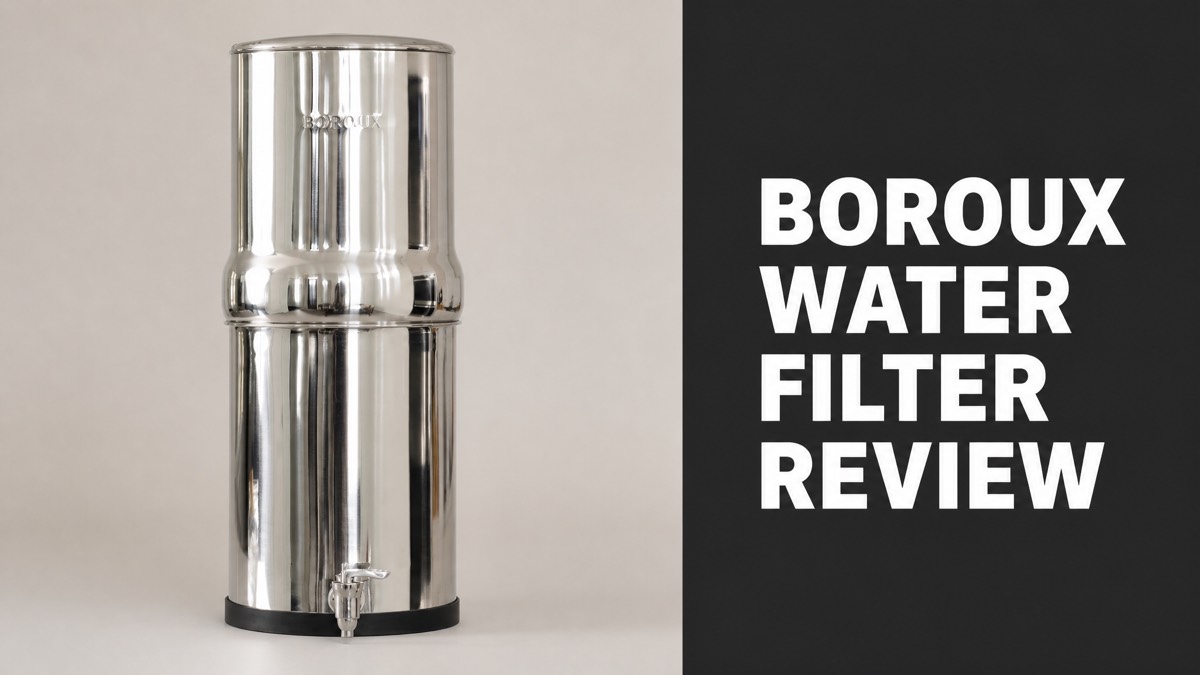
The Boroux water filter is a gravity-fed countertop system built from stainless steel chambers and carbon Foundation filters. The Legacy holds 3 gallons (11.4 liters), and the Compact holds 1.8 gallons. Neither needs power or plumbing, and Boroux sells both as a certified Berkey alternative.
The filters pull water through carbon by gravity at about 1 gallon (3.8 liters) per hour. They hold WQA certification to three NSF standards but not NSF/ANSI 53. Owners praise the taste and the low running cost. Common complaints cover the tall body, the slow flow, the lid design, and the first-time priming step.
The Legacy costs about $399, and the filters last up to 12 months. Fluoride needs a separate add-on, and untreated well water is off the table. The sections below weigh price, certification, and rivals so buyers can decide whether the system fits their kitchen and their water supply.
What Is the Boroux Water Filter?
The Boroux water filter is a gravity-fed countertop system from a Colorado company, built from stainless steel chambers and carbon filters. The flagship Legacy holds 3 gallons (11.4 liters). A smaller Compact model holds 1.8 gallons (6.8 liters).
In plain English: the Legacy needs no power and no plumbing. Gravity alone moves water through the filters. Why does that matter? The setup works in a rental, during a power cut, and off the grid.
To put it simply, Boroux positions the system as a replacement for the Berkey. The Foundation filters use the same formulation as the Black Berkey element. Boroux also holds third-party certifications that the Berkey never carried.
What Is the Legacy Made Of?
The Legacy is two stacked 304 stainless steel chambers with a stainless spigot. The spigot uses a ceramic valve. Assembled, the unit stands about 23 inches (58 cm) tall and 9 inches (23 cm) wide.
Nesting the parts drops the height to about 15 inches (38 cm). A full tank weighs more than 25 pounds (11 kg). So how do owners fill it? Most use a pitcher instead of carrying the tank to the sink.
Legacy Specs:
| Spec | Detail |
|---|---|
| Chambers | 304 stainless steel |
| Spigot | Stainless with ceramic valve |
| Height | 23 in (58 cm), 15 in (38 cm) nested |
| Capacity | 3 gallons (11.4 liters) |
A few small parts are plastic. The stem savers and hole plugs are BPA-free plastic and sit in the upper chamber, on the unfiltered side. Silicone gaskets seal the remaining joints. The stored water sits in stainless steel.
How Does the Boroux Water Filter Work?
The Boroux filter pulls water through carbon filters by gravity, with no pump and no pressure. You pour tap water into the top chamber. Gravity drives it through two Foundation filters into the 3-gallon lower chamber. A spigot at the bottom dispenses it.
Flow is slow. How slow? Two filters deliver about 1 gallon (3.8 liters) per hour. Four filters double the pace to 2 gallons (7.6 liters) per hour. One hands-on test needed more than three hours to fill the full tank.
The Foundation filters are carbon, with silver added as an antimicrobial agent for the carbon itself. Boroux rates each filter for up to 6,000 gallons (22,700 liters). A pair lasts up to 12 months.
How Do You Set Up and Prime It?
Setup takes more effort than a pitcher because the carbon filters ship dry and need priming. You assemble the chambers, install the filters, and prime them before the first batch. The first batch of water gets dumped. First-timers and owners with limited hand strength find assembly awkward.
Setup Steps:
- Assemble the stainless chambers
- Install the Foundation filters
- Prime the filters before the first batch
- Dump the first batch of water
Current kits include an automatic primer that charges over USB-C. Boroux advertises a prime in about 90 seconds. The primer replaces the older faucet-and-mess method.
Daily habits matter after setup. The tank needs regular refilling, so many owners top it up overnight. A stand adds six inches (15 cm) so a mug fits under the tap.
What Does the Boroux Water Filter Remove?
Boroux claims the Foundation filters remove up to 99.97% of lead, PFAS, and chlorine. The company lists more than 80 contaminants in its published test data. Those figures come from third-party lab sheets, not from the certification seal.
But independent testing adds a caution. One lab-style test found the filters added cobalt to the water, which lowered the overall contaminant score. The same test still saw most contaminants drop sharply.
Microbes sit outside the design. Does Boroux sell the system as a purifier? No. The Foundation filters are not intended to filter microorganisms, and Boroux does not call the system a microbiological purifier.
Is the Boroux Water Filter Certified?
Yes. The Foundation filters hold WQA certification to NSF/ANSI 42, NSF/ANSI/CAN 401, and NSF/ANSI/CAN 372. Standard 42 covers chlorine, taste, and particulates. Standard 401 covers emerging contaminants, and 372 covers lead-free materials.
Certification Scope:
| Standard | Covers |
|---|---|
| NSF/ANSI 42 | Chlorine, taste, particulates |
| NSF/ANSI/CAN 401 | Emerging contaminants |
| NSF/ANSI/CAN 372 | Lead-free materials |
| NSF/ANSI 53 | Not held |
The seal has limits. What is missing? NSF/ANSI 53, the health-contaminant standard that would certify lead reduction. Lead and PFAS figures rest on third-party lab sheets instead, and Boroux labels them that way.
And certification still sets Boroux apart from the Berkey. The Berkey never carried NSF certification, which drew the harshest criticism of that brand. Buyers who need a certified lead claim can choose a unit certified to NSF 53 instead.
Does the Boroux Water Filter Remove Fluoride?
No. The standard Foundation filters do not remove fluoride. Fluoride needs a separate add-on that Boroux calls the Proactive fluoride filter. The company released it in 2025.
What does that add-on cost? About $99 for the set. The shells hold it alongside the Foundation pair. Households that want fluoride out of the tap need to budget for the extra set.
What Are the Pros and Cons of the Boroux Water Filter?
The Boroux water filter pairs real certifications and a sturdy steel build with slow flow and a bulky body. Owners praise the taste and the low running cost. The common complaints involve height, speed, and first-time setup.
The good news? Cost over time stands out. Filters last up to 12 months, and the chambers carry a lifetime warranty. Owners compare the running cost favorably with pitcher cartridges and grocery-store filter brands.
Key Strengths:
- WQA certification to three standards
- Stainless steel chambers
- Lifetime chamber warranty
- Filters that last up to 12 months
Taste draws praise, too. One long-term owner says the water smells and tastes better after the switch from a pitcher. Another owner went over a year without changing the filters.
What Are the Common Complaints?
The most common complaint is size. The Legacy stands about 23 inches (58 cm) tall, which rules out most cabinet shelves. Owners park it on a counter stand or a side table. Tight kitchens struggle to host it.
Common Complaints:
- Tall 23-inch (58 cm) body
- Slow flow of about 1 gallon per hour
- Priming step before first use
- Lid tab instead of a knob
Speed comes second. Why does speed bite? The two-filter setup delivers about 1 gallon (3.8 liters) per hour, so the tank refills slowly. Daily filling habits keep the supply steady. Large households outrun it.
Small design details draw smaller complaints. Some owners dislike the little tab on the lid, which replaces a knob. Painted colors can chip near the lid, so the polished steel finish avoids that worry.
First-time setup frustrates new owners. Priming the carbon filters adds a step that pitcher users never face. The first hour is tedious. After that, the routine is simple.
Boroux vs Berkey: Which Is Better?
The better choice depends on whether certification or microbial filtration matters more. Boroux wins on third-party certification and on price. Berkey wins on microbial filtration.
At the same time, both systems share the same gravity design. Water passes through carbon filters between stainless chambers, and neither needs power or plumbing. The Foundation filters even share a formulation with the Black Berkey element.
Regulatory history separates the two brands. What is the difference? The Berkey was never NSF certified and faced regulatory scrutiny over unverified claims. Boroux answered that gap with WQA certification and published test data.
How Does Boroux Compare to Culligan MaxClear?
The Culligan MaxClear trades a longer certified contaminant list for slower ceramic flow and higher replacement cost. The unit holds 2.25 gallons (8.5 liters). Its listing cites IAPMO certification for microplastics, lead, and PFAS. The unit sells for about $175 on Amazon.
Boroux Legacy vs Culligan MaxClear:
| Feature | Boroux Legacy | Culligan MaxClear |
|---|---|---|
| Capacity | 3 gallons (11.4 liters) | 2.25 gallons (8.5 liters) |
| Price | About $399 | About $175 |
| Certification | WQA to NSF/ANSI 42, 401, 372 | IAPMO listed for microplastics, lead, PFAS |
| Filters | Foundation carbon | Ceramic plus carbon |
By comparison, Boroux holds a narrower certificate but a larger tank. The Legacy holds 3 gallons (11.4 liters) and sells for about $399. The Compact holds 1.8 gallons (6.8 liters) and costs $349.
Buyers who want a certified lead or PFAS sheet on the unit itself lean toward the Culligan. Buyers who want steel storage and a lifetime chamber warranty lean toward Boroux.
Who Should Skip the Boroux Water Filter?
Four groups fit better with a different system. Buyers who need fluoride removal must buy an add-on. Households that need a certified lead claim want an NSF/ANSI 53 unit. Small kitchens and large families struggle with the size and the speed.
Large households hit the speed limit. Why? Gravity filters suit one to four people best. A family that draws water all day outruns a flow of one gallon per hour. The four-filter upgrade doubles the pace to 2 gallons (7.6 liters) per hour.
Cold-water drinkers face a smaller issue, though. The tank holds room-temperature water unless you pour it into a glass pitcher and chill it. The system offers no hot or cold dispensing. Boroux sells a borosilicate pitcher for fridge storage.
Can the Boroux Water Filter Treat Well Water?
No. The Boroux filter is not designed for untreated well, pond, or other non-potable water. Boroux says so on its own spec sheet. The Foundation filters are not intended to filter microorganisms.
Here's why: the system targets municipal tap water. The silver in the carbon protects the filter from degrading while it treats that water. Microbiological purification needs a different product.
How Much Does the Boroux Water Filter Cost?
The Boroux Legacy costs $399 for the 3-gallon system with two Foundation filters. Street prices run from about $355 to $400. The 1.8-gallon Compact costs $349.
But extras raise the total. A wooden stand and a water-level spigot each cost about $65. The fluoride add-on set runs near $99. Boroux sells an automatic primer separately as well.
Boroux Price List:
| Item | Price |
|---|---|
| Legacy 3-gallon system | $399 |
| Compact 1.8-gallon system | $349 |
| Foundation filter pair | $149 to $166 |
| Fluoride add-on set | About $99 |
| Stand or spigot | About $65 each |
Shipping and payment options help. Boroux offers free shipping on website orders over $60. The system is eligible for HSA and FSA purchases. Prime members get free two-day shipping on Amazon.
How Often Do the Filters Need Replacing?
The Foundation filters last up to 12 months. Boroux rates each filter for up to 6,000 gallons (22,700 liters). A pair costs $149 on sale and $166 at list price.
Running cost depends on pace. What does a year cost? One pair works out to $149 to $166. Pitcher cartridges need changing about every two months by comparison.
Short answer: the warranty splits in two. The Foundation filters carry a one-year warranty. The stainless chambers, spigot, washers, plugs, and wingnuts carry a lifetime warranty.
Where Can You Buy the Boroux Water Filter?
Boroux sells the system directly at boroux.com and through Amazon. The direct store offers the full lineup, the colors, and the add-ons. Amazon lists the Legacy at $399 and the Compact at $349.
Other retailers carry the system too. Heirloom Products lists the 3-gallon model with stands. HSA and FSA marketplaces stock Legacy stand bundles as well.
Amazon ratings sit above four stars. The Legacy scores 4.4 from 121 ratings. The Compact scores 4.2 from 43 ratings.
Which Boroux Size Should You Pick?
The 3-gallon Legacy fits households of two to four people who want a steady supply. The 1.8-gallon Compact suits singles, couples, and small counters. Gravity filters work best for one to four people.
Finish matters too. Boroux sells stainless steel, white, black, and sage green versions. Polished steel avoids worries about chipped paint near the lid.
Filter count changes the pace. Two filters deliver 1 gallon (3.8 liters) per hour. Four filters deliver 2 gallons (7.6 liters) per hour. Heavier users pay for the upgrade.
Is the Boroux Water Filter Worth It?
Yes. The Boroux water filter earns its price for households that want certified gravity filtration in a steel body. The lifetime chamber warranty and the 12-month filters keep long-term cost low.
But the weak points are real. Flow is slow, the tower is tall, and the certificate lacks NSF/ANSI 53. Fluoride removal costs extra. Microbial purification sits outside the design.
Bottom line: buyers who need a certified lead claim or fast flow have better options. Buyers who want a Berkey alternative with certification and a lifetime warranty have a strong match.
Is the Boroux Water Filter Worth the Price?
Yes. At about $399, the Legacy costs less over time than grocery-store filter brands. A pair of filters lasts up to 12 months. The stainless chambers carry a lifetime warranty.
The price buys the build and the certificate. Steel chambers, a lifetime warranty, and WQA seals for three standards come with the tag. Real certification is rare in gravity filters.
The price does not buy speed or fluoride removal. Both need extra filters or extra patience. A pitcher costs $25 to $60 upfront and pours faster.
Pop Kitchen is a reader-supported platform. Purchases made through our links may earn us an affiliate commission at no extra cost to you.