
Brio Water Filter Review: Is It Worth It?
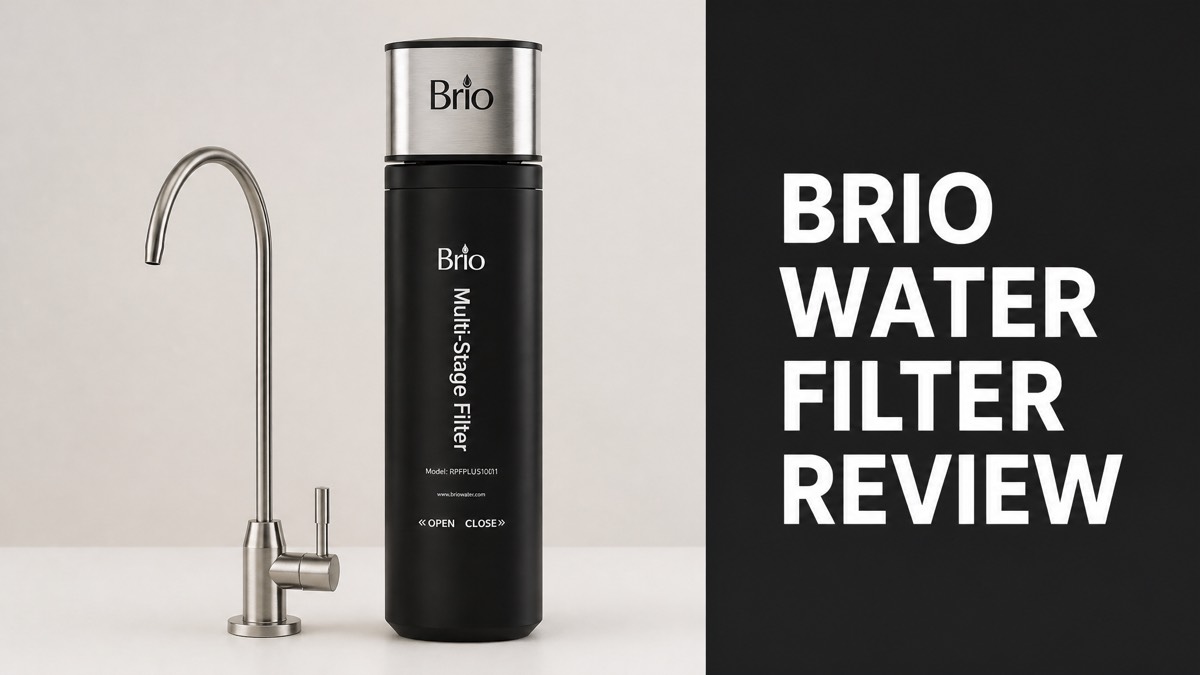
Brio is a water filtration brand that sells under-sink filters and tankless reverse osmosis systems next to its water dispensers. The under-sink line taps the cold-water line and feeds a dedicated faucet. Prices run from $40 to $800 depending on the model, and the range covers renters and homeowners alike.
The line splits into an 11-inch All-in-One filter and a family of tankless RO systems. The Aquus sends less water to the drain than a tank system. Filters twist out from the front in seconds. Certifications vary by model, and independent lab scores sit low for two Brio systems. Ratings run from 3.4 to 4.5 stars.
Customer service scores 2.6 out of 5, which matters for a product that needs filter changes. This review covers the models, the filters, the certifications, the cost, and the verdict. Every answer rests on product specs, certifications, and buyer ratings. Readers learn which Brio fits which home and who skips it.
What Is the Brio Water Filter?
Brio is a water filtration brand that sells under-sink filters, tankless reverse osmosis systems, and water dispensers. To be clear, the Brio water filter most buyers mean is the under-sink line. Those systems tap the cold-water line and send filtered water to a faucet.
The under-sink lineup splits into two groups. All-in-one single housing filters list from $40 to $200. Tankless reverse osmosis systems list from $200 to $800. And neither group needs a storage tank.
The brand also sells whole-house systems, countertop dispensers, and bottleless water coolers. Here's the scope: this review focuses on the under-sink filters and tankless RO units.
Which Brio Water Filter Models Are Covered?
This review covers five under-sink models: the 11-inch All-in-One, the Aquus, the Prism, the SIMPL, and a 700 GPD faucet-mount RO unit.
The 11-inch (28 cm) All-in-One is a three-stage tankless filter with sediment, carbon, and KDF media. The Aquus 600 and Aquus 800 are tankless RO systems with a smart faucet. The Prism is a four-stage 600 GPD RO unit.
The SIMPL is a four-stage 800 GPD tankless RO system. The faucet-mount model produces up to 700 gallons (2,650 liters) per day at a 2:1 pure-to-drain ratio. Every model sits under the sink and needs no storage tank.
Brio Under-Sink Models:
| Model | Type | Capacity |
|---|---|---|
| 11-inch All-in-One | Three-media filter, no RO | 10,000 gallons (37,854 liters) of filter life |
| Aquus 600 | Tankless RO, PCB plus membrane | 600 GPD, 1.5:1 pure-to-drain |
| Aquus 800 | Tankless RO, PCB plus membrane | 800 GPD, 2:1 pure-to-drain |
| Prism | Four-stage tankless RO | 600 GPD, 1.5:1 pure-to-drain |
| SIMPL | Four-stage tankless RO | 800 GPD |
| Faucet-mount | Tankless RO | 700 GPD, 2:1 pure-to-drain |
How Does the Brio Water Filter Work?
Brio filters clean water in stages as it flows from the cold-water line to the faucet. Water passes through sediment and carbon media first. Reverse osmosis models then push that water through a membrane. The faucet delivers the result on demand.
The RO membrane carries pores as small as 0.0001 microns. In plain English, those pores block dissolved solids, heavy metals, and PFAS. The rejected water leaves through a drain line instead of the faucet.
Tankless designs skip the storage tank. So what does that change? Cold water enters the unit when the faucet opens, and the purified water travels straight to the spout. No tank has to refill between glasses.
RO units need inlet water pressure between 30 and 100 PSI (2.1 to 6.9 bar). The reason is simple: scheduled pre-filter changes keep large particles off the membrane. A protected membrane keeps removing microscopic contaminants.
What Filter Stages Does Brio Use?
The 11-inch All-in-One packs three media into one cartridge: polypropylene sediment, activated carbon, and KDF (Kinetic Degradation Fluxion). The cartridge twists and locks into a single housing.
The Aquus pairs a PCB filter with an RO membrane. The PCB filter combines a sediment filter and a carbon block in one cartridge. Water that skips the membrane flows at 2.5 liters (0.66 gallons) per minute.
RO water leaves the membrane at 1 liter (0.26 gallons) per minute. Why so slow? Tiny membrane pores restrict flow compared with the PCB filter. The slower rate is deliberate.
Think of it this way: the smart faucet has two levers. One lever dispenses PCB-filtered water for cooking pasta, watering plants, and rinsing produce. The other lever dispenses RO water for drinking and baby formula.
What Are the Features of the Brio Water Filter?
Brio systems combine compact tankless bodies with fast cartridge swaps and optional smart faucets. The Aquus measures 5.2 x 16.6 x 18.2 inches (13.2 x 42.2 x 46.2 cm). And the small body leaves cabinet room for storage.
The smart faucet shows remaining filter life as a percentage. A built-in TDS meter tracks dissolved solids in the RO water as it pours. The spout reaches 6 inches (15 cm) over the sink.
Key Features:
- Two-lever smart faucet
- LED filter-life percentage
- Built-in TDS meter
- Quarter-turn front-access filters
- 6-inch (15 cm) spout reach
Filters face the front of the Aquus and lock with a quarter turn. Owners change cartridges without tools and without moving the unit. The 11-inch model uses a similar twist-and-lock design.
The Aquus 600 delivers up to 600 gallons (2,271 liters) per day. The Aquus 800 delivers up to 800 gallons (3,028 liters). Those figures count filtered and purified water combined.
Does the Brio Water Filter Remove PFAS and Lead?
Yes. The tankless RO systems target PFAS, lead, arsenic, fluoride, and nitrates, and Brio backs those claims with NSF/ANSI certification.
Brio also states that its Premium under-sink units removed 99% of PFAS, heavy metals, and cysts in testing. The 11-inch High Capacity model carries NSF 42 and 372 instead. Those standards cover chlorine, taste, odor, and lead-free materials.
The catch? Independent data is thin. Water Quality Rank scores the Brio Aquus 43 out of 100 and the Brio 3-Stage Undersink system 35 out of 100. Those scores draw on third-party lab reports. Buyers who want PFAS reduction check the model-specific certificate first.
Is the Brio Water Filter Easy to Install?
Yes. Brio designs its under-sink systems for DIY installation without a plumber. The 11-inch model fits both 3/8 inch and 1/2 inch cold-water lines. Basic tools and the step-by-step instructions cover the job.
The Aquus uses push-to-connect fittings. The fittings seat firmly and seal against leaks. A built-in manifold guards against pressure drops and internal leaks.
Measuring comes first. What does the Aquus need? The unit needs 5.2 inches (13 cm) of width and 18.2 inches (46 cm) of depth. Some sinks need a hole drilled for the dedicated faucet. But buyers unsure about plumbing hire a plumber.
What Do Brio Water Filter Reviews Say?
Brio water filter reviews run mixed to positive across retail pages. The Aquus holds 4.4 out of 5 stars across 15 ratings. The 700 GPD faucet-mount model holds 4.5 stars across 10 ratings. A larger pool of 95 ratings puts the same unit at 4.1 stars.
The good news? Buyers praise the looks and the saved space. The faucet-mount unit earns notes for a tidy design and clear instructions. A replacement filter that outlasted expectations earned a five-star rating.
Taste draws a caution on the Aquus. Does the water taste off? Yes, when drunk too fast after setup. A few pours before drinking clears the problem.
But lower scores appear too. The 3-Stage Under Sink system holds 3.4 stars across 7 ratings, and the SIMPL RO holds 3.7 stars across 34 ratings. The Prism sits at 4.2 stars across 35 ratings.
Rating Snapshot:
| Model | Stars | Ratings |
|---|---|---|
| Aquus | 4.4 | 15 |
| Faucet-mount 700 GPD | 4.5 | 10 |
| Prism | 4.2 | 35 |
| SIMPL | 3.7 | 34 |
| 3-Stage Under Sink | 3.4 | 7 |
What Are the Common Complaints About Brio?
Complaints cluster around water results, customer service, and replacement cost. Here's the thing: the pattern repeats across models.
A 3-Stage Under Sink system installed for two months looks good and installs easily. The water results didn't improve as hoped. The buyer expected a change within a few days.
Customer service scores low. How low? The brand website holds 2.6 out of 5 across 15 service reviews, a Poor rating.
Running costs add up on RO models. Why? A replacement 800 GPD RO membrane lists at $199.99. The PCB filter needs a change every 6 to 12 months, and the RO membrane every 12 to 24 months.
Common Complaints:
- Water results below expectations on the 3-Stage Under Sink
- Poor 2.6 out of 5 service score
- Costly RO replacement membranes
- Off taste if the Aquus is drunk too soon after setup
How Does the Brio Water Filter Compare to Other RO Systems?
Brio tankless RO units trade the storage tank for a smaller footprint and a lower waste ratio. A typical tank system sends 4 cups to the drain for each cup of purified water. And the Aquus 600? Aquus 600 units send 1 cup to the drain for every 1.5 cups of purified water.
The Aquus 800 runs a 2:1 pure-to-drain ratio. The 2:1 ratio wastes less water than the Aquus 600 at 1.5:1. Brio calls these the lowest ratios in the industry.
Brio positions the tankless design as free of the bacteria-growth risk that comes with a stagnant tank. A tank-free body also frees cabinet space.
Brio vs a Traditional Tank RO System: Which Is Better?
Brio tankless Aquus beats a traditional tank system on space, setup, and wastewater. A traditional system pairs a large storage tank with a rack of filters and a tangle of color-coded lines.
Setup also differs. Traditional units take time to connect and then fill, often more than once, before they dispense purified water. So how does the Aquus differ? The Aquus connects with push-fit fittings and dispenses on demand.
Aquus 600 vs Traditional Tank RO:
| Feature | Aquus 600 | Traditional |
|---|---|---|
| Storage tank | None | Large tank |
| Waste ratio | 1 cup drained per 1.5 cups purified | 4 cups drained per cup purified |
| Setup | Push-fit fittings | Rack of filters and color-coded lines |
Brio flow is slower at the RO tap. The membrane delivers 1 liter (0.26 gallons) per minute. A stored tank serves a first glass faster until the tank runs low.
Which Brio Model Fits Which Home?
The 11-inch All-in-One fits apartments, rentals, RVs, and small kitchens that want filtered water without RO. Single-housing bodies slide into tight cabinets.
The Aquus fits homes that want RO water and filtered water from one smart faucet. The Prism suits the same buyer with a black finish and a 600 GPD rating. The SIMPL adds an 800 GPD rating.
Short answer: the 11-inch All-in-One doesn't use RO. Buyers who need dissolved solids, fluoride, or nitrates reduced choose an RO model instead. Brio itself calls RO the highest level of purification.
Is the Brio Water Filter Safe?
Yes. Brio systems carry NSF/ANSI certifications that cover the claims they make. The 11-inch All-in-One holds NSF 42 and 372. The tankless RO line adds NSF 53 and 58, plus UL and CSA electrical safety marks.
NSF 372 confirms lead-free compliance of the wetted materials. UL and CSA marks cover the electrical parts of RO units. Certification differs by model, so check the exact one.
Independent scoring is less flattering. How much less? Water Quality Rank gives the Aquus 43 out of 100 and the 3-Stage Undersink system 35 out of 100. Buyers weigh those scores against the Brio certification claims.
Which Certifications Back the Brio Water Filter?
Four NSF/ANSI standards appear across the Brio tankless RO line: 42, 53, 58, and 372.
NSF 42 covers chlorine and aesthetic reduction. NSF 53 covers health-effect contaminants and underpins the Brio PFAS claims. NSF 58 covers RO system performance. NSF 372 covers lead-free compliance.
The 11-inch All-in-One carries only NSF 42 and 372. Its job covers chlorine, taste, odor, and lead-free materials. Buyers who need membrane-level reduction pick an RO model.
How Much Does the Brio Water Filter Cost?
Brio under-sink systems cost between $40 and $800 by model. All-in-One filters list from $40 to $200. Tankless RO systems list from $200 to $800.
What's more, sales lower those prices. A Black Friday code took an extra 30% off at the time of writing. Orders on the Brio site ship free.
Brio claims its filter and membrane costs over ten years run a fraction of comparable competitor systems. Some rivals cost two to three times more to maintain, per the brand.
How Much Do Replacement Filters Cost?
Replacement filters arrive every 6 to 24 months depending on the model. The 11-inch All-in-One lasts 10,000 gallons (37,854 liters) or up to 24 months. The Aquus PCB filter changes every 6 to 12 months and the RO membrane every 12 to 24 months.
Filter Schedule:
| Filter | Change Interval |
|---|---|
| 11-inch All-in-One | 10,000 gallons or up to 24 months |
| Aquus PCB filter | 6 to 12 months |
| Aquus RO membrane | 12 to 24 months |
A 3-stage replacement set for the ROSL500 lists at $35.30. An 800 GPD RO membrane lists at $199.99. Bottom line: membranes cost the most per change.
Brio offers auto-ship so cartridges arrive right before they are due. And auto-ship removes the guesswork from the 6 to 24 month schedule.
Where to Buy the Brio Water Filter?
Brio sells its filters on briowater.com and through major retailers. Amazon, Home Depot, Walmart, and Wayfair all carry Brio listings.
Purchases on briowater.com include a 30-day change-of-mind return window for items in original condition. The 11-inch model carries a one-year warranty on defects in materials and workmanship. Registering through Brio Care activates the coverage.
Replacement filters also sell at Walmart, Wayfair, and eBay. Buyers match the model number on the filter, such as RPFFUS10011 for the 11-inch system, before ordering.
Is the Brio Water Filter Worth It?
Yes. The Brio water filter is worth it for renters and small kitchens that want easy installation and low waste. The verdict tightens for buyers who want proven contaminant removal.
Let me break that down. The pros are clear. Tankless bodies save cabinet space. Quarter-turn filters change in seconds. The Aquus wastes less water than a tank RO unit, and filter life runs up to 24 months.
The cons are just as clear. What are they? Independent scores for the Aquus and the 3-Stage unit sit at 43 and 35 out of 100, customer service rates 2.6 out of 5, and RO replacement parts cost real money.
Pros:
- Tankless bodies that save cabinet space
- Quarter-turn filter changes
- Lower waste than tank RO systems
- Filter life up to 24 months
Cons:
- Independent scores of 43 and 35 out of 100
- Customer service rated 2.6 out of 5
- Costly RO replacement parts
Bottom line: pick the Aquus or another RO model for contaminant reduction. Pick the 11-inch All-in-One for simple chlorine and taste improvement.
Who Should Skip the Brio Water Filter?
Buyers who rank independent lab scores above convenience skip Brio. The Aquus and the 3-Stage unit score 43 and 35 out of 100.
And homes that need a verified PFAS result on the exact model skip it too. The 11-inch All-in-One lists neither RO nor NSF 53 and 58, so it doesn't fit that need.
Buyers who dislike filter swaps look elsewhere. RO models need a PCB change every 6 to 12 months and a membrane change every 12 to 24 months. Weak customer service ratings push cautious buyers away too.
Pop Kitchen is a reader-supported platform. Purchases made through our links may earn us an affiliate commission at no extra cost to you.