
Brita Water Filter Review: Is It Worth It?
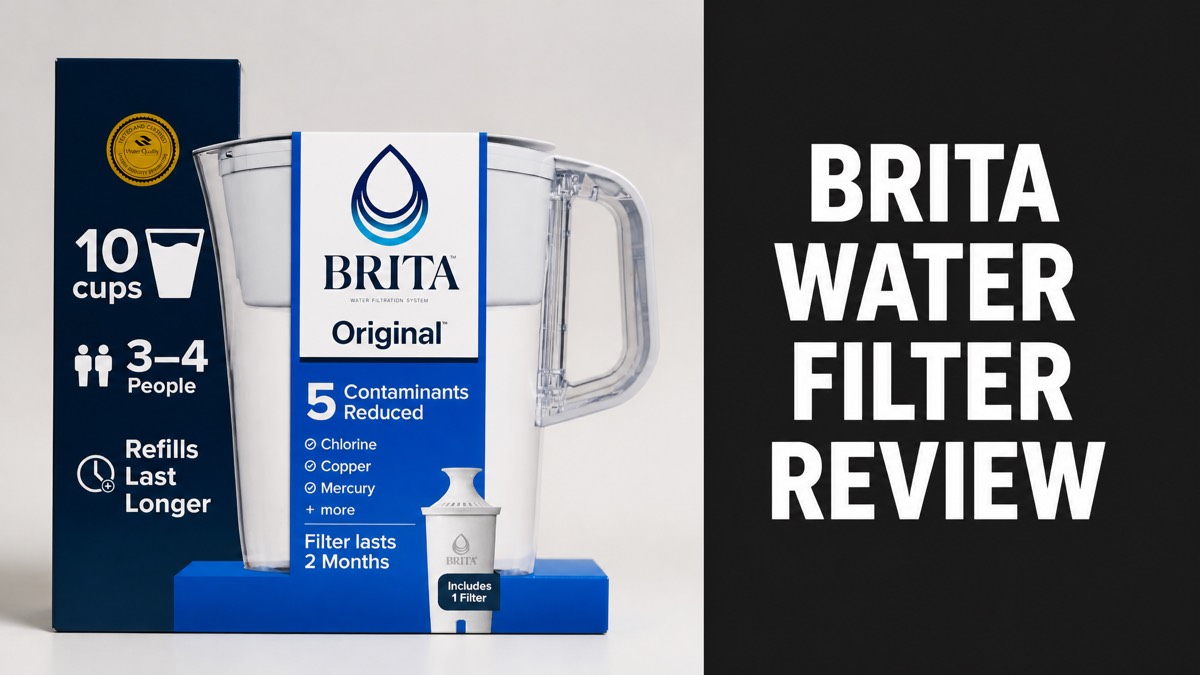
A Brita water filter is a gravity-fed pitcher, dispenser, bottle, or faucet filter that cleans tap water with activated carbon and ion-exchange resin. Heinz Hankammer started the brand in 1966 with a simple garden filter jug. Brita now sells in more than 70 countries and leads the pour-through filter market.
Standard filters last 2 months, and Elite filters last 6 months. Elite cartridges reduce lead, but no Brita filter covers fluoride or hard-water minerals. Taste and speed test well in blind trials and lab work. PUR beats Brita on contaminant coverage, while Brita wins on running cost, filter life, and warranty. Pitchers cost little to run.
A Brita costs between $15 and $180 up front, with replacement filters from $6.13 to $19.99. The verdict leans positive for taste and everyday value. Read on for what each filter removes, where the design falls short, and which buyers should pick a different filter instead.
What Is a Brita Water Filter?
A Brita water filter is a gravity-fed carbon filter that improves the taste and quality of tap water. Brita sells it as pitchers, dispensers, bottles, and faucet systems. Water drips from a top reservoir through the cartridge into a clean lower tank.
Let me break that down: the Brita pitcher is the brand's best-known product. The 10-cup Tahoe costs $36.99 and fits the door shelf of most refrigerators. The Soho holds 6 cups for small fridges. The Rapid Stream holds 10 cups and filters as the water pours.
Dispensers cover larger households. The Ultraslim Stream holds 25 cups and costs $44.99. The Ultramax holds 27 cups and costs $49.99. The countertop Hub holds 12 cups, needs electricity, and costs $179.99.
Brita Pitcher and Dispenser Lineup:
| Product | Capacity | Price |
|---|---|---|
| Tahoe pitcher | 10 cups | $36.99 |
| Ultraslim Stream dispenser | 25 cups | $44.99 |
| Ultramax dispenser | 27 cups | $49.99 |
| Hub countertop system | 12 cups | $179.99 |
Who Makes Brita Filters?
Heinz Hankammer founded Brita in 1966 after building a simple filter jug in his garden to clean dirty tap water. The company carries his daughter's name. Brita now sells its products in more than 70 countries.
Brita backs its filters with a one-year warranty and a 30-day money-back guarantee. A recycling partnership with TerraCycle takes back used cartridges, pitchers, and packaging. The owner only pays to ship the unit.
And Brita holds the largest share of the pour-through filter market. An estimated 70 percent of North American pour-through sales go to the brand. Low prices, wide availability, and decades of marketing built that lead.
How Does a Brita Filter Work?
A Brita filter pushes tap water through carbon and ion-exchange resin by gravity. The standard cartridge combines coconut-based activated carbon with resin in one chamber. Carbon lowers the taste and smell of chlorine. Carbon also lowers mercury.
The ion-exchange resin handles metals. The resin filters zinc, copper, and cadmium out of the water. The resin leaves calcium, magnesium, and fluoride in place. Why does that matter? Those minerals pass through the standard cartridge.
Pore size controls what gets through. Each cartridge uses pores that block some particles and pass others. Faster designs cut the contact time between water and carbon. Stream filters use that trade and remove fewer contaminants.
What Is the Difference Between Standard, Elite, and Stream Filters?
Brita sells three pitcher filters, and the Standard, Elite, and Stream cartridges differ in lifespan and contaminant coverage. Standard lasts 40 gallons (151 liters) or about 2 months. Elite lasts 120 gallons (454 liters) or about 6 months. Stream lasts 40 gallons (151 liters) or 2 months.
The Elite filter is the former Longlast+ cartridge. The cartridge adds a micro-porous fiber layer and removes lead, asbestos, and some volatile organic compounds. Elite fits every Brita pitcher and dispenser except Stream models.
The Stream filter trades coverage for speed. What does it give up? Most of the coverage. The filter works as water pours and removes only chlorine and particulates, so lead and heavy metals stay. Brita advises filtering only 2 gallons (7.5 liters) of water daily with it.
Brita Filter Comparison:
| Filter | Lifespan | Lead Reduction |
|---|---|---|
| Standard | 2 months (40 gallons) | No |
| Elite | 6 months (120 gallons) | Yes |
| Stream | 2 months (40 gallons) | No |
What Does a Brita Filter Remove?
A Brita filter removes chlorine taste and odor plus several metals, and the exact list varies by cartridge. Standard filters reduce chlorine, copper, mercury, cadmium, and zinc. Elite filters add lead, asbestos, and certain organic compounds to that list.
To be clear, Brita uses the word 'reduce' for good reason. A filter that reduces a contaminant cuts the amount without removing every trace. Brita claims reduction, not elimination. Even the Elite filter does not filter out 100 percent of any contaminant.
Certifications define the claims. Brita filters carry NSF or WQA certification to the NSF/ANSI standards 42, 53, and 401. Water Quality Rank scored the Elite pitcher filter 57 out of 100. The score rests on measured removal across 15 contaminant categories.
Does a Brita Filter Remove Lead?
Yes. The Elite filter reduces 99 percent of lead, but the Standard filter does not. Brita certifies the Elite cartridge for lead reduction. Does the Standard cartridge do the same? No. The cartridge removes other metals such as copper and mercury but does not reduce lead.
Buyers who want lead protection need the long-lasting blue Elite cartridge. Brita sells Elite versions of the Tahoe, Denali, Huron, Monterey, and Soho pitchers. Standard filters also fit those pitchers, so the cartridge box needs a check before purchase.
What Does a Brita Filter Not Remove?
A Brita filter does not remove dissolved minerals or most hard-water content. Water that started at 500 ppm of minerals still held 350 ppm after the Standard filter and 300 ppm after the Longlast filter in one three-year test. Brita says total dissolved solids do not measure aesthetic quality.
Lab results show more gaps. Fluoride is the clearest gap. Did the Elite filter reduce it in one tap water test? No, fluoride stayed flat while uranium fell by 26 percent. Nitrate dropped by only 5 percent. Neither Brita nor PUR claims fluoride or uranium reduction.
Brita has not tested its filters for several common worries. The Elite filter is tested to reduce 33 contaminants, and many of them are pharmaceuticals. Fluoride, chromium-6, arsenic, and nitrates are not among the tested claims. Buyers with those concerns need a different filter.
Not Tested For:
- Fluoride
- Chromium-6
- Arsenic
- Nitrates
How Well Do Brita Filters Work in Testing?
Brita filters perform well on taste and speed but only modestly on health-related contaminants. Lab testing of the Elite pitcher cleared chlorine from 1 ppm to 0 ppm. Copper dropped 97 percent. Barium dropped 100 percent.
Speed is a strength. How fast is it? A test of the Elite pitcher measured 2.92 gallons per hour (11 liters per hour). In another test, the Standard filter was the fastest of five pitchers at 40 seconds per cup.
For context, Consumer Reports takes a measured view of all pitchers. Pitchers remove unappetizing flavors and odors at a practical, inexpensive price. Consumer Reports does not call them the most effective way to purify tap water.
Does Brita Water Taste Good?
Yes. Brita-filtered water tastes clean and neutral in blind tests. Reviewed's taste panel preferred Brita Standard water over PUR Basic water. Panelists called it 'most clean' and 'pure'.
The margin was small. Who finished behind? PUR water came a close second and earned comments such as 'clean and refreshing' with 'no aftertaste'. A separate lab review found no taste preference between Brita Elite and PUR Plus.
Elite water also beat an older pitcher in a home blind test. Two tasters slightly preferred the Denali Elite water. The Elite filter cleared chlorine in lab testing, which supports the clean taste.
What Are the Drawbacks of Brita Filters?
Brita filters carry design flaws, narrow contaminant coverage, and plastic construction. Brita pitchers are entirely plastic and cannot go in the dishwasher. The 10-cup pitcher feels bulky to carry and pour. Several models leave the spout open to dust.
Here is the part most people miss: filter claims draw caution too. Brita pitcher filters are certified for a limited set of contaminants. The Standard and Stream cartridges do not reduce lead. Hard-water minerals pass through the cartridges largely intact.
New filters need prep. Brita directs owners to discard three pitchers of water when a new filter goes in. Why? Brita does not state the reason. One tester skipped the step and saw no sediment.
Do Brita Pitchers Have Design Flaws?
Yes. Brita pitchers share a few repeated design flaws. The Tahoe, Soho, and Denali leave the spout open, so dust or bugs can drop in. The Soho let unfiltered water run under the lid while pouring.
Dispensers show other faults. The Ultraslim Stream spigot started leaking after two months of use. Was that a one-off? No, other owners reported the same fault. The Rapid Stream pitcher traps a quarter cup of unfiltered water at the bottom.
An old hygiene question surrounds the six-month Elite filter. A 1990s study found that Brita filters introduced bacteria through biofilm growth after one week. Designs have improved since then, and the current risk is unclear.
Brita vs PUR: Which Is Better?
Brita beats PUR on taste, filter life, and replacement cost. PUR reduces more contaminants. Reviewed named Brita the overall winner and PUR the contaminant winner.
PUR filters cover a wider range of chemicals. The PUR Plus reduced 7 of 8 health-related contaminants in one lab test, while the Brita Elite did less on uranium, strontium, and nitrate. Water Filter Guru scored PUR Plus 7.08 and Brita Elite 6.59 overall.
The good news? Brita offers the better company terms. Brita warrants its filters for one year and offers a 30-day money-back guarantee. PUR warrants its pitchers for 90 days and its cartridges for 30 days.
Which Costs Less to Run, Brita or PUR?
Brita costs less to run each year than PUR. Reviewed priced yearly filters at $25.02 for Brita Standard, $33.00 for Brita Elite, $36.00 for PUR Standard, and $49.98 for PUR lead reduction.
Yearly Filter Cost:
| Filter | Per Year |
|---|---|
| Brita Standard | $25.02 |
| Brita Elite | $33.00 |
| PUR Standard | $36.00 |
| PUR lead reduction | $49.98 |
Per-gallon cost agrees. The Brita Elite ran $0.17 per gallon ($0.04 per liter) in one lab comparison. The PUR Plus ran $0.27 per gallon ($0.07 per liter).
The PUR Plus filter lasts only 30 gallons (114 liters), or 2 months. How does the Elite compare? It lasts 120 gallons (454 liters), four times as long. Brita pitchers also accept cheaper off-brand filters from FilterLogic and Great Value.
How Much Does a Brita Filter Cost?
A Brita setup costs $15 to $180 up front, with the price set by the product. Basic 10-cup pitchers run $15 to $30, and Grand pitchers run $25 to $40. Elite pitchers such as the Tahoe cost $41.99. The Hub countertop system costs $179.99.
Replacement filters set the ongoing cost. How much is that? A single Standard filter costs $6.13, a Stream filter $7.99, and an Elite filter $19.99. Multipacks cut the per-filter price to $4.17 for Standard and $16.50 for Elite.
Single Filter Prices:
| Filter | Price |
|---|---|
| Standard | $6.13 |
| Stream | $7.99 |
| Elite | $19.99 |
Other product lines carry their own costs. The faucet system costs $19.99, with $17.99 replacements about three times a year. Filtering bottles cost $23.99 to $39.99, with 3-pack filters at $14.99. Hub replacements cost about $59.99 a year.
Is a Brita Worth the Price?
Yes. Brita delivers low upfront and running costs for better-tasting tap water. The Standard filter costs about $0.10 per gallon ($0.03 per liter) in one test. The Elite filter costs $0.09 per gallon ($0.02 per liter) in the same test.
Pitchers also beat bottled water. Consumer Reports rates filter pitchers a better economic and environmental choice than disposable plastic bottles. The Brita filter recycling program trims waste further.
The catch: value shrinks when contaminants matter. A buyer who needs fluoride or arsenic reduction pays for a filter that targets neither. Elite and Standard filters suit taste and metals, not every tap water problem.
How Often Should You Replace a Brita Filter?
Brita filters need replacing every 2 to 6 months, with the interval set by the cartridge type. Standard and Stream filters last 2 months, or 40 gallons (151 liters). Elite filters last 6 months, or 120 gallons (454 liters).
Other products follow their own schedule. Filtering water bottles need a new filter every 2 months. Faucet systems need one about every 4 months, or 100 gallons (379 liters).
Electronic indicators track the schedule. Many pitchers carry a light that glows green, yellow, or red as the filter ages. One owner prefers a date label on the pitcher and treats both methods as estimates.
Replacement Schedule:
- Standard filter: every 2 months
- Elite filter: every 6 months
- Stream filter: every 2 months
- Filtering bottle: every 2 months
- Faucet system: every 4 months
Does Hard Water Shorten Filter Life?
Yes. Hard water and heavy sediment shorten Brita filter life. Brita states that owners in hard-water areas may need to change filters more often. Sediment and dissolved solids cut the stated gallon limit.
Faucet filters follow the same rule. High dissolved solids can force a change sooner than the usual 4 months.
Is a Brita Water Filter Worth It?
Yes. A Brita filter is worth it for cleaner-tasting tap water at a low price. The Elite version adds lead protection and a 6-month life. The Standard version suits buyers who only want better taste.
Brita is not the best filter for every worry. Water Filter Guru does not rank the Brita Elite among the very best pitchers available. Consumer Reports calls pitchers a practical option but not the most effective way to purify tap water.
Bottom line: buy the Elite filter for lead protection and fewer changes. Buy the Standard filter for taste alone. Pick a PUR or ZeroWater model for wider contaminant coverage or mineral-free water.
Pros:
- Low upfront and running costs
- Fast filtering
- Elite lead reduction
- Elite 6-month filter life
- One-year warranty
Cons:
- No hard-water mineral reduction
- Limited contaminant testing
- All-plastic build
- Open spouts on several models
Who Should Skip a Brita Filter?
Buyers with fluoride, arsenic, chromium-6, or nitrate worries need a filter tested for those contaminants. Brita pitcher filters carry no such claims. A lab-tested option fits those buyers better.
In plain English: mineral-free water seekers need ZeroWater instead. ZeroWater removes mineral ions to effectively zero, while Brita leaves most minerals in place. ZeroWater filters cost more, at $0.33 per gallon ($0.09 per liter) in one test.
Households that want a closed spout need a specific model. Brita pitchers are plastic, hand-wash only, and often open-spouted. The 6-cup Space Saver model includes a spout cover.
Pop Kitchen is a reader-supported platform. Purchases made through our links may earn us an affiliate commission at no extra cost to you.