
BRUNO Air Fryer Review: Is It Worth the Price?
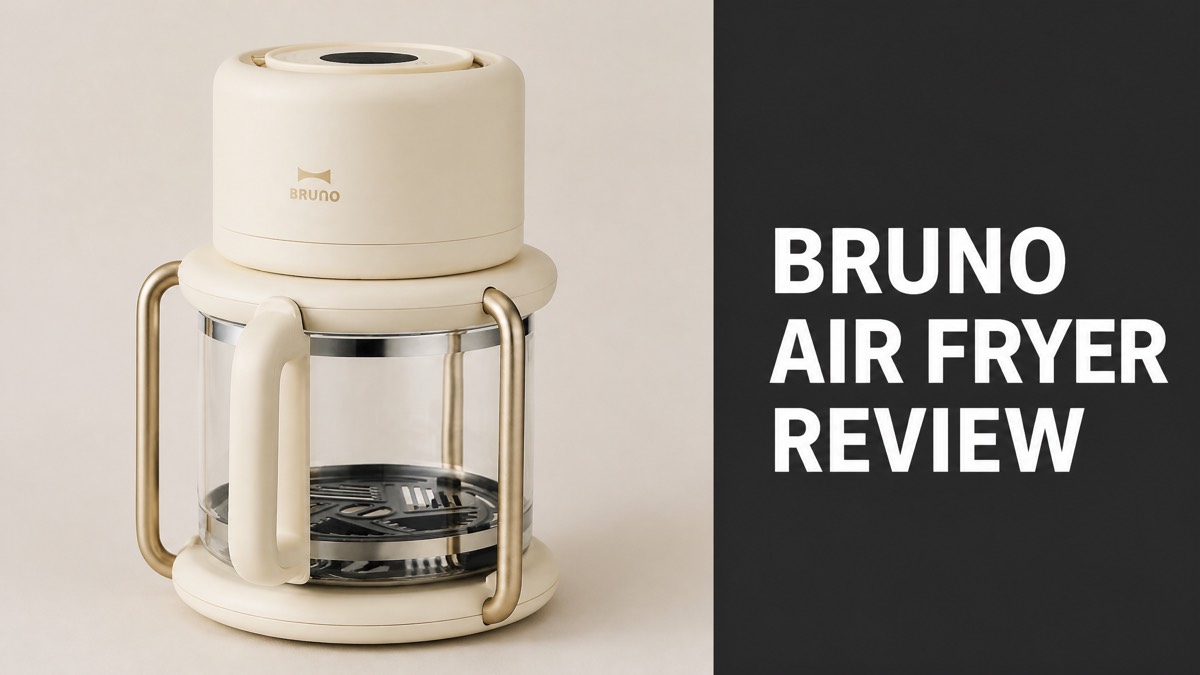
The BRUNO air fryer is a countertop air fryer from the Japanese brand BRUNO. The best-known version, the Compact Glass Air Fryer BOE122, holds 3.5 L (3.7 US quarts) and cooks inside a clear glass basket. The cook watches every stage of browning. A 2.6 L (2.7 US quarts) compact sibling costs less.
The unit cooks with 360-degree heat flow. Twelve presets cover fried chicken, fish, vegetables, and sweets. The glass basket washes easily and holds no odors. Reheated fried food returns crisp, and little sticks to the pan. Fish dinners leave no smell behind. A 3 kg (6.6 lb) body and a small basket count against it.
Singapore prices run from S$168 to S$238, and prices differ a lot by region. A safety switch pauses cooking when the basket comes out. Small households get the most value. Read on for specs, real results, complaints, and a final verdict on whether the glass model earns its price.
What Is the BRUNO Air Fryer?
The BRUNO air fryer is a countertop air fryer from BRUNO, a Japanese brand known for stylish kitchen appliances. Two models cover most listings: the 3.5 L (3.7 US quarts) Compact Glass Air Fryer BOE122 and a 2.6 L (2.7 US quarts) compact model with a solid pan.
The glass model cooks inside a clear borosilicate basket. The cook watches food brown in real time. Twelve preset menus cover fried chicken, fish, vegetables, gratin, sweets, and semi-dried fruit.
Looks drive much of the appeal. Why does that matter? A countertop appliance stays in view every day. The glass model comes in ivory and charcoal black. The compact model sells in five shades: ivory, greige, pink, pale blue, and blue grey.
Which BRUNO Air Fryer Models Exist?
Two BRUNO models matter most to home cooks. The Compact Glass Air Fryer (BOE122) holds 3.5 L (3.7 US quarts) and uses a see-through basket. The compact model (BAK803) holds 2.6 L (2.7 US quarts) and uses a solid pan with a detachable oil filter tray.
The glass model costs more. The glass model sells for S$238 in Singapore, against S$168 for the compact model. The extra money buys a bigger basket, a glass pot, and 12 preset menus.
Marketplace listings also show larger BRUNO-branded ovens. Examples are 5 L (5.3 US quarts) and 18 L (19 US quarts) units. Those listings carry different model numbers and specs, so each one needs its own check. Don't assume the glass model's numbers apply.
What Are the Specs of the BRUNO Air Fryer?
The BRUNO Glass Air Fryer runs on 1,000 W with a temperature range of 60 to 200 °C (140 to 392 °F). The timer spans 1 to 60 minutes, and the temperature moves in 5 °C steps.
The body measures 240 x 308 x 282 mm (9.4 x 12.1 x 11.1 in) and weighs about 3 kg (6.6 lb). The cord runs 1.3 m (4.3 ft). Materials include polypropylene, stainless steel, silicone rubber, and heat-resistant glass.
BRUNO Glass Air Fryer Specs:
| Spec | Value |
|---|---|
| Capacity | 3.5 L (3.7 US quarts) |
| Power | 1,000 W |
| Temperature | 60 to 200 °C (140 to 392 °F) |
| Timer | 1 to 60 minutes |
| Size | 240 x 308 x 282 mm (9.4 x 12.1 x 11.1 in) |
| Weight | About 3 kg (6.6 lb) |
| Cord | 1.3 m (4.3 ft) |
Listings disagree on some numbers. One listing gives 2.8 L, 1,200 W, and 4.6 kg (10.1 lb) for the same BOE122 name. Most listings agree on 3.5 L and 1,000 W, so those figures are the safer ones.
How Does the BRUNO Air Fryer Work?
The BRUNO air fryer cooks with 360-degree heat flow that circulates hot air around the food. A fan and heater in the top unit move the air around the basket. The moving air browns the surface with little or no oil.
The control panel uses touch buttons instead of knobs. The cook sets temperature and time, or taps a preset icon. A clear display shows both values. Smooth surfaces wipe clean faster than dials.
Here's the short version of the safety logic: pulling the basket out pauses cooking. The glass model resumes after a press of the power button, while the compact model resumes on its own. After cooking, the fan runs for 30 more seconds to cool the unit.
What Are the 12 Preset Menus?
The glass model packs 12 preset menus that set temperature and time for common dishes. The list covers oil-free frying, fried chicken, frozen foods, meat, fish, shrimp, vegetables, baked sweet potatoes, gratin, reheating, sweets, and semi-dried fruits.
Recipe posts from owners show the presets at work. The fish preset ran meatballs at 180 °C (356 °F) for 15 minutes. The meat preset cooked an omelette at 180 °C (356 °F) for 10 minutes. Reheat mode revived store-bought fried chicken.
The 12 Presets:
- Oil-free
- Fried chicken
- Frozen foods
- Meat
- Fish
- Shrimp
- Vegetables
- Baked sweet potatoes
- Gratin
- Reheating
- Sweets
- Semi-dried fruits
Presets are optional, and that's a plus. The cook can set any temperature from 60 to 200 °C (140 to 392 °F) by hand. The semi-drying preset runs low and slow for fruit such as oranges and kiwis.
What Are the Benefits of the BRUNO Air Fryer?
The BRUNO air fryer delivers three clear benefits: visible cooking, easy cleaning, and compact storage. Each benefit comes from the same design choice, a clear glass basket on a round base.
Visibility changes the cooking routine. How so? The cook checks doneness without opening anything. One owner watched fried chicken reheat with a partner and enjoyed seeing the oil drip off.
And here is the best part: storage is the third benefit. The main unit nests inside the glass basket when not in use. The design frees counter space in a small kitchen.
Does the BRUNO Air Fryer Actually Make Food Crispy?
Yes. The BRUNO air fryer makes fried food crisp with little or no oil. Reheated supermarket karaage came out crunchier than the microwave version, and fried squid showed the same gap.
Crispness has limits. Where? The bottom of the fried squid stayed a little soggy, and the owner guessed that flipping it halfway would fix that. Packing chicken pieces tightly fused them into one slab, so space between pieces matters.
Fried chicken without frying worked too. The recipe used a potato starch coating and a light oil spray. The result tasted delicious, and the glass wall made it easy to adjust the browning.
The brand claims 34% fewer calories for karaage than deep frying. The figure comes from an internal brand comparison, not an independent test.
Is the BRUNO Air Fryer Easy to Clean?
Yes. The glass basket, grill rack, and heater protective cover all detach and wash with mild detergent. The round bottom has no corners, so a sponge reaches everywhere.
Smell stays out. Does fish leave a trace? No. Salmon baked in parchment left no odor in the glass after washing. Glass resists odors, so fish dinners become practical.
The main unit and base need only a slightly damp soft cloth. Neither part goes into water. Not ever. The glass basket dries upside down to prevent water pooling.
Cleaning Steps:
- Detach the glass basket, grill rack, and heater protective cover.
- Wash those parts with mild detergent.
- Wipe the main unit and base with a slightly damp soft cloth.
- Invert the glass basket to air dry.
What Do BRUNO Air Fryer Reviews Say?
BRUNO air fryer reviews lean positive, with an average of 4.0 out of 5 stars across 102 ratings at a major online retailer. More than 100 units sold there in a single recent month.
Written feedback is thin. Why? The glass model only launched in 2025, so long-term durability reports are scarce. Owners who do write describe daily use for reheating frozen food and light cooking.
And buyers who researched before purchase found the same pattern. Posts showed appetizing recipes and regular use, even when that use was only reheating frozen food.
What Do Owners Like About the BRUNO Air Fryer?
Owners praise the clear basket, easy cleanup, and stylish design most. To be clear, the three points show up again and again in buyer posts.
One owner cooked meat at high heat for long stretches and found very little stuck to the pan. Residue rinsed off with water and needed no scrubbing.
Looks matter too. Buyers describe the soft cream body and clear glass as cute enough to keep on the counter. Reheating works well: store-bought fried foods return crispy while the oil drips off.
Pros:
- Clear basket shows the food
- Easy to wash with no corners
- Little food sticks to the pan
- Glass resists odors
- Main unit nests inside the basket
- Reheated fried food returns crispy
The glass basket weighs less than it looks. One owner washed it with one hand by holding the handle.
What Are the Common Complaints About the BRUNO Air Fryer?
The most common complaints center on weight, capacity, price, and support. None of them break the product, but each can sour a purchase.
Weight surprises shoppers. How heavy is it? The glass model weighs about 3 kg (6.6 lb), and one buyer who carried it home wished for online delivery. The same owner also planned a dedicated shelf for it.
Capacity limits batch size. The 2.6 L (2.7 US quarts) compact model is listed for one to four people. Tight packing in the glass model fused chicken pieces, so bigger meals need two batches.
The bad news? Support adds friction. The Japan listing ships a Japanese manual. The E1 error code signals an abnormal signal and needs servicing through the distributor. The warranty runs one year and requires online registration within 7 days of purchase.
Cons:
- Weighs about 3 kg (6.6 lb)
- Small basket limits batch size
- Tight packing fuses food
- Japanese manual on the Japan version
- Servicing runs through the local distributor
How Does the BRUNO Air Fryer Compare to Basket-Style Models?
The BRUNO air fryer trades some capacity for looks, visibility, and easy cleaning compared with basket-style models. The solid pan and the glass walls drive that trade.
One owner compared a BRUNO against a Xiaomi air fryer. The Xiaomi left dried sauce that needed toothbrush scrubbing, and meat juices overflowed inside the unit. The BRUNO pan rinsed clean with water.
A solid pan beats a thin wire basket here. Why? Food residue sticks to wire and resists scrubbing. The BRUNO rack also carries two large openings that serve as grips for easy removal.
Which Is Better: BRUNO Glass or BRUNO Compact?
The glass model wins on capacity and features, and the compact model wins on price. Glass holds 3.5 L (3.7 US quarts) and offers 12 presets. Compact holds 2.6 L (2.7 US quarts) and costs S$168 against S$238.
Power and range differ. The compact unit lists 1,400 W and 80 to 200 °C (176 to 392 °F). The glass unit lists 1,000 W and 60 to 200 °C (140 to 392 °F). The lower floor suits the semi-drying preset.
Glass vs Compact:
| Feature | Glass (BOE122) | Compact (BAK803) |
|---|---|---|
| Capacity | 3.5 L (3.7 US quarts) | 2.6 L (2.7 US quarts) |
| Power | 1,000 W | 1,400 W |
| Temperature | 60 to 200 °C (140 to 392 °F) | 80 to 200 °C (176 to 392 °F) |
| Presets | 12 | None listed |
| Price in Singapore | S$238 | S$168 |
Cleaning favors different designs. The glass basket shows the food and resists odors. The compact pan has an easy-clean coating and a detachable oil filter tray. Both models pause when the basket comes out.
Is the BRUNO Air Fryer Safe?
Yes. The BRUNO air fryer includes several built-in safety protections. A safety switch pauses cooking when the basket comes out. A heater protective cover and silicone anti-slip pads sit on the base.
Cool-down is automatic. How long does it take? The fan runs for 30 seconds after cooking ends. The glass basket uses high borosilicate glass rated for a 150 °C (302 °F) temperature difference.
First use needs a burn-off run. Here's why: it eliminates the odors. The unit runs empty at 180 °C (356 °F) for 15 minutes before the first meal. A faint odor during that run is normal. Later cooks preheat for 3 minutes.
Who Should Avoid the BRUNO Air Fryer?
Large households, bargain hunters, and buyers without a matching mains voltage fit the BRUNO air fryer poorly. Each group hits a different limit.
Voltage deserves a check. Why? The Japan edition lists AC 100 V. The UK edition lists 220 to 240 V with a UK plug. The Singapore edition lists 220 to 240 V with a 3-pin plug. Each edition suits only its own regional supply.
Big families outgrow the baskets. The compact model is listed for one to four people, and tight packing in the glass model ruins texture. Large meals mean batch cooking.
Budget shoppers face a wide price spread. Retail prices run S$168 to S$238 in Singapore, and the glass model costs ¥13,200 in Japan.
How Much Does the BRUNO Air Fryer Cost?
The BRUNO air fryer costs S$168 for the compact model and S$238 for the glass model in Singapore. Japan prices the glass model at ¥13,200. Amazon Japan lists it at €67.80 after a 9 percent discount.
Prices vary widely by region. How wide is the gap? The same glass model sits at S$238 in Singapore and €67.80 (list €74.58) on Amazon Japan. Region, currency, and plug version all differ between those listings.
BRUNO Air Fryer Prices:
| Model | Market | Price |
|---|---|---|
| Glass | Singapore | S$238 |
| Glass | Japan | ¥13,200 |
| Glass | Amazon Japan | €67.80 |
| Compact | Singapore | S$168 |
The compact model undercuts the glass one by S$70. At launch, all five shades sold at the same S$168 across Singapore stores.
Where to Buy the BRUNO Air Fryer?
The BRUNO air fryer sells at Amazon Japan, Japan Trend Shop, and a range of regional retailers. The UK store happycooking.uk carries the BOE122 with a UK plug. HipVan and FairPrice list the glass model in Singapore.
The compact model reached Singapore through color-specific stores. Takashimaya sold pink, Tangs sold pale blue, Crate & Barrel sold greige, and Cote Maison sold blue grey. Prices matched across them.
UK orders over £50 ship free at happycooking.uk. Cote Maison showed the pink compact model as sold out, so stock varies by color and store.
Is the BRUNO Air Fryer Worth It?
Yes. The BRUNO air fryer is worth it for one to four people who want easy cleanup and a good-looking appliance. The glass model adds see-through cooking and 12 presets for a higher price.
Bottom line: buyers who need big batches or the lowest price are better served elsewhere. The 3.5 L (3.7 US quarts) basket and the 3 kg (6.6 lb) body carry real limits.
Who Should Buy the BRUNO Air Fryer?
Small households, apartment cooks, and reheating fans get the most from the BRUNO air fryer. The nesting design saves counter space, and the glass basket makes cooking fun to watch.
Pros and cons weigh out clearly. Visible cooking, easy washing, odor-free glass, and crisp reheating balance against a small basket, a 3 kg (6.6 lb) body, a high price in some markets, and servicing through local distributors.
To put it simply, shoppers who want a classic opaque basket, a large capacity, or a rock-bottom price pass on it. For everyone else, the glass model earns its spot on the counter.
Pop Kitchen is a reader-supported platform. Purchases made through our links may earn us an affiliate commission at no extra cost to you.