
Camco Water Filter Review: Is It Worth It?
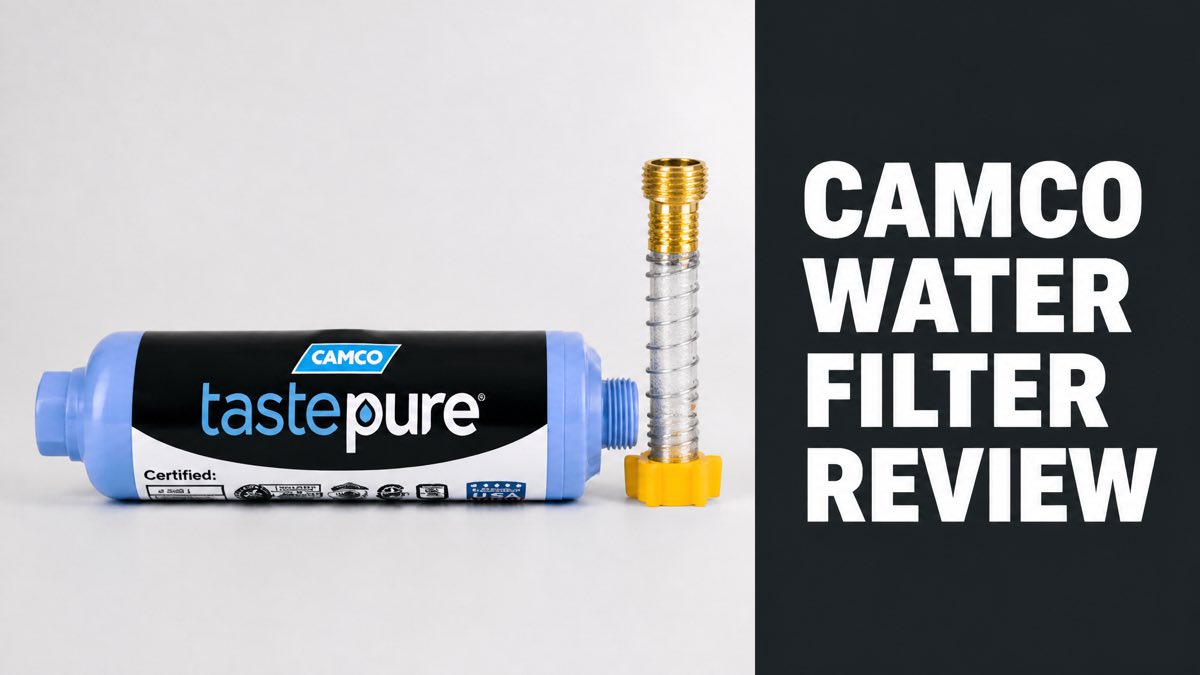
The Camco water filter is a disposable inline filter that screws onto a garden hose to clean RV and marine water. Camco sells it as the TastePURE line, with GAC and KDF media, a 20-micron sediment layer, and a flexible hose protector in the box. The design is patented and made in the USA.
The filter improves the taste and smell of campground water. Camco lists NSF/ANSI 42, 53, and 372 certifications, and each filter lasts about three months. The filter does not soften hard water, and a few housings fail early. Leaks show up at some trailer connections. Setup takes one step at the spigot or the RV inlet.
The two pack has sold for $28.97, which works out to about $14.49 per filter and keeps each replacement cheap. The sections below cover what the filter removes, how it compares with the EVO and dual-stage systems, and who should skip it. The verdict at the end weighs the pros and cons.
What Is the Camco Water Filter?
The Camco water filter is a disposable inline filter that screws onto a garden hose to clean RV and marine water. Camco sells it as the TastePURE line, with the single filter listed as model 40043. A flexible hose protector ships with it.
Camco has made RV products since 1966. Where did it start? With one person and one product: antifreeze. The home office sits in Greensboro, North Carolina. The TastePURE filter carries a patented design and a made in the USA label.
Here's the part that trips people up: the same filter comes in several packs. Model 40045 is the two pack. The TastePURE XL (model 40019) is a bigger version with more capacity. Camco also sells a marine version, model 40645.
What Does It Remove?
The filter reduces bad taste, odor, chlorine, and sediment in hose water. Granular activated carbon (GAC) handles the chlorine taste and smell. A 20-micron internal sediment filter blocks silt and grit.
What It Reduces:
- Bad taste
- Odor
- Chlorine
- Sediment
KDF media controls bacteria and mold growth inside the filter while it sits unused. What does that protect? The cartridge in storage, not your drinking water. To be clear, the filter does not disinfect unsafe water.
Short answer: a taste-and-sediment filter is not a purifier. Water from a source that may be microbiologically unsafe needs proper treatment first. The filter belongs on a known potable source.
How Does the Camco Water Filter Work?
Water passes through six filtration layers inside a sealed polypropylene housing. Camco calls the design Hex-Flow. The media include a sediment layer, GAC, and KDF.
A wide-body design keeps the flow strong, so water runs efficiently through the filter. The filter sits inline between the spigot and the hose, or between the hose and the RV. Any standard garden or drinking water hose fits.
For example, the housing measures 3.1 inches deep, 3.9 inches wide, and 7.6 inches tall (7.9 by 9.9 by 19.3 centimeters). The filter weighs 1.1 pounds (0.5 kilograms). The material is polypropylene.
Which Certifications Does It Carry?
The filter carries NSF/ANSI 42 and NSF/ANSI 53 listings, plus CSA lead-free certification to NSF/ANSI 372. NSF/ANSI 42 covers aesthetic effects such as chlorine taste and odor. NSF/ANSI 372 covers lead-free content.
Certifications:
- NSF/ANSI 42
- NSF/ANSI 53
- NSF/ANSI 372 (lead-free)
The standard numbers do not mean every contaminant is removed. So what should you check? The certification directory, because certified claims belong to the exact model listing and model number.
And the product also complies with all federal and state lead-free laws.
Does the Camco Water Filter Actually Work?
Yes. The filter improves the taste and smell of campground water for most users. Chlorine odor drops, and grit stays out of the tank. Full-time RVers use the filter for years.
A full-time RVer ran the filter for eight years with one failure. A missing flexible coupling at the faucet caused the break. In fact, a camper who uses about 25 nights per year runs one filter for a whole season.
Some users doubt the effect because they never drink campsite water. So why keep buying the filter? Because clean, odor-free water from the faucets is proof enough for them.
Bottom line: the filter averages 4.7 out of 5 stars. The score reflects easy setup, better taste, and good value for the cost.
Does It Soften Hard Water?
No. The filter does not remove water hardness. Calcium carbonate passes through the carbon and sediment layers. Only 10 to 20 ppm drops out.
One buyer measured a drop from 446 ppm to 164 ppm in San Diego tap water. So do the results agree? No. Another buyer measured only 10 to 20 ppm, and the two numbers point in opposite directions.
The truth is, buyers whose main goal is hardness removal should not treat this filter as the solution. The car-wash spot claim overstates what the media does.
Does the Camco Water Filter Leak?
Yes. The filter leaks at the trailer connection for some users. Leakage complaints center on that one connection.
A few customers saw the housing blow apart after only a few days of use. Most users never hit this problem.
The good news? A flexible coupling between the filter and the faucet protects the connection. A 90-degree elbow, about $4, keeps the hose from kinking at the inlet. A 30 to 50 PSI (2.1 to 3.4 bar) pressure regulator protects the hose and the RV plumbing.
How Do You Install and Replace the Camco Water Filter?
Installation attaches to a standard hose in one step. The filter screws onto a standard garden hose thread. The hose then connects to the open end.
Placement is flexible. Many campers install the filter right at the campground spigot, then run the hose to the trailer. Others install it where city water meets the camper. And both setups work.
Here's why: a new filter needs a one minute flush before drinking.
Steps:
- Screw the filter onto the spigot or the RV inlet.
- Connect the hose to the open end.
- Flush the new filter for one minute before drinking.
How Long Does It Last?
Each filter lasts an average of three months. The two pack covers about six months of filtration. Actual life depends on water quality and frequency of use.
A camper who uses about 25 nights per year runs one filter for a whole season. What happens at winterizing? That user throws the filter out and opens a new one in spring.
Here's a simple trick: use a permanent marker. Writing the install date on the side of the housing tells the owner when to swap.
But replace the filter sooner if the flow drops. Advertised capacity is not a guarantee for every campsite.
How Does the Camco Water Filter Compare With Other RV Water Filters?
The TastePURE sits in the budget inline category of RV filters. Inline filters are compact and screw straight onto a hose. Dual-stage systems use separate cartridges and need more space.
Rivals include the AQUA CREST inline filter, the GLACIER FRESH four pack, the Culligan RVF-10, and the PUREPLUS dual-stage system. In plain English, each one targets a different camping style.
AQUA CREST lists a flow rate of 0.5 gallons per minute (1.9 liters per minute) and a life of about three months. The media include KDF and coconut-shell carbon. The certifications are NSF/ANSI 42 and 372.
The Culligan RVF-10 rates its cartridge at 250 gallons (946 liters). The housing is reusable with a five year warranty. The compact size fits tight storage bays.
Filter Comparison:
| Filter | Type | Life |
|---|---|---|
| Camco TastePURE | Inline, GAC and KDF | About 3 months |
| AQUA CREST | Inline, KDF and carbon | About 3 months |
| PUREPLUS | Dual-stage | 3-6 months per set |
| Culligan RVF-10 | External housing | 250 gallons per cartridge |
How Does the Camco TastePURE Compare With the Camco EVO?
The EVO uses an external housing with a replaceable cartridge, while the TastePURE is a sealed disposable unit. The EVO package includes the housing, a 12-inch (30 centimeter) extension hose, and a replaceable polypropylene cartridge. KDF protects the cartridge when idle.
The EVO suits tight spaces. Owners swap only the cartridge, not the whole filter. By comparison, the TastePURE needs no housing and no extra parts.
How Does It Compare With Dual-Stage Systems?
Dual-stage systems filter in two separate steps. The Beech Lane system pairs a 5-micron sediment filter with a 0.5-micron carbon block. The PUREPLUS pairs a 5-micron sediment cartridge with a 1-micron carbon block.
Dual-stage kits mount on a bracket and need space in a storage bay. What's more, the cartridges replace separately. The PUREPLUS advertises up to 13,000 gallons (49,210 liters) or three to six months per set.
Full-timers who stay put for months gain the most from this design. Weekend campers need a simpler, cheaper inline filter. So the TastePURE fits short trips.
How Much Does the Camco Water Filter Cost?
The two pack has sold for $28.97, down from a list price of $44.99. That works out to about $14.49 per filter. Prices change often.
The TastePURE XL sells for $26.99 at Camping World, reduced from $40.99. The sale cuts 34 percent off the list price.
Price Snapshot:
| Option | Price | List Price |
|---|---|---|
| TastePURE two pack | $28.97 | $44.99 |
| TastePURE XL | $26.99 | $40.99 |
| Two pack, per filter | $14.49 | $22.50 |
Replacement is a recurring cost. One filter lasts about three months. So how many does a year-round user need? Several each year.
Is It Worth the Price?
Yes. The filter costs little compared with bottled water. One camper dropped bottled water entirely and drinks from the tap through the filter. The camper also frees storage space that cases of water used to fill.
The value case weakens for buyers chasing water hardness goals. Why? Those buyers pay for a feature the filter does not offer.
And the two pack adds a spare for mid-season. The pack also lowers the per-filter price.
Is the Camco Water Filter Worth It?
Yes, for most RV owners. The Camco water filter earns its place as a cheap taste and sediment filter. The filter scores 4.7 out of 5 stars. At the two pack price, each filter costs under $5 per month of use.
The drawbacks are real. Some housings fail early, and leaks show up at the trailer connection. Is that a dealbreaker? For most users no, since most never hit the failure. Still, the filter leaves water hardness untouched.
Pros:
- Improves taste and odor
- Blocks sediment
- Attaches to a hose in one step
- Carries lead-free certification
Cons:
- Some housings fail early
- Leaks at the trailer connection for some users
- Does not soften hard water
- Needs replacement about every three months
Bottom line: buy the filter for taste, odor, chlorine, and grit. Skip it for hardness or safety concerns.
Who Should Skip the Camco Water Filter?
Buyers who need hard water softening should look elsewhere. The filter removes only 10 to 20 ppm. A dedicated treatment fits that goal.
Anyone with microbiologically unsafe source water needs proper treatment, not a taste filter. And full-timers who stay for months may prefer the larger XL or a dual-stage system.
Pop Kitchen is a reader-supported platform. Purchases made through our links may earn us an affiliate commission at no extra cost to you.