
Philips Series 3000 Double Hot Air Fryer NA353 Review: Is It Worth It?
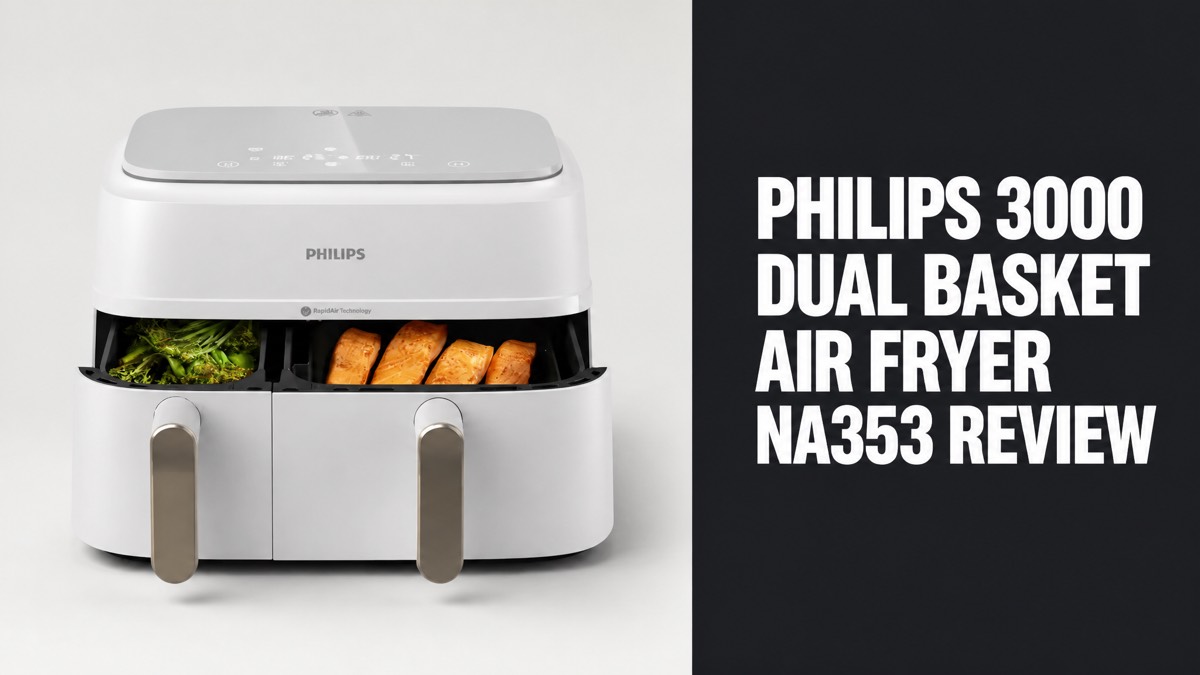
The Philips Series 3000 Double Hot Air Fryer NA353 is a white, two-drawer air fryer with 9 liters (9.5 quarts) of total capacity. The NA353 shares its hardware with the NA350, NA351 and NA352, so this review covers the whole 3000 Series Dual Basket family for everyday home cooks.
The two drawers hold 6 and 3 liters, and Rapid Air Plus Technology cooks food evenly. Sync finish ends both cooks together. The fryer runs slower than its rivals and tops out at 200 degrees Celsius (400 degrees Fahrenheit). Owners rate it highly, though most complaints target grease on the serving plate and the missing viewing windows.
Energy use and price also work in the Philips favor against the Ninja and Cosori. The big picture is simple: gentle, even cooking beats raw speed for most households. Read on for presets, drawer sizes, honest owner complaints and a clear verdict on who the fryer suits.
What Is the Philips Series 3000 Double Hot Air Fryer NA353?
The Philips Series 3000 NA353 is a two-drawer air fryer with 9 liters (9.5 quarts) of total capacity. Rapid Air Plus Technology drives the hot air, and the unit carries a 2750 watt rating.
The NA353 name is a model code. A white version appears as the NA353/19 at a UK retailer, and a French retailer lists an NA353/10. Both sit on the same 3000 Series Dual Basket platform as the NA350, NA351 and NA352.
The design suits couples and small families. One drawer can hold meat while the other holds vegetables. The small drawer handles a lunch for one. Why does that matter? The small drawer avoids heating a full-size basket.
A touchscreen control panel sits on top of the unit, and eight presets cover common foods. The top placement keeps the panel away from splatter.
How Does the NA353 Differ From Other 3000 Series Models?
The NA353 differs from its siblings mainly in colour and region code, not in cooking hardware. The NA353/19 is white, while the NA351/00 is black and the NA352/00 is charcoal grey with copper.
Every listing shares the same 9 liter capacity, unequal drawers and eight presets. A copper-handle version is almost identical to the standard one. So does the colour change the cooking? No. Shoppers can choose on looks alone.
Buyers comparing the NA350, NA351, NA352 and NA353 need to check the colour and the retailer rather than the specification sheet. Region codes after the slash, such as /19 or /10, mark the local market.
How Does the Philips 3000 Dual Basket Air Fryer Work?
Rapid Air Plus Technology circulates heat around and through the food in both drawers. Philips patented the design to give crispy, tender and evenly cooked results, and food needs no flipping halfway through.
A patented starfish-shaped groove on the base of each basket boosts airflow. The groove makes cleaning trickier. Why accept that? The groove boosts airflow. The raised base also rules out cooking straight on the drawer floor without the insert.
Air frying is the only cooking mode. The unit has no bake, roast or dehydrate setting. Based on test observations, the fan appears to run at one speed across every preset.
How Do Sync Finish and Copy Settings Work?
Sync finish lets two drawers with different cook times end together. Each drawer gets its own time and temperature. So how do both finish together? The drawer with the longer time starts first, and the second joins once the remaining times match.
Copy settings duplicate the time and temperature from one drawer to the other. In one test unit, the function worked in manual mode only and copied from the left drawer to the right.
A shake reminder is built into the frozen fries and fresh fries presets. A user can switch it on or off for any other preset by selecting the drawer and pressing the shake symbol.
What Features Does the Philips NA353 Have?
The NA353 gives manual control from 40 to 200 degrees Celsius (104 to 400 degrees Fahrenheit) with a timer from 1 to 60 minutes. Extra time can be added midway through a cook.
The baskets are non-stick and dishwasher safe. Philips didn't disclose the exact coating, either in the booklet or when asked directly.
The fryer is not a smart appliance. The Philips Home ID app holds recipes and the full manual, but the app cannot program the unit.
The body measures about 444 by 383 by 314 millimeters (17.4 by 15 by 12.3 inches) and weighs 17 pounds (7.7 kilograms). The power cord runs 80 centimeters (31 inches).
Key Specs:
| Spec | Value |
|---|---|
| Large drawer | 6 liters (about 6 quarts) |
| Small drawer | 3 liters (about 3 quarts) |
| Temperature range | 40 to 200 degrees Celsius (104 to 400 degrees Fahrenheit) |
| Timer | 1 to 60 minutes |
| Presets | 8 |
| Weight | 17 pounds (7.7 kilograms) |
| Cord length | 80 centimeters (31 inches) |
What Cooking Presets Does It Include?
The control panel offers eight presets: frozen fries, fresh fries, chicken, meat, fish, vegetables, cake and reheat. Each preset has its own default time for the large drawer and the small drawer.
Preset temperatures vary by food. Frozen potato snacks run at 200 degrees Celsius (392 degrees Fahrenheit), fresh fries and vegetables at 180 degrees (356 degrees), and cake at 140 degrees (284 degrees). Reheat runs at 160 degrees (320 degrees) for 5 minutes.
Presets:
- Frozen fries
- Fresh fries
- Chicken
- Meat
- Fish
- Vegetables
- Cake
- Reheat
Presets are a starting point only. Why? Frozen foods and fish differ too much in size for one fixed time. The presets stay discreet on the panel, so manual mode is easy to reach.
How Big Are the Two Drawers?
The large drawer holds 6 liters (about 6 quarts), while the small drawer holds 3 liters (about 3 quarts). The unequal split gives the large side room for a full main dish.
Philips rates the large drawer for a 1.5 kilogram (3.3 pound) chicken. A tester squeezed in a 1.8 kilogram (4 pound) bird by breaking the breastbone, so a smaller bird fits better. A whole butternut squash also fits.
The small drawer fits a surprising amount of chicken tenders. Its flat plate-like insert leaves extra cooking space. The large drawer uses a high-sided insert with rubber grips that stays put.
Does the Philips 3000 Dual Basket Air Fryer Cook Well?
Yes. The Philips 3000 Dual Basket cooks very evenly and handles meat especially well. Fries come out fluffy inside and crispy outside, and chicken tenders stay juicy.
Vegetables caramelize without drama. Cubed butternut squash browned evenly even without a mid-cook shake. Broccoli stems did not scorch at a lower temperature, which shows the heat control is accurate.
The unit renders fat well. Why did the bacon come out crispy? The fat cleared the meat, although the batch needed 10 minutes at 350 degrees Fahrenheit (175 degrees Celsius) instead of the usual 6 minutes.
A full roast dinner works too. A long-term owner cooked pork loin, roast potatoes, carrots and Yorkshire puddings. Everything came out crispy and juicy, not dry.
Is It Fast Enough?
No. The Philips 3000 Dual Basket is not the speediest air fryer. Frozen fries at the 400 degree Fahrenheit (200 degree Celsius) maximum needed more than 20 minutes to crisp.
To be clear, the 400 degree Fahrenheit ceiling is standard but lower than some rivals. The Ninja Foodi Max reaches 240 degrees Celsius (464 degrees Fahrenheit), which suits crispy pork skin better.
Why is it slower? Gentle, even heat is the trade. Test results justified the wait. Cooks who want the fastest crisp will prefer a hotter model.
What Do Owners Say About the Philips NA353?
Owner scores run high. The manufacturer listing shows 4.8 out of 5 from 65 ratings, with 100 percent recommending the product. Retail feedback on the NA353/19 also reads positive.
And long-term use backs up the scores. One owner cooked with the fryer for eight months and rated it 4 out of 5. Food stayed evenly cooked, crispy and not dry.
Here is the pattern: owners praise the easy operation and the cooking quality, while complaints focus on design details rather than food results.
What Do Owners Like Most?
Owners like the simple operation most. Touch buttons respond even with wet hands, and the layout needs little learning.
The two drawer sizes win praise. The small drawer suits one portion, and the large drawer feeds a family. Several owners say they now use the oven far less.
Build quality also scores well. Owners describe the unit as sturdy with a premium feel, and the top-mounted panel stays cleaner than a front panel.
What Are the Common Complaints?
The most common complaint is grease on the serving plate. The basket cannot be lifted out of the drawer while serving. So where does the grease go? Onto the plate with the food.
And the drawers have no viewing windows. Cooks must open a drawer to check progress. Cooks used to windows on other models miss them.
The full manual is digital only. A QR code on the basic guide leads to a download or the Philips Home ID app. One buyer also found no visible controls until the unit was switched on.
The panel layout draws a small gripe. The start button sits close to the timer down arrow, so a quick tap can start a cook early.
Common Complaints:
- Grease falls onto the serving plate
- No viewing windows on the drawers
- Full manual is digital only
- Start button sits close to the timer arrow
Philips 3000 Series vs Ninja and Cosori: Which Is Better?
The Philips 3000 Series wins on usable space and price but trails on temperature range and timer length. A head-to-head test crowned the Cosori the narrow overall winner.
The Ninja Foodi Max holds 9.5 liters and runs from 40 to 240 degrees Celsius for up to 12 hours. Ninja ships a printed manual and offers phone support with remote video help.
The Cosori Dual Basket holds 8.5 liters and runs from 35 to 230 degrees Celsius for up to 48 hours. Cosori also adds a preheat option and ships a printed manual.
The Philips offers 9 liters, 40 to 200 degrees Celsius and 1 to 60 minutes. Philips ranked first for usable space. List price sits about 50 pounds below the Ninja.
Dual Basket Comparison:
| Model | Capacity | Temperature | Timer | Manual |
|---|---|---|---|---|
| Ninja Foodi Max | 9.5 liters | 40 to 240 degrees Celsius | Up to 12 hours | Printed |
| Cosori Dual Basket | 8.5 liters | 35 to 230 degrees Celsius | Up to 48 hours | Printed |
| Philips 3000 Series | 9 liters | 40 to 200 degrees Celsius | 1 to 60 minutes | Digital only |
Which Dual Basket Air Fryer Uses Less Energy?
The Philips 3000 Series uses the least energy per half liter of capacity among the three. Cosori came second and Ninja third.
The test ran both drawers for 10 minutes at 200 degrees Celsius (392 degrees Fahrenheit). Capacity and wattage differ by model, so the comparison divides power use by capacity.
Why does it use less? A less powerful fan likely explains the result. Cooking times showed no large penalty, and the Philips also used less power than the Ninja Foodi Max despite a higher wattage rating.
How Much Does the Philips NA353 Cost?
The Philips 3000 Dual Basket retails for about $199 in the United States and often drops to $149 at Amazon. Another listing shows $210.38.
UK pricing starts at 179 pounds and often falls to 149 pounds. A January sale pushed the model down to 99.99 pounds from 179.99 pounds, the lowest price since launch.
The price sits level with Ninja and Instant. Philips costs more than budget brands such as Bella and Dash.
Price Snapshot:
| Market | Usual Price | Sale Price |
|---|---|---|
| United States | $199 | $149 |
| United Kingdom | 179 pounds | 149 pounds |
| United Kingdom, January sale | 179.99 pounds | 99.99 pounds |
Amazon lists the fryer on its own and bundled with a breakfast kit. Which costs less? Sometimes the bundle.
Where Can You Buy It?
Major retailers list the 3000 Series Dual Basket in the United States, with listings at Best Buy, Home Depot, Wayfair, Walmart and Crate and Barrel.
In the UK, Currys sells the white NA353/19, and John Lewis and Amazon carry other 3000 Series colours. A French retailer lists the NA353/10.
Philips sells a skewer rack and a combined egg and toast rack as accessories. Both are standard add-ons for dual basket models.
Is the Philips NA353 Safe and Reliable?
Yes. The Philips NA353 has excellent build quality and runs quietly. Everything feels solid from the moment the unit leaves the box.
Noise averages 65 to 66 decibels with both drawers at maximum temperature. The beeps are quiet, which suits noise-sensitive households and not cooks who leave the room.
A plastic piece in the box doubles as a cord holder and a fender. The fender keeps the unit off the wall so the rear hot air outlets stay clear.
But one gap remains. Philips didn't name the non-stick coating of the baskets. Philips has a long history here, since the company developed the first air fryer with a Dutch engineer.
What Does the Warranty Cover?
The warranty lasts two years and starts automatically at purchase, with no registration needed.
Support runs through a phone line and a WhatsApp option in the UK. Other regions use a support form on the Philips site.
Cosori also gives two years without registration. Ninja gives one year automatically, and the second year needs registration within 28 days.
Is the Philips NA353 Worth It?
Yes. The Philips NA353 is worth buying for couples and small families who value even results, especially at a sale price.
The good news? The pros are clear. The fryer cooks evenly, runs quietly, feels sturdy and offers unequal drawers with sync finish. Low energy use adds to the case.
Pros:
- Even cooking
- Quiet operation
- Sturdy build
- Unequal drawers with sync finish
- Low energy use
The bad news? The cons are just as clear. The cooking runs slow, the maximum is 200 degrees Celsius (400 degrees Fahrenheit), the drawers have no windows, and the full manual is digital only. Air frying is the sole mode.
Cons:
- Slow cooking times
- 200 degree Celsius maximum
- No viewing windows
- Digital manual only
- Air fry is the only mode
Bottom line: the pros win for everyday meals. The fryer earns its place when the price drops toward $149.
Who Should Skip It?
Speed-focused cooks need a hotter model, since the Philips trades pace for evenness and tops out at 200 degrees Celsius.
Bakers and dehydrators gain little here. The timer stops at one hour, and air frying is the only mode.
Cooks of liquid dishes face limits too. The raised pattern on the drawer base makes wet foods awkward, and a multicooker suits that job better.
Pop Kitchen is a reader-supported platform. Purchases made through our links may earn us an affiliate commission at no extra cost to you.