
Toshiba Countertop Microwave Oven Air Fryer Combo Review: Is It Worth It?
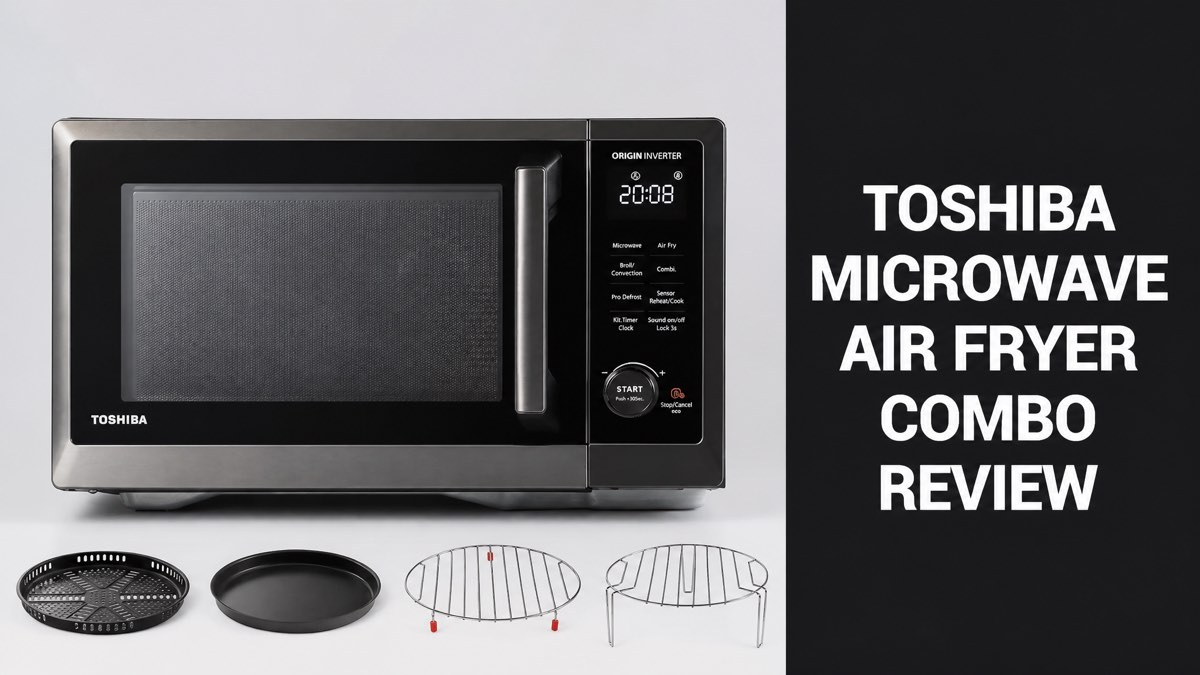
The Toshiba countertop microwave oven air fryer combo is one counter appliance that microwaves, convection bakes, broils and air fries. Toshiba sells it in 4-in-1 to 8-in-1 versions built by Midea, with capacities from 0.9 to 1.5 cubic feet (25 to 42 liters). Each version sits on the counter like a standard microwave.
Convection baking and microwave basics work well, while air frying trails a standalone air fryer. Controls differ by model, and the 8-in-1 uses a rotary dial with no number pad. Owners rate the line near four stars out of five, yet reliability and value split opinion. Retail prices and models vary widely.
Safety also needs attention, because Consumer Reports flagged 28 incidents of units starting on their own. Prices run from about $200 to $313 for common versions, so cost matters. Read on to learn which model fits, what owners complain about and whether the combo is worth buying.
What Is the Toshiba Countertop Microwave Air Fryer Combo?
The Toshiba countertop microwave air fryer combo is a single appliance that microwaves, air fries, convection bakes and broils. Toshiba sells it in versions from 4-in-1 to 8-in-1, and each one sits on the counter like a normal microwave.
To be clear, Midea builds Toshiba-brand microwaves. Some versions add inverter technology, and others rely on standard power control. Capacity runs from 0.9 to 1.5 cubic feet (25 to 42 liters).
The pitch is simple: one box replaces a microwave, a small oven and an air fryer. Small kitchens gain the most from that trade.
What Comes in the Box?
The box holds the oven, a glass turntable, racks, a baking tray and a recipe book. Exact extras depend on the model.
Most versions ship with two wire racks and a bake tray. The OptiChef 7-in-1 adds an air fry basket. Cookbook size varies from 27 to 47 recipes by version.
Included accessories:
- Glass turntable
- Two wire racks
- Bake tray
- Air fry basket (OptiChef 7-in-1)
- Recipe book with 27 to 47 recipes
This is important: none of the metal racks or the tray belong in a microwave mode. The manual for the 4-in-1 states that no accessory is safe with microwave functions. Combination modes therefore need a plate that survives both heat and microwaves.
How Does the Toshiba Microwave Air Fryer Combo Work?
The oven pairs a microwave magnetron with a convection fan and a heating element. The microwave side heats food from the inside. The convection side circulates hot air at up to 425°F (218°C) on the 6-in-1.
In plain English, air fry mode is convection cooking with a preset. On the 8-in-1, the Air Fry and Bake buttons share one display icon. Why does that matter? Air frying there equals standard convection with a preset temperature.
Combination modes run the microwave and the oven together. Timing tests on the 8-in-1 showed setting C-1 pairing convection with about 25% microwave power. Setting C-2 pairs the broiler with about 40% microwave power.
Now, inverter models hold power steady instead of cycling it on and off. Toshiba says that gives even heating and defrosting. The 6-in-1 runs at 50 decibels, roughly 20 decibels quieter than non-inverter microwaves.
How Crispy Does the Air Fry Mode Get?
Air fry results land below a standalone air fryer. In one kitchen test, frozen fries stayed soft after 30 minutes at 350°F (177°C). Did the crispness ever arrive? No. The fries stayed soft the whole time.
Toshiba listings promise crisp nuggets, fish and fries without added oil. Real results vary. Air-fried hard-boiled eggs at 250°F (121°C) for 15 minutes also fell short in testing.
Better results come from a preheat, the supplied tray or basket and the preset air fry menus. Pizza improves in convection mode on a rack, because air reaches the bottom crust. A combination-mode pizza stayed soft underneath.
What Features and Specs Matter Most?
Four specs decide how the oven performs: wattage, capacity, turntable size and cooking modes. Microwave output runs about 1,000 watts, and the 6-in-1 adds up to 1,800 watts of convection heat.
Inverter models add steadier power and quieter running. Sensor models add a humidity sensor that adjusts power and time automatically. Preset counts run from 25 to 31 by version.
The 8-in-1 adds low-temperature modes. Settings L1 to L4 cover yogurt, proofing, keep warm and slow cook from 105°F to 230°F (41°C to 110°C). The longest timer runs 12 hours.
Small extras add polish: a mute button, a child lock, a five-minute deodorizing fan cycle and a turntable that returns to its start position.
How Big Is It Inside and Out?
Outside, the 6-in-1 measures 19.5 by 17.6 by 11.5 inches (49.5 by 44.7 by 29.2 cm). Other versions run about 20 inches (51 cm) wide.
Inside, the 1.0 cubic foot models fit a 12-inch (30 cm) pizza, an 8 by 4 inch (20 by 10 cm) casserole or a whole roasting chicken. The 1.5 cubic foot 4-in-1 fits a 6-pound (2.7 kg) chicken.
Clearance matters for ventilation. How much room does the oven need? Three inches (7.6 cm) on each side and on top, plus 1 inch (2.5 cm) at the back. The 8-in-1 weighs about 40.6 pounds (18.4 kg).
What Are the Benefits of This Combo Oven?
The main benefit is counter space. One appliance covers microwaving, baking, broiling, air frying and defrosting, so two other machines can leave the kitchen.
Convection baking earns the strongest praise. Single-serve cakes baked to a fluffy, moist crumb in about 35 minutes at 350°F (177°C). The same mode suits roasting vegetables, fish and meat.
The good news? Microwave basics work well too. A frozen dinner came out piping hot, with no cold middle, after seven minutes. The popcorn preset popped a 3.2 ounce (91 g) bag almost completely in 2:30.
Defrost modes add finesse. The 8-in-1 offers seven custom defrost settings for vegetables, fruit, chicken, fish, meat, broth and timed thawing.
Main benefits:
- Counter space saved
- Convection baking that works
- Reliable microwave basics
- Custom defrost settings
How Easy Is It to Use?
Ease of use depends on the model. The 4-in-1 proved intuitive in testing: each function has its own button, and the manual answers setup questions.
The bad news? The 8-in-1 is harder. How much harder? Time entry runs through a rotary dial with no number pad, so setting 6:30 takes 39 clicks. The dial climbs in 5 second steps to one minute, then 10, 30 and 60 second steps.
Manuals add friction. The 8-in-1 manual leaves air fry out of its cookware table and words the clock steps oddly. Presets print inside the door, which helps.
Pay attention to this: wrong cookware is the common trap. Metal racks and trays work only in oven modes, while paper fails in oven modes. Every mode demands a quick mental check.
Which Toshiba Model Fits Best?
The right model depends on household size and budget. The 4-in-1 ML-EC42P offers 1.5 cubic feet for families. The 6-in-1 MASTER Series packs inverter power into 0.9 cubic feet for small kitchens.
The 8-in-1 sits in the middle at 1.0 cubic foot. The 8-in-1 delivers 25 presets, 1,000 watts of output and 12-inch pizza capacity at a lower price than inverter models.
The OptiChef 7-in-1 holds 1.0 cubic foot and adds a humidity sensor and an air fry basket. Its 12.4 inch (31.5 cm) turntable beats the 11.3 inch (28.7 cm) turntable on the 6-in-1. The OptiChef PRO MAX tops the range at 1.3 cubic feet with a color screen.
Model comparison:
| Model | Capacity | Standout |
|---|---|---|
| 4-in-1 ML-EC42P | 1.5 cu ft | Family capacity |
| 6-in-1 MASTER Series | 0.9 cu ft | Inverter power, small footprint |
| 8-in-1 | 1.0 cu ft | 25 presets, lower price |
| OptiChef 7-in-1 | 1.0 cu ft | Humidity sensor, air fry basket |
| OptiChef PRO MAX | 1.3 cu ft | Color screen |
How Does It Compare to a Standalone Air Fryer?
A standalone air fryer still wins on crispness. The tester's own Ninja air fryer outperformed the Toshiba's air fry mode on fries.
The combo wins on versatility. What can a standalone air fryer not do? Standalone models cannot microwave, defrost or bake a cake in a ramekin. Toshiba packs those jobs into one footprint.
Price tilts the choice too. Combo ovens list at $200 to $313, while standalone models listed beside them start at $139.99. Buyers who already own an air fryer gain little from the air fry mode.
What Do Owners Say About It?
Owners rate the combo near four stars out of five. The 8-in-1 holds 4.0 stars across 1,291 ratings, the 6-in-1 holds 4.2 across 743 and the OptiChef 7-in-1 holds 4.2 across 783.
Praise centers on versatility and quiet running. Owners like the counter space saved and the even reheating from inverter models.
But reliability and value split opinion. Owners of the 1.0 cubic foot stainless model call it versatile and quiet, yet the same group flags reliability, durability and value for money.
What Are the Common Complaints?
Complaints cluster around reliability, controls and value. Some owners report units failing within 6 months, and others say the convection or broiler section stopped working.
Controls draw criticism on several models. The rotary dial on the 8-in-1 makes timing slow, and the display blinks busily in complex modes. The bake tray also sits a bit large on the low rack.
Air fry doubts show up often. Testers question whether the mode differs from plain convection. Manual gaps leave owners guessing about combination settings.
And hot surfaces round out the list. The tight cavity puts stainless steel walls close to food, so burns come easier than in a larger oven.
Common complaints:
- Reliability failures
- Slow rotary dial controls
- Air fry doubts
- Hot surfaces in a tight cavity
What Are the Safety Concerns?
The main concern involves reports of units starting or adding cooking time on their own. Consumer Reports published a safety alert on June 25, 2026 covering certain Toshiba microwaves and air fryer combos.
How big is the problem? The alert counts 28 incidents filed with the Consumer Product Safety Commission between January 2023 and April 2026. Reports describe overheating, sparks, smoke and melting. All but four involve the ML2-EC10SA or its black stainless version, the ML2-EC10SA(BS).
Other cited models include the ML2-EC09SA (two incidents), the EM131A5C (one) and the EM925A5A-SS (one). Consumer Reports has not tested these models, and the group has not seen the problem in Toshiba microwaves it did test.
What Does the Manufacturer Say?
Midea, which builds Toshiba microwaves, acknowledges a power button issue on the ML2-EC10SA. What is the issue? A spokesperson said the button can stick and trigger the 30-second add-time function unintentionally.
The company found no evidence of a safety risk and says any effect stays inside the unit. Owners with the issue can call 866-646-4332 for free service. Midea did not comment on melting parts or smoke, and six complainants say they received no remedy.
So, Consumer Reports advises caution for owners of affected models. The advice: monitor the oven while it runs, never leave it unattended, keep the cavity empty when idle and unplug it after use. Problems can be reported at SaferProducts.gov.
Consumer Reports advice:
- Monitor the oven while it runs.
- Never leave the oven unattended.
- Keep the cavity empty when idle.
- Unplug the oven after use.
How Much Does It Cost?
Current listings run from about $200 to $313 for the common 1.0 cubic foot versions. The 8-in-1 lists at $199.99 on Amazon after an 11% cut from $223.99.
Why such a wide spread? Inverter and sensor models cost more. The OptiChef 7-in-1 lists at $312.99 at Walmart, down from $499.99. The 6-in-1 lists at $229.99, down from $389.99. The OptiChef PRO MAX reaches $477.70.
The 4-in-1 sells at $219.99 at Walmart and Amazon, and $254.99 at Lowe's. Short answer: sale prices sit well below list on several models, so list price rarely matches the real price.
Listed prices:
| Model | Current price |
|---|---|
| 8-in-1 (Amazon) | $199.99 |
| 4-in-1 (Walmart, Amazon) | $219.99 |
| 4-in-1 (Lowe's) | $254.99 |
| 6-in-1 | $229.99 |
| OptiChef 7-in-1 (Walmart) | $312.99 |
| OptiChef PRO MAX | $477.70 |
Where to Buy It?
Major retailers stock the Toshiba combo in most versions: Amazon, Walmart, Lowe's, Home Depot and Target all list Toshiba air fry microwaves.
Toshiba's own US site lists fewer models, and the 4-in-1 no longer appears there. Retail listings change fast, and one 8-in-1 Walmart page showed out of stock.
Warranty coverage matters more given the reliability reports. What does Walmart offer? Protection plans of 3 years at $39 and 4 years at $49 on the OptiChef.
Is the Toshiba Microwave Air Fryer Combo Worth It?
Yes. The Toshiba combo is worth it for buyers who want one appliance for microwaving, baking and light air frying. Pricing sits between $200 and $313 for most versions.
The pros are clear. Convection baking works, microwave basics work and inverter models run quietly. The counter space saved is real.
But the cons are clear too. Air frying trails a standalone air fryer, controls frustrate on some models and the safety reports around the ML2-EC10SA call for caution.
Pros:
- Convection baking works
- Microwave basics work
- Inverter models run quietly
- Counter space saved is real
Cons:
- Air frying trails a standalone air fryer
- Controls frustrate on some models
- Safety reports around the ML2-EC10SA
Bottom line: the balance tips positive for small kitchens and negative for crispy-food fans. Why? Counter space is the biggest gain, and air frying is the biggest gap.
Who Should Skip It?
Buyers who care mostly about crispness are better served by a standalone air fryer. Test results show fries staying soft even after 30 minutes.
Buyers who only need a microwave can find one for far less. A plain microwave heats just as well.
Anyone uneasy about the auto-start reports can pick a different model or brand. Owners of the ML2-EC10SA can monitor the oven and unplug it after each use.
Pop Kitchen is a reader-supported platform. Purchases made through our links may earn us an affiliate commission at no extra cost to you.