
Xiaomi Air Fryer Review: Is It Worth the Price?
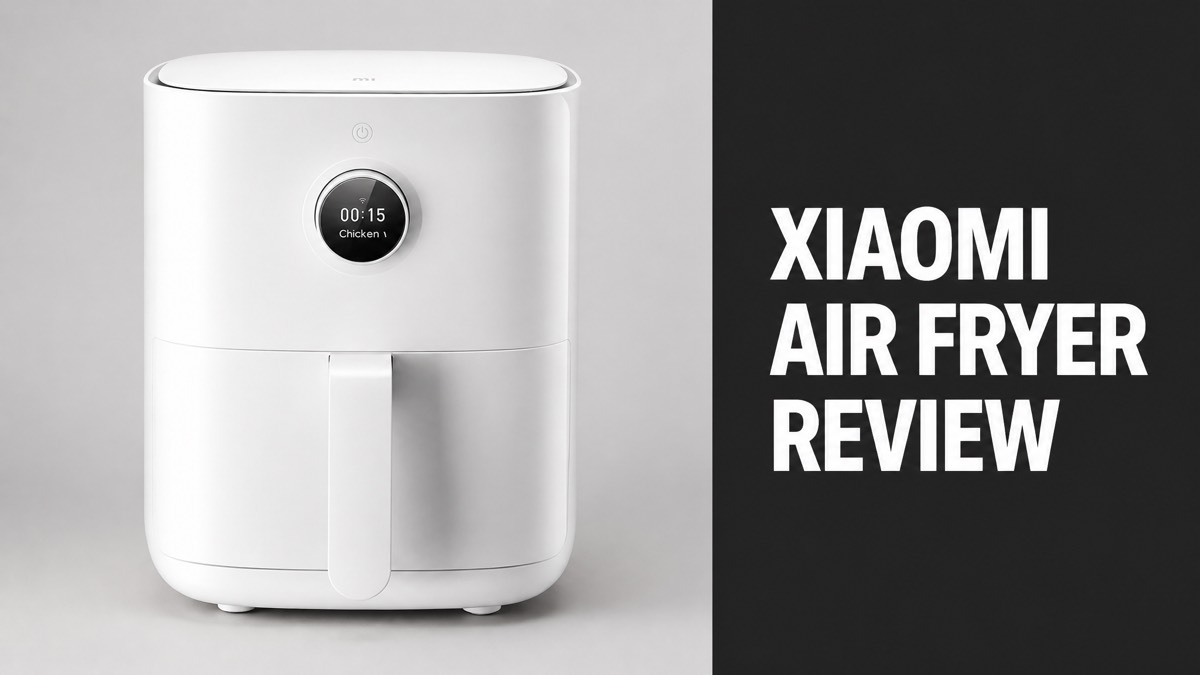
The Xiaomi air fryer is a compact, Wi-Fi-enabled air fryer from the well-known smartphone maker. The best-tested model, the Mi Smart Air Fryer 3.5L, packs 1,500 W, a round OLED display and app control into a white, glossy body built for one or two people at home. Weight stays under 5 kg (11 lb).
The guide below covers how the fryer works, which features matter and how it cooks fries, wings and a full breakfast. Next come the weak points: a low 200 °C (392 °F) ceiling, a small 3.5 L basket, a fiddly basket fit and app recipes that need checking. Price, multi-cooker comparisons and buyer fit follow.
The big picture is simple. Xiaomi trades raw power for convenience, a low price and clean design. Read on to learn who benefits, who needs a different machine, which pros and cons matter most and whether the Xiaomi air fryer earns a permanent place on your kitchen counter.
What Is the Xiaomi Air Fryer?
The Xiaomi air fryer is a compact smart air fryer from the phone maker, built around Wi-Fi app control and a small round display. The model with the most hands-on testing is the Mi Smart Air Fryer 3.5L, a white unit with a glossy plastic shell.
Retail specifications for the 3.5L list 1,500 W of power and a 40 to 200 °C (104 to 392 °F) temperature range. The box holds the fryer, a grill rack and a user manual.
Dimensions measure 33.5 x 25.2 x 30.4 cm (13.2 x 9.9 x 12.0 inches). Weight is quoted between 3.9 and 4.6 kg (8.6 to 10.1 lb), so one person moves the unit around the kitchen with ease.
What Sizes Does Xiaomi Offer?
Xiaomi sells air fryers from 3.5 liters up to a 12-liter double-stack model. Common sizes include 3.5 L (3.7 qt), 4.5 L, 5.5 L and 6.5 L, plus a 12 L dual-basket version for bigger households.
Larger models raise the power rating. So how much more power do you get? The 4.5 L carries 1,500 W, the 5.5 L carries 1,600 W and the 6.5 L carries 1,800 W. The 6.5 L also reaches 220 °C (428 °F), which is 20 °C (36 °F) higher than the 3.5 L.
The global 4.5 L model adds 24-hour scheduling, more than 100 app recipes and 360-degree convection. Most hands-on testing still covers the 3.5 L, so the rest of this review focuses there.
Power by Size:
| Size | Power |
|---|---|
| 3.5 L | 1,500 W |
| 4.5 L | 1,500 W |
| 5.5 L | 1,600 W |
| 6.5 L | 1,800 W |
How Does the Xiaomi Air Fryer Work?
The Xiaomi air fryer cooks food by circulating hot air around the basket. Inlets on the top edges pull air in, an outlet at the back vents the hot air, and grills at the base dissipate heat.
A grill rack splits the 3.5 L basket into two layers. Two layers let a cook prepare two foods at once. A seven-layer composite coating with a dual-layer PTFE nonstick finish lines the basket.
Pulling out the basket pauses cooking. What happens when you slide it back in? The cycle resumes without any button press. A beep and an on-screen reminder tell the cook when to shake the food.
How Does the App Control Work?
The app control links the fryer to a phone through the Xiaomi Home app over Wi-Fi. The app detects the fryer through Bluetooth 4.0, then joins it to a 2.4 GHz network (802.11b/g/n). Pairing takes a few careful steps. Is it quick? Not really, since it can take a while.
Once paired, the app offers manual mode, favorite recipes, custom recipes and settings. The app also starts and pauses cooking, shows the time remaining and schedules a meal up to 24 hours ahead.
Voice control works through Amazon Alexa and Google Assistant. Voice commands start or pause the fryer and report the cooking time left.
What the App Does:
- Manual mode
- Favorite and custom recipes
- Start, pause and time remaining
- Scheduling up to 24 hours ahead
- Voice control through Alexa and Google Assistant
What Features Does the Xiaomi Air Fryer Have?
The Xiaomi air fryer offers air frying, grilling, baking, reheating and defrosting from one compact body. Seven preset menus cover common foods such as fries, vegetables, cakes and potato chips.
The 24-hour timer opens up slow jobs. What kind of jobs? Yogurt takes up to 8 hours, dried fruit takes 5 hours and dried meat takes 4 hours. A low 40 °C (104 °F) floor also suits dehydrating and proofing dough.
Look at the front and you'll see a dial with a small OLED display. The dial sets time and temperature, picks presets and changes the language, so the fryer works without the app.
Key Functions:
- Air frying
- Grilling
- Baking
- Reheating
- Defrosting
Is the Xiaomi Air Fryer Easy to Clean?
Yes. The Xiaomi air fryer cleans up quickly thanks to a nonstick basket and a wipe-clean white shell. The coating comes clean in seconds, and a single wipe handles the outer body.
The drawer and crisper tray are dishwasher-friendly. The greasiest parts go straight in the dishwasher, which removes the worst of the mess.
The outer shell still gets dirty easily. Why does that matter? Grease and food residue build up after only a couple of days of use, so regular wipe-downs stop it.
Does the Xiaomi Air Fryer Cook Well?
Yes. The Xiaomi air fryer cooks fries, wings, frozen snacks and breakfast foods well once the settings are tuned. Results improve when the cook moves from presets to manual control.
Wings come out crisp outside and cooked through inside. One test crisped Cajun-spiced wings in about 8 minutes after a start in a cast iron skillet. A full breakfast of bacon, egg and frozen haggis cooked in 7 minutes at 180 °C (356 °F).
Here's the catch: capacity limits the batch. Only about two bacon slices fit at a time, and bulky vegetables fill the basket fast.
Test Cooking Times:
| Food | Time and Setting |
|---|---|
| Hand-cut fries | 15 minutes at 180 °C (356 °F), plus 1 minute at 200 °C |
| Packaged fries | As little as 7 minutes |
| Cajun wings | About 8 minutes |
| Full breakfast | 7 minutes at 180 °C (356 °F) |
Does It Make Crispy Fries?
Yes. The Xiaomi air fryer makes crispy fries, though the 200 °C (392 °F) ceiling holds back the crunch. Hand-cut fries crisped in 15 minutes at 180 °C (356 °F), plus one minute at 200 °C, with a spray of oil.
In fact, packaged fries finish in as little as 7 minutes with a pinch of salt. The fries preset takes about 19 minutes, so manual settings save time once the cook knows the machine.
Crunch varies by food. Why do some foods come out less crisp? The low maximum temperature leaves some chips, frozen spring rolls and wings less crisp than on hotter rival models. Adjusting the timing by hand recovers much of that crunch.
Are the App Recipes Reliable?
No. The app recipes need checking before use because some settings run far too hot or too long. The crispy tofu recipe called for 600 g (1.3 lb) of tofu at 200 °C (392 °F) for 24 minutes and produced rock-hard cubes. Was that a one-off? Not quite, since a second try at 180 °C (356 °F) for 16 minutes gave the same hard result.
A custom 7-minute program at 180 °C (356 °F) fixed the problem. Chicken pieces take that same program twice. The tofu then came out crisp outside and juicy inside.
The recipe library is still large, at roughly 100 entries, and gives step-by-step instructions. Turning on the preheat step improves results across the recipes.
What Are the Problems With the Xiaomi Air Fryer?
The Xiaomi air fryer has four main weaknesses: a small basket, a modest top temperature, a fiddly basket fit and a thin recipe ecosystem. To be clear, none breaks the machine, but each narrows the list of ideal buyers.
The basket needs correct positioning before the cook pushes it in. A basket set at the wrong angle will not close fully, and the fryer will not start. A few tries fix the habit.
Community support is thin. Few online cooks share Xiaomi-specific recipes, so inspiration comes mostly from the built-in app list.
Main Weaknesses:
- Small 3.5 L basket
- Modest 200 °C (392 °F) top temperature
- Fiddly basket fit
- Thin recipe ecosystem
Is 3.5 Liters Big Enough?
No, not for families. A 3.5 L (3.7 qt) basket feeds one or two people comfortably and strains at three or more.
Fries fill the basket for two people. What about a third person? Bulky vegetables leave little space, so the basket runs out of room fast. Families of three or more need the 4.5 L or 6.5 L Xiaomi models, or a multi-cooker.
Short answer: single cooks gain the most. A hot meal for one takes minutes, with no pans to scrub and no full-size oven to heat.
How Does the Xiaomi Air Fryer Compare With a Multi-Cooker?
A multi-cooker covers far more dishes, while the Xiaomi air fryer stays focused on fried-style food. The air fryer suits a short list of quick jobs, and the multi-cooker suits varied cooking.
A Ninja Foodi multi-cooker with an air frying function made slightly tastier fries in a home comparison. Most multi-cooker recipes skip the mid-cook pause to turn the food. Does the Xiaomi skip it too? No, the Xiaomi needs that pause.
Price and footprint favor the Xiaomi. The fryer is compact, stores easily in a cupboard and sits at a lower price point than a multi-cooker.
Do Smart Features Beat a Standard Air Fryer?
No. Smart features add convenience but do not change how the food cooks. The cooking matches a standard air fryer, so capacity and temperature matter more than the app.
The app earns its place for scheduling and remote checks. Scheduled cooking, a start from another room and voice control suit smart-home households.
Here's the thing: manual control wins day to day. The cook stands at the machine to load food, so the dial gets more use than the phone. One tester preferred the dial for everything by week two.
How Much Does the Xiaomi Air Fryer Cost?
The Xiaomi 3.5L air fryer sits at the budget end of the market, at about £79.99 in the UK, around $100 in the US and from ₹9,999 in India. Retailers often discount it below those figures.
Availability varies by region. Amazon carries it in the UK, and Xiaomi sells it through its official website and Mi Home Stores in India. Check the current price before buying, since sales change it often.
Launch pricing in India included a ₹2,000 pre-order discount. So early buyers paid less than the ₹9,999 starting price.
Starting Prices:
| Region | Price |
|---|---|
| UK | £79.99 |
| US | Around $100 |
| India | From ₹9,999 |
Does It Pay for Itself?
Yes. The Xiaomi air fryer can nearly pay for itself for people who cook small meals. Frying with little to no oil trims the cooking-oil bill.
A full electric oven is hard to justify for one or two portions. Why is that? The air fryer heats only a small basket, so a quick meal uses less energy than an oven.
Larger households lose most of the savings. The small basket needs several batches, which cancels the time and energy advantage.
Who Should Buy the Xiaomi Air Fryer?
The Xiaomi air fryer suits singles and couples who want healthier fried food with minimal effort. Busy cooks get a hot meal in minutes, with little oil and little cleanup.
Smart-home households gain the most. Alexa, Google Assistant and the Xiaomi Home app slot into an existing setup, and the sleek white design blends into most kitchens.
And budget shoppers fit the bill too. The price stays low while the build quality and feature set remain well-rounded.
Who Should Skip the Xiaomi Air Fryer?
Large families outgrow the 3.5 L basket and need a bigger model. A household of three or more fills the basket quickly and cooks in several batches.
Cooks who want maximum crunch fall short at a 200 °C (392 °F) ceiling. Anyone who never uses Wi-Fi gets more capacity per dollar from a non-smart model.
And cooks who want variety miss out too. An air fryer handles mostly fried-style food, while a multi-cooker handles diverse dishes.
Is the Xiaomi Air Fryer Worth It?
Yes. The Xiaomi air fryer is worth it for one or two people who want a simple, affordable machine with app control. Buyers outside that group need to compare other models first.
A 4 out of 5 rating fits the product. The machine delivers the basics at a reasonable price, with no unique accessories and no frills. Bottom line: it does the job without fuss.
The bad news? The weak points stay clear. A low maximum temperature, a small basket and a limited recipe ecosystem hold it back against hotter, larger rivals.
What Are the Pros and Cons?
The Xiaomi air fryer trades raw power for convenience and price. Strengths include a reasonable price, easy setup, easy cleaning, a compact stylish body and a long app recipe list.
Weaknesses include a 200 °C (392 °F) ceiling, a 3.5 L basket, a basket that takes practice to close and an app with limited appeal. In plain English: crisping suffers most from the heat cap.
Pros Versus Cons:
| Pros | Cons |
|---|---|
| Reasonable price | 200 °C (392 °F) ceiling |
| Easy setup | 3.5 L basket |
| Easy cleaning | Basket takes practice to close |
| Compact, stylish body | App with limited appeal |
Pop Kitchen is a reader-supported platform. Purchases made through our links may earn us an affiliate commission at no extra cost to you.